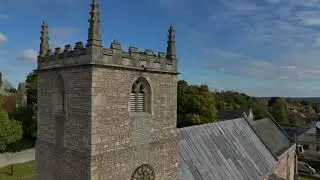
St Margaret & St Catherine. Aldham. Colchester. Essex. CO6 3QZ.
Автор: Suznet 555
Загружено: 2025-12-26
Просмотров: 32
Описание:
** aldhamchurch.org.uk/church-history **
Locally, Aldham Parish Church is sometimes referred to as the church that was moved. The literal moving of buildings is quite common in parts of the USA, Australia and New Zealand, but less so here. Aldham church was “moved” about three-quarters of a mile from what is now Church House Farm to its present site at the crossroads in Aldham in 1854/55. Curiously, another house in Aldham, a wooden framed dwelling, was moved on a transporter in 1922!
The Old Church
Aldham Church was first mentioned around 1145 when Thiel of Aldham, who held one of the two manors, gave half the tithes from his land to Colne priory in Earls Colne, the other half being reserved for the rector of Aldham church. Tithes, an annual tenth of the produce from land, were paid to the rector of the church as his living. It is possible that the church existed many years before this.
Until 1854 the church stood north of Church House Farm about three-quarters of a mile to the south-west of the present site and near the parish boundary. Its dedication is not known. A north-east chapel was dedicated to St. Anne; this became ruinous and was demolished before the middle of the 18th century, before the Essex historian Philip Morant became rector here (1745 - 70), when he wrote his History and Antiquities of Essex (1768).
By 1853 the church was supported by exterior brick buttresses. There was a small bell turret and a singers’ gallery at the west end and box pews.
The Poor State of the Fabric
By 1850 the church building was in a very poor state; in December the vestry members called a meeting to consider repairs and re-seating but agreed to adjourn ‘in consideration of the present times’. The country was still in a trade depression and prices for agricultural produce had dropped. Further delay was apparently caused by the rector’s ‘illness and his absence abroad’ In February 1853 “it was resolved and agreed that the parishioners and occupiers of land should raise among themselves, by a rate, the sum of £200 for the building of a new church the rest of the amount being promised from other sources as proposed by the Rector.” The Rector appears to have had some private means and was therefore able to contribute substantially himself.
In May 1853 the archdeacon of Colchester described the church as in a ‘most slovenly and wretched state’ but he was informed that a new church was then ‘in contemplation’.
The design for the new church was prepared by the architect, Edward C. Hakewill who also designed the magnificent church of St John of Jerusalem, South Hackney. Hakewill drew up the plans in December 1853; the new church was to be built to a similar plan as the old, with the addition of a north vestry, a south aisle and a tower; the new church would be about a third larger than the old. Most of the old materials were to be re-used. It was suggested that when the old church was demolished services could be held in the rectory barn.
The old churchyard was sold in 1981 for the sum of £500 and whilst it is now part of Church House Farm, use of the old site is restricted to grazing.
So there remains nothing of the old church except the ruins of the stone wall which once enclosed it. Turning away from the old churchyard, one sees across the cornfields the graceful grey spire with gilded weather cock of our present church.
The New Church
The rector, Charles Bannatyne, proposed removal to the present site as more central, though there were only two houses nearby then; Ford Street was more populated and the farmhouses were scattered throughout the parish. The site of the new church was on Upper Chalk Field, owned by Sir Thomas Western who sold it for £24. It was over three-quarters of an acre .
And so, after some opposition the old church was taken down and rebuilt on the new site in 1854 - 55 by Henry Luff of Ipswich. Mr. Luff was to 'apply' the materials of the ancient church “for the sum of £1,352 if the tower were roofed without spire or the sum of £1,477 if a spire were erected on the tower.” Thus the spire would cost an extra £125. The case for funding the re-build went on:
By means of the £200 rate, grants of £190 (£150 from the Incorporated Building Society and £40 from the Essex Church Building Society), contributions from the Rector and his family, from friends and others amounting to £1,100, a sum sufficient for the expense of the removal of the old church and the construction of the new church was received or secured. The accounts show the Rector's generous contribution of £500.
The church’s dedication to the Saints Margaret and Catherine dates only from the late 19th century and is probably taken from the names of the bells. Any earlier dedication is unknown.
Roof alarms were installed at the church in August 2013.
-- Iain MacCallum, Reader, Aldham February 2014 --
Повторяем попытку...

Доступные форматы для скачивания:
Скачать видео
-
Информация по загрузке: