James Spudich (Stanford) 2: A brief history of muscle biology 1969-2017
Автор: Science Communication Lab
Загружено: 2017-11-01
Просмотров: 6631
Описание:
https://www.ibiology.org/cell-biology...
James Spudich begins his talk with an early history of muscle biology, and through parts 2-4 of his talk, he moves forward to our current understanding of the molecular basis of muscle contraction and disease.
Talk Overview:
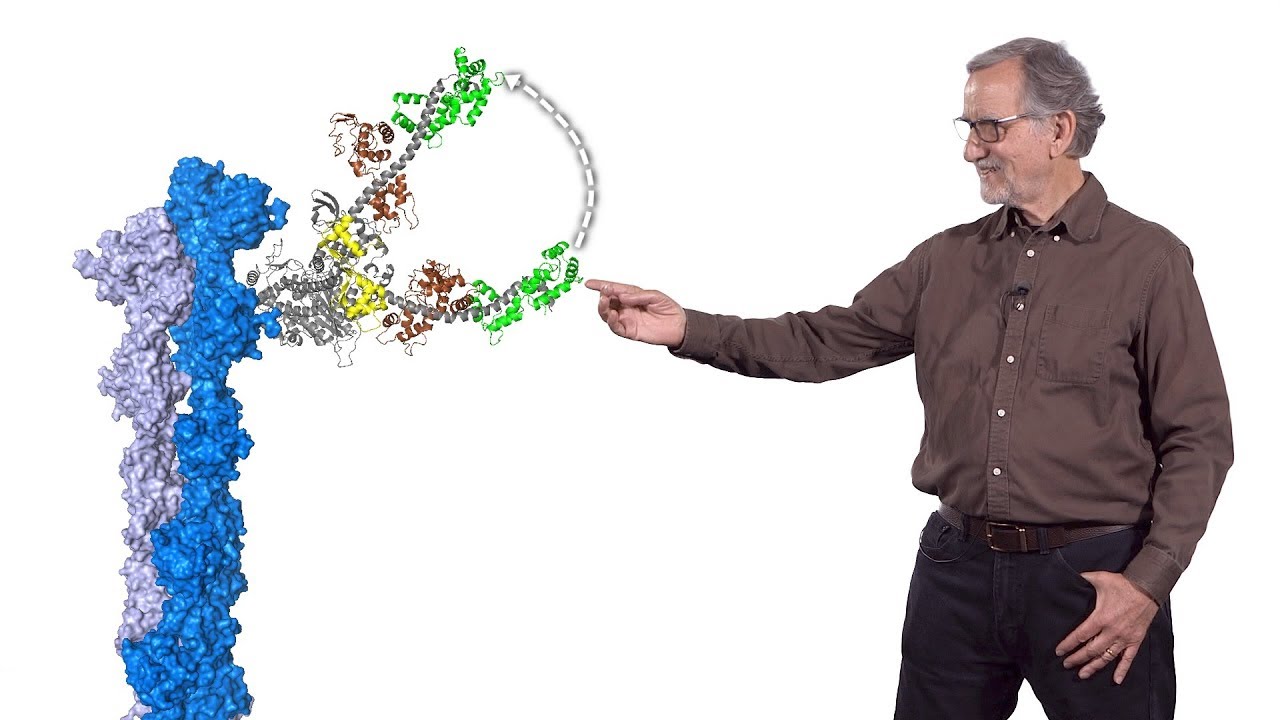
In his second talk, Spudich describes the technological and experimental advances of the last ~50 years that have allowed researchers to understand muscle contraction in even greater detail. The development of an in vitro assay let Spudich and his colleagues determine which domains of the myosin molecule (which is very large) are necessary for movement and which are necessary for binding to cargo. A laser trap assay allowed them to measure the size of the “step” taken by a myosin molecule moving along actin, as well as the force generated by a single myosin molecule. The solution of a crystal structure for myosin also provided key information about its mechanism of action. These results, together with early enzymatic analysis, have led to a detailed molecular model for the chemo-mechanical cycle of myosin.
Speaker Biography:
James (Jim) Spudich is the Douglass M. and Nola Leishman Professor of Cardiovascular Disease in the Department of Biochemistry at Stanford University School of Medicine. For the past several decades, his lab has studied the structure and function of the myosin family of motor proteins. More recently Spudich’s lab has focused on human cardiac muscle myosin and the molecular basis of hypertrophic cardiomyopathy.
Spudich received his B.S. in chemistry from the University of Illinois and his Ph.D. in biochemistry from Stanford University. He was a post-doctoral fellow at Stanford University and then at the MRC Laboratory in Cambridge where he worked with Hugh Huxley. Spudich joined the faculty of the University of California, San Francisco from 1971-1977. In 1977, he moved to Stanford University where he was first a professor in the Department of Structural Biology and, since 1992, has been a professor in the Department of Biochemistry. Spudich is also an Adjunct Professor at the Institute of Stem Cell Biology and Regenerative Medicine (inStem) and the National Center for Biological Sciences (NCBS) in Bangalore, India.
Spudich serves on numerous editorial and scientific advisory boards. His research contributions have been recognized with many honors and prizes including the Albert Lasker Basic Medical Research Award in 2012, the E.B. Wilson Award from the American Society for Cell Biology in 2011, and the Biophysics Society Award for Outstanding Investigator in 2005. He is an elected fellow of the American Association for the Advancement of Science and the American Academy of Arts and Sciences, and an elected member of the US National Academy of Sciences.
Learn more about Spudich’s research here: http://spudlab.stanford.edu/
Повторяем попытку...
Доступные форматы для скачивания:
Скачать видео
-
Информация по загрузке:


