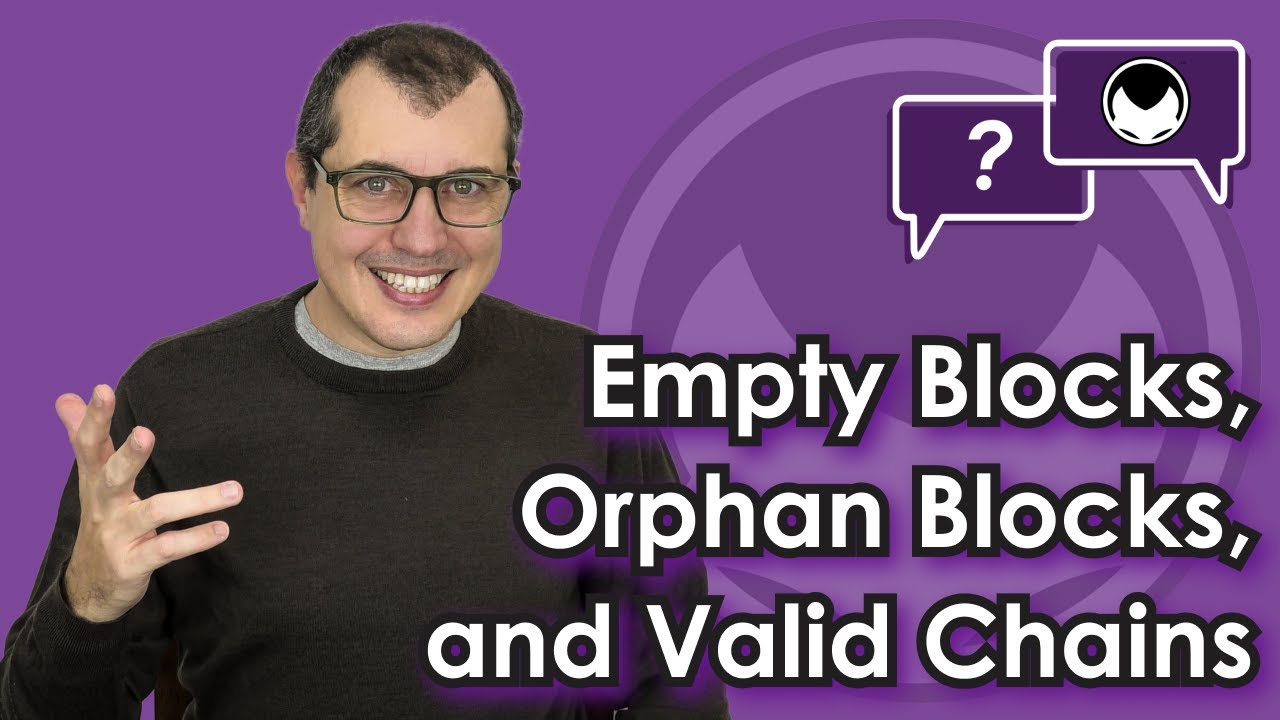
Bitcoin Q&A: Empty Blocks, Orphan Blocks, and Valid Chains
Автор: aantonop
Загружено: 2018-05-24
Просмотров: 8850
Описание:
What are empty blocks and are they necessarily bad? What are orphan blocks? Where do bitcoin balances come from? What is meaning of "the longest cumulative difficulty, valid chain"?
Chapters
0:00 Are the miners simultaneously verifying the solution of the previous block's cryptographic function while competing to find the puzzle solution for the next new block?
3:14 How do you stop miners from creating empty blocks when they create a regular one?
5:46 What happens if two miners solve the next block at the same time?
7:22 Is a Satoshi the smallest unit of bitcoin that can be mined and tracked?
8:07 Where is the history of each bitcoin fraction stored and how can it be traced on a blockchain?
8:38 When calculating your total amount of coin balance, must your wallet go through the entire blockchain from the genesis block? What are the calculations on the blockchain
the wallet must make? What verification does it perform?
9:59 Are there any short-cuts to doing this?
10:59 What if two miners send out blocks with conflicting information? How do the clients choose?
12:37 Is the 'longest chain' the chain with the most blocks?
These questions are from the MOOC 8.2, 9.2, 9.3, 9.4, and 9.5 sessions, which took place on September 15th 2017, February 23rd, March 2nd, March 9th, and March 16th 2018 respectively. Andreas is a teaching fellow with the University of Nicosia. The first course in their Master of Science in Digital Currency degree, DFIN-511: Introduction to Digital Currencies, is offered for free as an open enrollment MOOC course to anyone interested in learning about the fundamental principles.
If you want early-access to talks and a chance to participate in the monthly live Q&As with Andreas, become a patron: / aantonop
RELATED:
Consensus Algorithms, Blockchain Technology, and Bitcoin - • Consensus Algorithms, Blockchain Technolog...
Advanced Bitcoin Scripting Part 1: Transactions and Multisig - • Advanced Bitcoin Scripting -- Part 1: Tran...
Advanced Bitcoin Scripting Part 2: SegWit, Consensus, and Trustware - • Advanced Bitcoin Scripting -- Part 2: SegW...
What is Consensus: Rules without Rulers - • What is Consensus: Rules without Rulers
Forkology: A Study of Forks for Newbies - • Forkology: A Study of Forks for Newbies
Bitcoin: Where the Laws of Mathematics Prevail - • Bitcoin: Where the Laws of Mathematics Pre...
The mining process - • Bitcoin Q&A: The Mining Process
Genesis block and coinbase transactions - • Bitcoin Q&A: Genesis Block and Coinbase Tr...
The rules of Bitcoin (part 1) - • Bitcoin Q&A: The Rules of Bitcoin (Part 1)
The rules of Bitcoin (part 2) - • Bitcoin Q&A: The Rules of Bitcoin (part 2)
Decentralized power, leaderless governance - • Bitcoin Q&A: Decentralized Power, Leaderle...
Scaling, trust, and trade-offs - • Bitcoin Q&A: Scaling, Trust, and Trade-offs
Why running a node is important - • Bitcoin Q&A: Why Running a Node is Important
Honest nodes and consensus - • Bitcoin Q&A: Honest Nodes and Consensus
Running nodes and payment channels - • Bitcoin Q&A: Running Nodes and Payment Cha...
What happens during a fork? - • Bitcoin Q&A: What Happens During a Fork?
SegWit adoption - • Bitcoin Q&A: SegWit Adoption
How do mnemonic seeds work? - • Bitcoin Q&A: How Do Mnemonic Seeds Work?
Andreas M. Antonopoulos is a technologist and serial entrepreneur who has become one of the most well-known and respected figures in bitcoin.
Follow on Twitter: @aantonop / aantonop
Website: https://antonopoulos.com/
He is the author of two books: “Mastering Bitcoin,” published by O’Reilly Media and considered the best technical guide to bitcoin; “The Internet of Money,” a book about why bitcoin matters.
THE INTERNET OF MONEY, v1: https://www.amazon.co.uk/Internet-Mon...
[NEW] THE INTERNET OF MONEY, v2: https://www.amazon.com/Internet-Money...
MASTERING BITCOIN: https://www.amazon.co.uk/Mastering-Bi...
[NEW] MASTERING BITCOIN, 2nd Edition: https://www.amazon.com/Mastering-Bitc...
Subscribe to the channel to learn more about Bitcoin & open blockchains!
Music: "Unbounded" by Orfan ( / orfan )
Outro Graphics: Phneep (http://www.phneep.com/)
Outro Art: Rock Barcellos (http://www.rockincomics.com.br/)
Join the aantonop Channel: https://aantonop.io/joinaantonopyt
Повторяем попытку...
Доступные форматы для скачивания:
Скачать видео
-
Информация по загрузке: