Dense vs. Sparse: Why Traditional AI is Obsolete
Автор: AI Researcher
Загружено: 2026-03-17
Просмотров: 38
Описание:
What if you could build a 1-Trillion parameter model but only pay for the "brain power" of a much smaller one? Welcome to the era of Mixture of Experts (MoE).
In this deep dive, we break down the architecture that saved the AI industry from the "Energy Wall." We explore how Sparse Computation allows us to activate only the "expert" parts of a model needed for a specific task, leaving the rest of the network dark.
In this video, we cover:
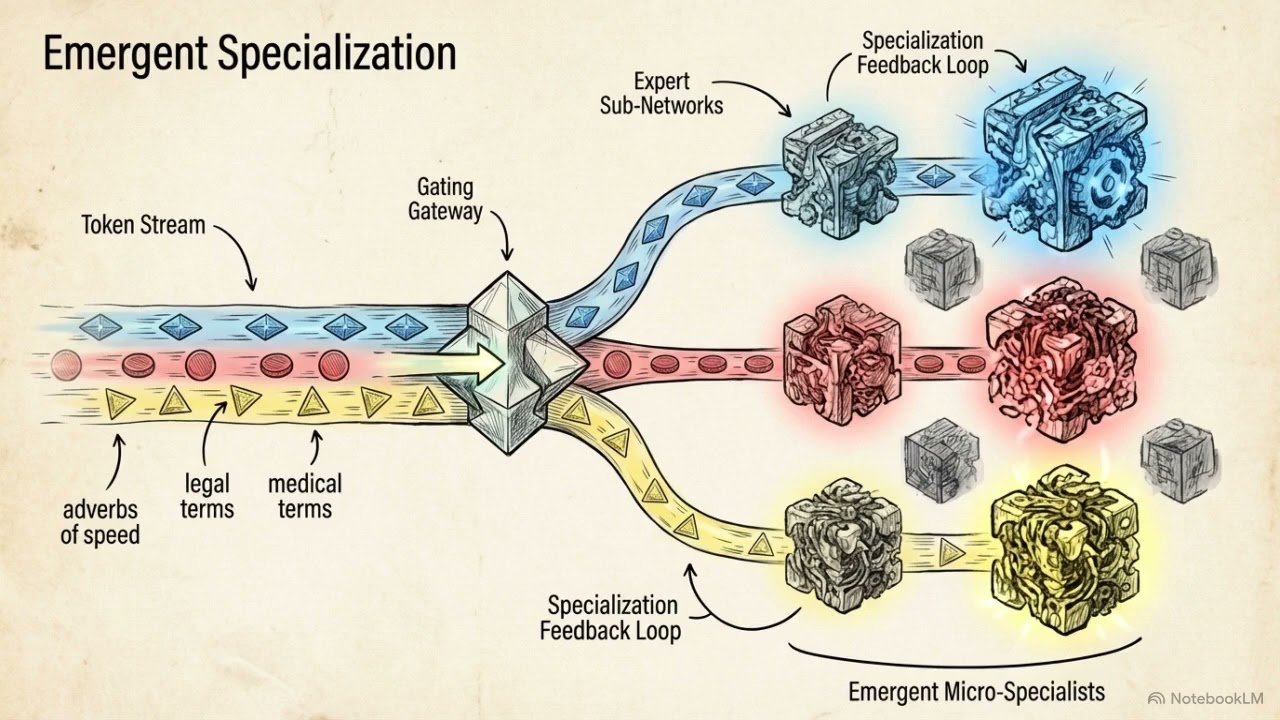
The Gating Network: The "Air Traffic Controller" that decides which tokens go to which experts.
Expert Specialization: How sub-networks naturally evolve to handle specific tasks like coding, math, or creative writing.
Sparse vs. Dense: Why traditional "Dense" models (that use 100% of their parameters for every word) are hitting a scaling limit.
The Efficiency Paradox: How we get "Smarter" results with "Lower" inference costs and energy consumption.
If you've ever wondered how models are getting exponentially larger without getting exponentially slower, this is the architecture you need to know.
#AI #MixtureOfExperts #MoE #DeepLearning #MachineLearning #GPT4 #Mixtral #AIInfrastructure #GreenAI #NeuralNetworks
Training an MoE model is like managing a high-end restaurant: if everyone crowds the Head Chef while the Sous Chef stands around doing nothing, the kitchen crashes.
In MoE, this "crowding" is the enemy. Here is how you can explain the two most technical hurdles in your video.
🏗️ 1. Expert Capacity: The "Waiting Room" Problem
In a perfect world, tokens are distributed evenly. In the real world, data is biased. If you’re processing a Python script, every single token might want to go to the "Coding Expert."
The Problem: Hardware (GPUs) needs fixed-size blocks of data to be efficient. If an expert has a "Capacity" of 64 tokens but 200 tokens are sent to it, the expert overflows.
The Result: The extra 136 tokens are either dropped (the model ignores them) or passed to a "residual connection" (the model guesses without an expert).
The Visual: Imagine a popular nightclub with a strict capacity. If too many people show up, the bouncer (Gating Network) has to start turning people away or sending them to the boring lounge next door.
⚖️ 2. Load Balancing: The "Lazy Expert" Trap
This is the biggest headache during the training phase. Neural networks are inherently lazy—they take the path of least resistance.
The Problem: Early in training, if one expert happens to get slightly better at a task, the Gating Network will start sending everything to that expert.
The "Death Spiral": Because that expert gets all the data, it gets smarter. Because it's smarter, the Gating Network sends it even more data. Meanwhile, the other 14 experts stay "dumb" and untrained because they never see any tokens.
The Fix (Auxiliary Loss): Engineers add a "penalty" to the loss function. Essentially, the model gets "fined" if it doesn't distribute tokens across all experts. It forces the Gating Network to give the "lazy" experts a chance to learn.
#AIResearch #MoE #DeepLearning #NeuralNetworks #MachineLearning #AIEngineering #GPT4 #ScalingLaws
Повторяем попытку...
Доступные форматы для скачивания:
Скачать видео
-
Информация по загрузке: