Ancient Pilgrim Road, Jerusalem – Just Opened to the Public - From The Time of Jesus
Автор: Adventures with Phil and Laura
Загружено: 2026-02-07
Просмотров: 139
Описание:
Remember to Like & Subscribe ---
January 2026 Israel - Lands of the Bible Tour
Imagine Tours & Travel ([email protected]) – Leader and Teacher Dr. John DeLancey (www.biblicalisraeltours.com) along with local guide Shlomo, driver David and Canyon Hills Community Church from Bothell WA.
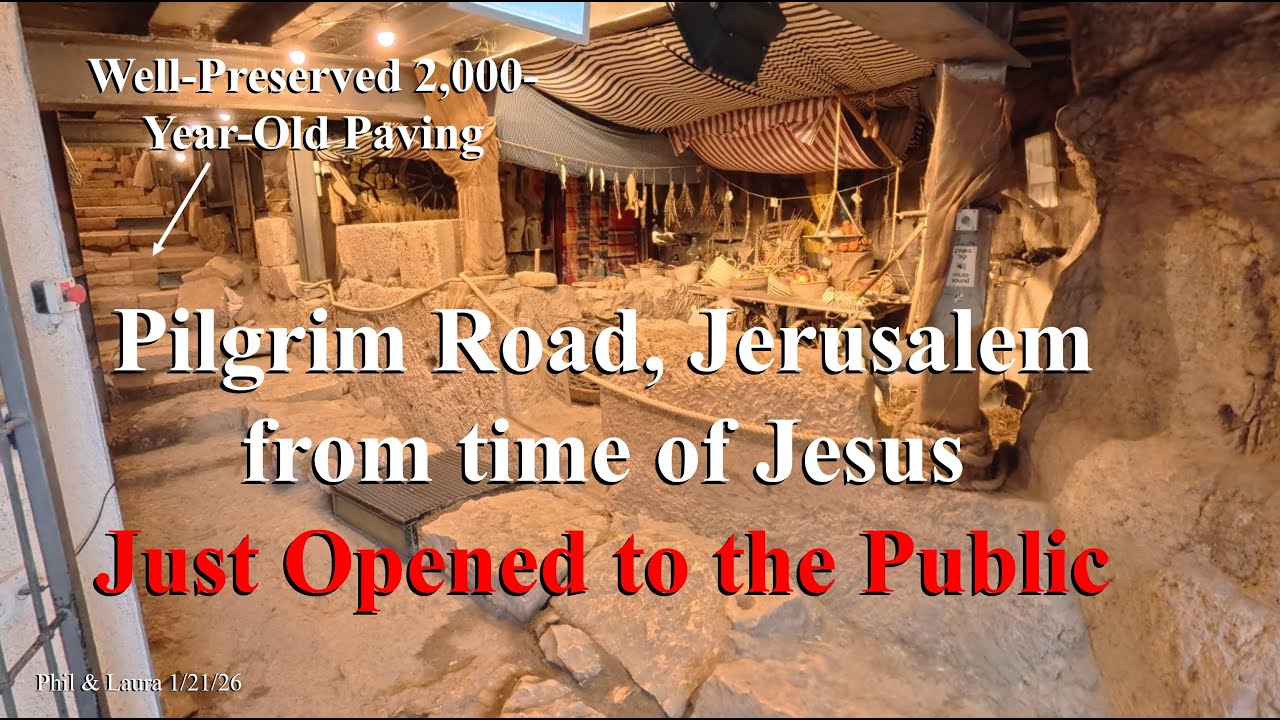
The Pilgrim Road, a main street of ancient Jerusalem’s City of David, is one of the most remarkable archaeological discoveries of recent decades. The Pilgrim Road was literally opened to the public 20 Jan 2026, the day before this filming, though it was actually inaugurated 15 Sep 2025. This opening is the results of over 15 years of archeological excavation. The road measures 8 meters (26 ft) wide and 600 meters (almost 2,000 ft) long, passing under the current city of Jerusalem. The southern end of the road expands to 30 meters (100 ft) wide.
The road was most likely built by the Roman Governor Pontius Pilate, also known for sentencing Jesus to crucifixion. Coins found under the paving suggest the road was built around 17–31 AD. The AD 70 destruction of Jerusalem and the Temple covered this relatively new road in ash and debris, preserving it as a pristine time capsule till this day. The well-preserved pavement is believed have been walked on by Jesus and His disciples.
An ancient drainage channel passes underneath the road. The drainage channel served as a hiding place for Jewish rebels who were hiding from Roman soldiers during the siege that led to the destruction of Jerusalem and the Temple in AD 70, burying the road and preserving it till this day.
Jesus healed a man born blind at the Pool of Siloam – the very place where pilgrims began their journey (John 9). Pilgrims would begin their journey by immersing in the Pool of Siloam to purify themselves before ascending to the Temple. The Gospels describe Jesus going to Jerusalem for major feasts, such as Passover and Sukkot (Feast of Tabernacles). The Pilgrimage Road was the main route for these ascents. Psalms of Ascent (Psalms 120-134) were traditionally sung by Jewish pilgrims as they traveled up to Jerusalem.
Archaeology reveals a bustling daily environment of shops, ritual baths, and crowds – matching the social and religious background reflected in the New Testament. The Pilgrimage Road is a living bridge that physically connects archeological history with faith, and scripture, allowing us to experience the footsteps of many, including the Jewish Pilgrims and most likely Jesus Himself.
The Southwest corner of the temple mount is where a stone was discovered featuring Hebrew text translated as "To the Place of Trumpeting" where a priest would signal the start and end of Shabbat (Sabbath) and holidays. Priests stood on this high vantage point and blew a trumpet, or shofar, to announce the beginning of the Sabbath and other religious holidays to the city below.
The Pool of Siloam (Lower Pool according to Isaiah 22:9) project is an extensive, ongoing archaeological excavation in Jerusalem's City of David, aimed at fully uncovering the 2,700-year-old biblical site. The Pool of Siloam was built during the reign of Hezekiah.
Jesus left the temple and was walking away when his disciples came up to him to call his attention to its buildings. “Do you see all these things?” he asked. “Truly I tell you, not one stone here will be left on another; every one will be thrown down.” Matthew 24:1-2. Jesus' prophecy was fulfilled in AD 70.
Robinson’s Arch was a massive bridge staircase over the road that once allowed access to the Temple complex.
Повторяем попытку...
Доступные форматы для скачивания:
Скачать видео
-
Информация по загрузке: