2021 ICCF-23 – S Dana Seccombe, “Phonon Assisted Fusion”
Автор: ISCMNS
Загружено: 2025-03-25
Просмотров: 19
Описание:
2021 ICCF-23 – S Dana Seccombe, “Phonon Assisted Fusion”
Accession ID: 319
Date: June, 2021
Location: Virtual
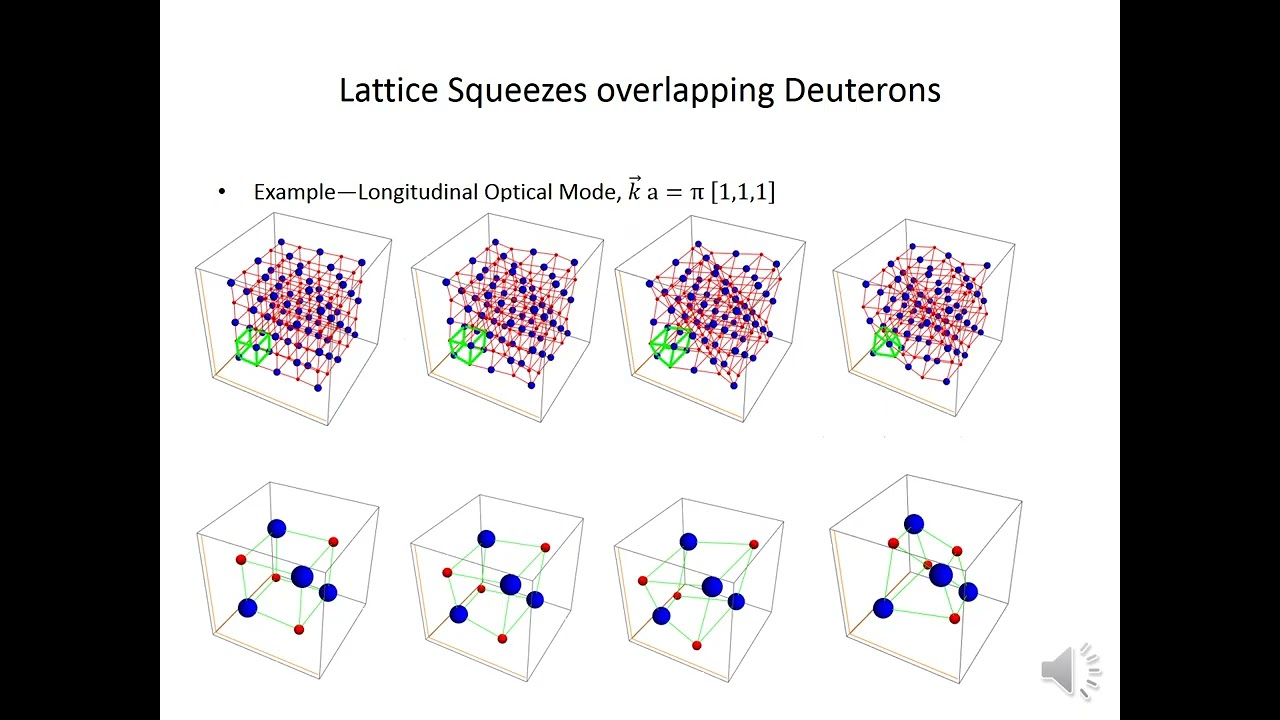
Abstract: This paper continues and expands upon a paper presented at ICCF-22 related to phonon assisted fusion. The overall thesis is that there exist sparsely occupied “nearly free” deuteron states which are modelled similarly to nearly free electrons in traditional solid state physics. These states are occupied in the range of 10-4 , depending on D doping and lattice temperature. The probability amplitude of the states is largest in regions other than where Pd and bound are. The charge of nearly free D’s, whose spatial extent is in the range of .4 A, is neutralized by a much shorter electron Debye length than the local de Broglie wavelength, so D-D repulsion is negligible, and nearly free D’s overlap. This results in a “large” excited compound (roughly .4A) nucleus that could decay either through the normal paths, with hot particles, or through an additional path, which involves multiphonon assisted transitions. The transition rates for the traditional paths can be shown to be decreased by ~28 orders of magnitude because of the increased volume of the compound nucleus, whereas the phonon assisted rates are appreciable under certain conditions. When threshold conditions are right for a specific phonon mode, the mode becomes rapidly occupied, with the created phonons draining energy from the excited nucleus. The mode occupation grows until a saturation point is reached where the mode decay rate, which is phonon occupation dependent, exceeds the phonon generation rate. Hence, the total power released depends on the number of modes above threshold, and the number of phonons in those modes, as limited by saturation. This leads to two formulas: one for mode threshold, and a second for mode occupation/power generation, which are derived. The threshold equation and the power equation depend on parameters which are spatially non-uniform, temperature and pressure dependent, and generally not measured locally, if at all. This leads to huge nonuniformities and experiment-to-experiment variations. The equations give clues as to how to choose and improve LENR systems, including hydrogen systems. Of particular interest are, for a microcrystal in a material: • The impact of pressure, impurities and vacancies on phonon densities of states at a given wavevector, and the consequent impact on thresholds • The impact of external stimulation of phonon mode occupation to initiate a reaction • The number of “nearly free deuterons” as a function of temperature, doping, externally applied potentials • The microcrystal size and shape • The material lattice parameter The phonon decay rate as a function of k and mode occupancy, temperature, stress and host lattice Newly available information on phonon spectra in nearly pure Pd:D, and stressed Pd:D suggest that phonon lifetimes are strongly influenced in perhaps unappreciated ways.
Source: http://ikkem.com/iccf-23.php
Повторяем попытку...
Доступные форматы для скачивания:
Скачать видео
-
Информация по загрузке:





![What is a Plasma? Is it the 4th State of Matter? - [5]](https://image.4k-video.ru/id-video/WVYJQucn2yU)