O vis aeternitatis (Hildegard von Bingen and Katelyn Bouska)
Автор: YarlungChannel
Загружено: 2024-11-06
Просмотров: 432
Описание:
Hildegard von Bingen (ca. 1098-1176)
O vis eternitatis (The Power Within Eternity) taken from Symphonia armonie celestium revelationum (“Symphony of the Harmony of Heavenly Revelations”).
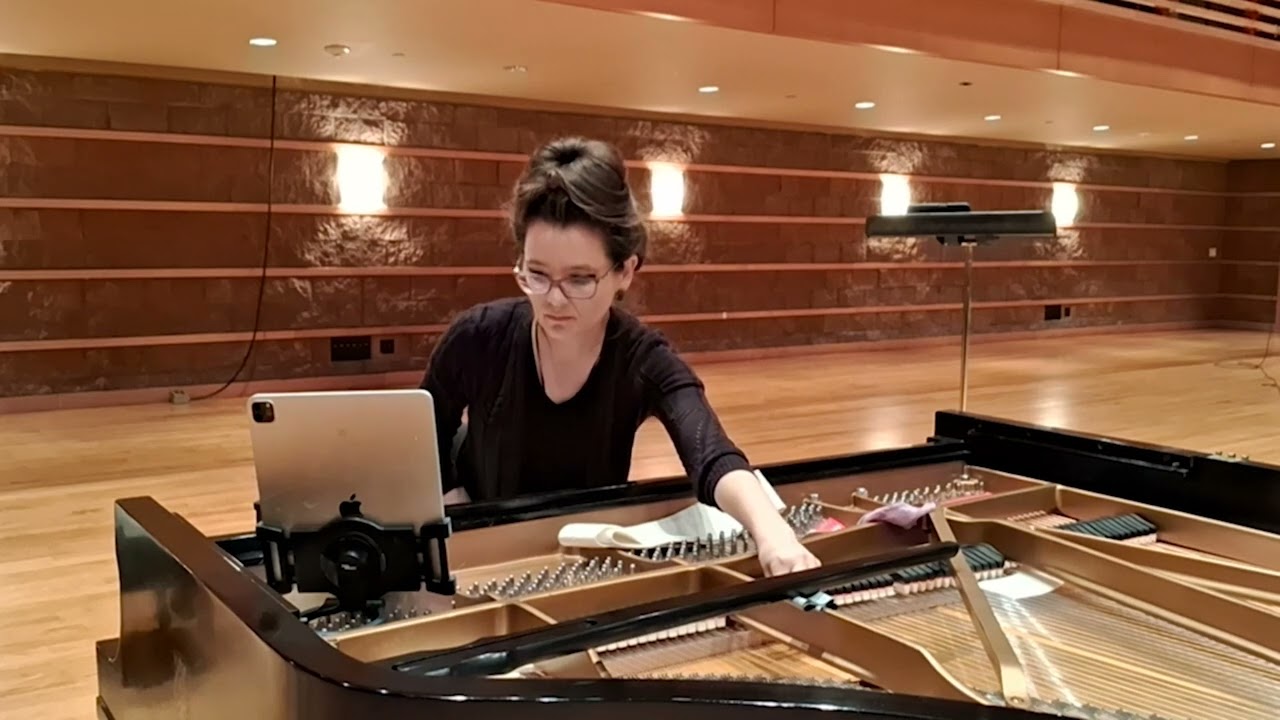
Audio and Video captured directly by Samsung mobile phones during our recording session.
Thoughts by Katelyn Bouska:
Saying that there is something special about Hildegard von Bingen feels about as original as stating that Bach was a contrapuntal genius. These words “genius” and “special” have been so overused they lose their poignancy, but in the case of the timeless nature of Hildegard and her body of work I am at a loss for any other words.
Oten, when approaching music and art from the Medieval period, I find an intrinsic barrier between our modern experience and those left to us from the Medieval period (even from those centuries later than our dear 12th century Hildegard). The passage of time has left an obscuring film that requires a necessary amount of valor as a guide. But I find Hildegard to be unique in that her music and personality has a brightness and enduring quality that needs little translation.
She was a true polymath: abbess, visionary, writer, composer, traveling preacher, and writer of practical and theoretical medical texts. Hildegard was equally at home in the spiritual realm as in the earthier matters of the body and the natural world. In fact, she is considered in Germany as the founder of natural science. If one wishes for a specific example of her enduring legacy, one need only to study her writing of the use of hops to preserve beer. Hildegard’s words remain our first known reference to the topic.
As composer, she is equally as groundbreaking. The practice of her 12th-century contemporaries was to combine music to randomly selected texts and sign, Anonymous. Hildegard broke from this tradition, created her own texts, and crafted soaring lines that pushed the limits of Gregorian chant. From the void of rhythmless, improvised chant, she created form and shape with the use of recurring motives to develop the music and hold the listener’s attention. We have more surviving works by Hildegard than by any other composer from the entire Middle Ages.
About the Music
The chants selected for this project are taken from Hildegard’s Symphonia armonie celestium revelationum (“Symphony of the Harmony of Heavenly Revelations”). This is the main collection of her works, including 77 chants and one musical drama. As her life drew to a close, she oversaw the collection and copying of the included works.
Before sitting down at my piano, I spent time with the text. I wanted to prevent my modern melodic sense and its resulting harmonic implications from taking over from the feeling of Hildegard’s writing itself. Later, I began singing to myself as I was strolling along the Delaware river, or sitting in Rittenhouse Square in Philadelphia under my favorite tree. Hildegard’s text took me many places, and inspired many images. My goal was to use the instrument not in its melodic and harmonic fullness, but as a conjurer of sounds.
--Katelyn Bouska, Prague
This video shows one of our takes of “O vis aeternitatis” as reimagines, and recomposed by Kate Bouska, thanks to a generous commission from Stratton-Petit Foundation.
From Kate’s Yarlung recording “Hildegard And Her Sisters” https://yarlungrecords.com/product/hi...
Executive Producer: Randy Bellous
Повторяем попытку...
Доступные форматы для скачивания:
Скачать видео
-
Информация по загрузке: