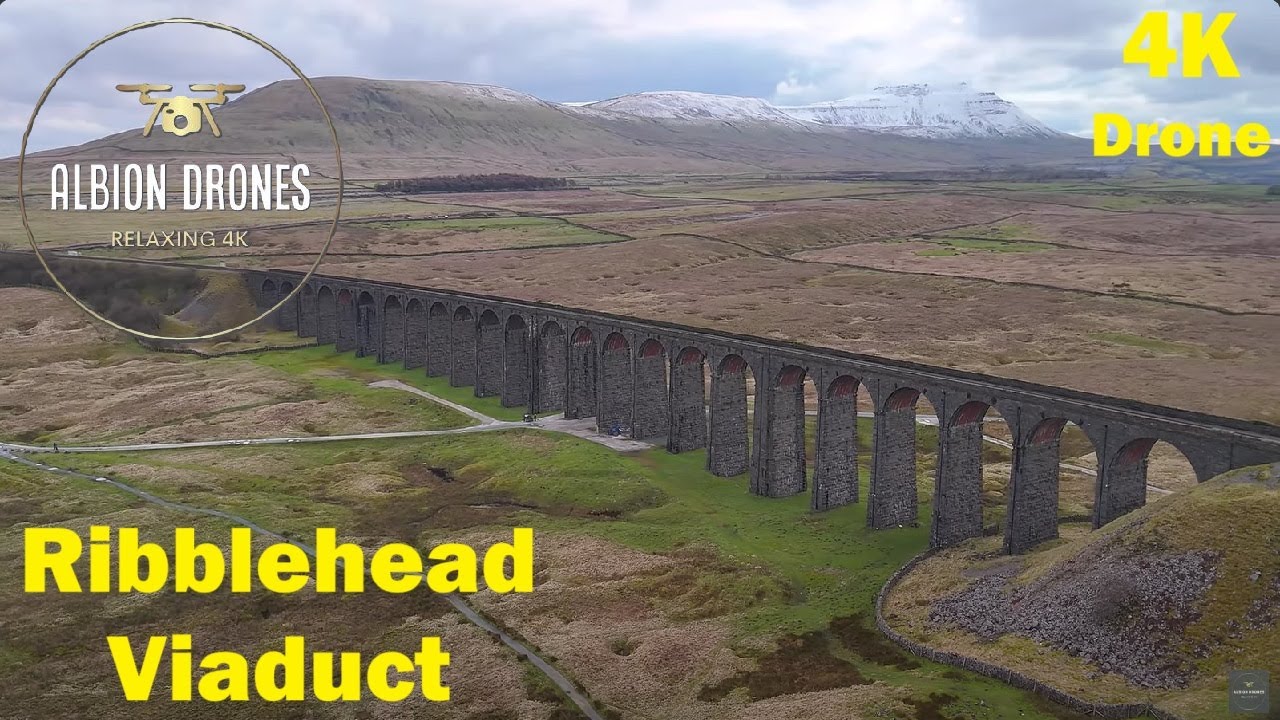
Snow capped Fells above Ribblehead Viaduct, Lancashire - DJI AIR3 4K 60fps
Автор: Albion Drones
Загружено: 2024-03-12
Просмотров: 429
Описание:
The penultimate stop on our Yorkshire Dales / Lancashire day out on Sunday 3rd March 2024, and a destination I have long wanted to fly - and the snow capped fells made it a must fly on the day - despite the cold!
Looking back there was much more I could have done, but as this was the 4th location and I was cold and getting tired, I managed to do what I could, sufficient for a short video, perhaps I shall return when a train is crossing and see what else can be captured...
Drones - 'Mighty Midge' - DJI MINI3 Pro + 'Monster Midge' - DJI AIR3 + 'Demon Midge' - DJI AVATA
Edited using - DaVinci Resolve 18
Music - HAZE MUSIC LIBRARY - kingdom-of-fantasy-epic-cinematic-background-music-5797 - • Kingdom of Fantasy Epic Cinematic Backgrou...
From Wikipedia, the free encyclopedia
The Ribblehead Viaduct or Batty Moss Viaduct carries the Settle–Carlisle railway across Batty Moss in the Ribble Valley at Ribblehead, in North Yorkshire, England. The viaduct, built by the Midland Railway, is 28 miles (45 km) north-west of Skipton and 26 miles (42 km) south-east of Kendal. It is a Grade II* listed structure. Ribblehead Viaduct is the longest and the third tallest structure on the Settle–Carlisle line.
The viaduct was designed by John Sydney Crossley, chief engineer of the Midland Railway, who was responsible for the design and construction of all major structures along the line. The viaduct was necessitated by the challenging terrain of the route. Construction began in late 1869. It necessitated a large workforce, up to 2,300 men, most of whom lived in shanty towns set up near its base. Over 100 men lost their lives during its construction. The Settle to Carlisle line was the last main railway in Britain to be constructed primarily with manual labour.
By the end of 1874, the last stone of the structure had been laid; on 1 May 1876, the Settle–Carlisle line was opened for passenger services. During the 1980s, British Rail proposed closing the line. In 1989, after lobbying by the public against closure, it was announced that the line would be retained. Since the 1980s, the viaduct has had multiple repairs and restorations and the lines relaid as a single track. The land underneath and around the viaduct is a scheduled ancient monument; the remains of the construction camp and navvy settlements (Batty Wife Hole, Sebastopol, and Belgravia) are located there.
History
In the 1860s, the Midland Railway, keen to capitalise on the growth in rail traffic between England and Scotland, proposed building a line between Settle and Carlisle. The line was intended to join the Midland line between Skipton and Carnforth to the city of Carlisle. On 16 July 1866, the Midland Railway (Settle to Carlisle) Act was passed by Parliament, authorising the company "to construct Railways from Settle to Hawes, Appleby, and Carlisle; and for other Purposes".
After the Act passed, the Midland Railway came to an agreement with the London & North Western Railway, to run services on the LNWR line via Shap. The company applied for a bill of abandonment for its original plan but Parliament rejected the bill on 16 April 1869 and the Midland Railway was compelled to build the Settle to Carlisle line.
The line passed through difficult terrain that necessitated building several substantial structures. The company's chief engineer, John Sydney Crossley and its general manager, James Joseph Allport, surveyed the line. Crossley was responsible for the design and construction of the major works, including Ribblehead Viaduct.
On 6 November 1869, a contract to construct the Settle Junction (SD813606) to Dent Head Viaduct section including Ribblehead Viaduct was awarded to contractor John Ashwell. The estimated cost was £343,318 and completion was expected by May 1873. Work commenced at the southern end of the 72-mile (116 km) line.
Structure
Ribblehead Viaduct is 440 yards (400 m) long, and 104 feet (32 m) above the valley floor at its highest point, it was designed to carry a pair of tracks aligned over the sleeper walls.[7] The viaduct has 24 arches of 45 feet (14 m) span, the foundations of which are 25 feet (7.6 m) deep. The piers are tapered, roughly 13 feet (4 m) across at the base and 5 feet 11 inches (1.8 m) thick near the arches and have loosely-packed rubble-filled cores. Every sixth pier is 50 per cent thicker, a mitigating measure against collapse should any of the piers fail. The north end is 13 feet (4 m) higher in elevation than the south, a gradient of 1:100.
#albiondrones
Повторяем попытку...
Доступные форматы для скачивания:
Скачать видео
-
Информация по загрузке: