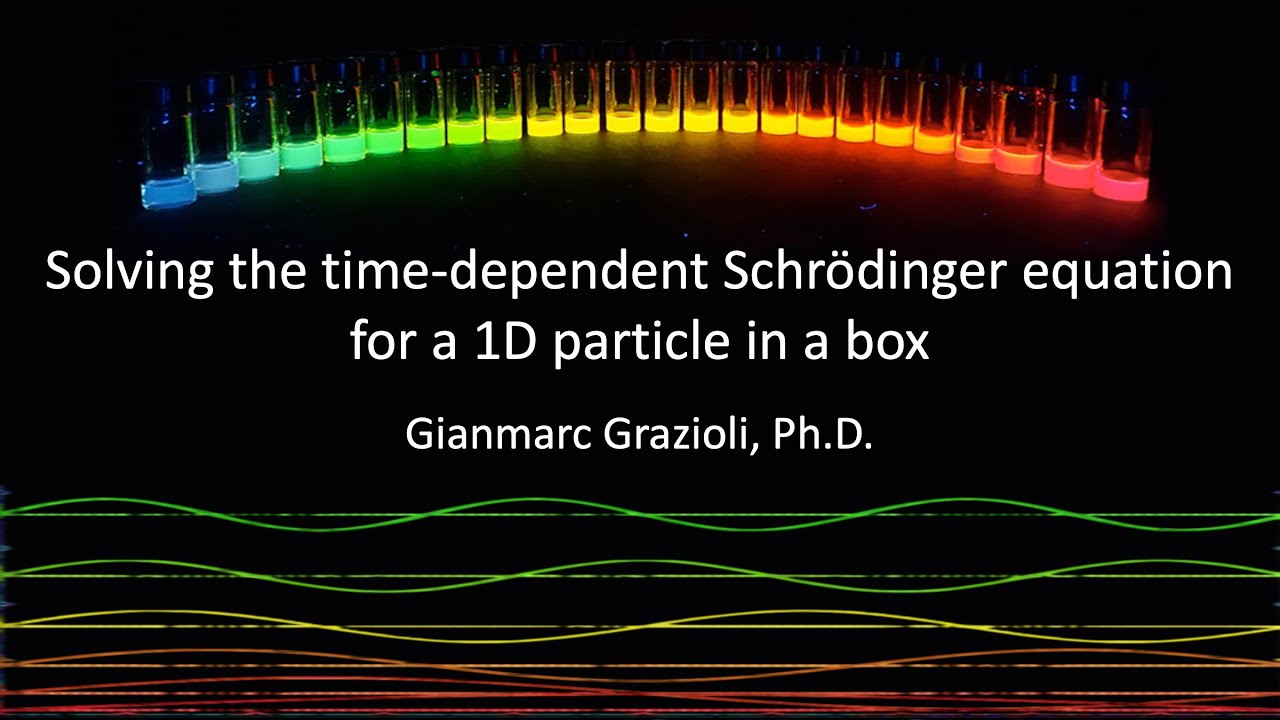
Solving the Time-dependent Schrödinger Equation for the 1D Particle in a Box
Автор: Gianmarc Grazioli
Загружено: 2023-04-24
Просмотров: 7099
Описание:
This video is part of my Quantum Mechanics for Physical Chemistry playlist: • Quantum Mechanics
0:00 – Intro: What we’re solving today
0:14 – Why most lessons stop at the time-independent case
0:34 – Quantum dots as real-world “particles in boxes”
1:16 – How box size determines quantized energy levels
2:03 – What “one-dimensional particle in a box” means
2:38 – Infinite potential barriers and confinement
3:22 – Visualizing the 1D box with the marble-in-a-tube analogy
4:14 – Energy inside the box vs. infinity outside
4:33 – What is a complex conjugate? Real and imaginary parts
6:04 – Multiplying conjugates gives real numbers
6:23 – What is separability? Breaking multi-variable functions apart
8:12 – Introducing the full time-dependent Schrodinger equation
9:13 – Understanding it as a differential equation
11:16 – What wavefunctions represent and how they give probabilities
12:56 – Combining Schrodinger’s equation with separability
13:43 – Splitting position and time into separate equations
17:08 – Setting both sides equal to a constant (energy)
19:48 – Solving the time-independent, position-dependent part first
21:08 – Recognizing sine and cosine as natural solutions
24:00 – Applying boundary conditions inside the box
25:34 – Quantization emerges: only certain values of k are allowed
26:57 – Connecting wavefunctions to musical harmonics
28:42 – Deriving the quantized energy levels (energy proportional to n² over L²)
30:09 – Normalizing the wavefunction so total probability equals one
31:49 – Solving the normalization integral
33:29 – Finding the normalization constant (square root of 2 over L)
34:22 – Writing the full spatial wavefunction
34:47 – Solving the time-dependent part
35:18 – The surprising property that 1 divided by i equals negative i
36:03 – Checking the time-dependent exponential solution
38:19 – Combining space and time for the full wavefunction
39:33 – Visualizing the real and imaginary parts
41:24 – Oscillating amplitudes and phase relationships
42:23 – Multiplying by the complex conjugate to get probability density
43:33 – Stationary states: why probabilities don’t change with time
47:02 – Using the PhET simulator to visualize the wavefunction
48:21 – Identifying quantum states (n = 2, the first excited state)
48:39 – Superposition states and time-dependent probabilities
50:59 – Summary and invitation to explore with the PhET simulator
Повторяем попытку...
Доступные форматы для скачивания:
Скачать видео
-
Информация по загрузке: