IFT Interfacial Tension Explained ⚡ | Sludge Risk, Oil Ageing and Action Plan (IEEE/IEC)
Автор: ELECTRIVERSE
Загружено: 2026-01-04
Просмотров: 11
Описание:
IFT Interfacial Tension is one of the most sensitive indicators of transformer oil contamination and oxidation.
A falling IFT signals polar compounds, sludge precursors and loss of oil cleanliness, often before TAN becomes critical.
In this video, you will clearly understand IFT in transformer oil using practical senior-engineer logic.
What Interfacial Tension actually measures
Why IFT drops as oil oxidizes
How polar contaminants reduce IFT
Difference between early contamination and advanced ageing
Why IFT often warns earlier than TAN
Relationship between IFT, TAN and oil color
Impact of low IFT on cooling and sludge formation
Typical IFT limits for healthy, ageing and critical oil
Why filtration may improve IFT temporarily
Correct actions when IFT falls below limits
Common mistakes engineers make while interpreting IFT
This video is part of the Transformer Oil Testing and Condition Monitoring Master Series for utilities, OEMs, EPCs and reliability engineers worldwide.
Comment your data
IFT value, TAN value, oil color and voltage level
I will reply with oil condition severity and recommended next action.
Like and Subscribe for detailed videos on TAN, BDV, moisture, relative saturation, DGA gases, furan, corrosive sulphur and complete transformer oil report interpretation.
Disclaimer: Educational content only. Always follow OEM manuals, site procedures and applicable IEEE and IEC standards.
#Transformer
#TransformerOil
#IFT
#InterfacialTension
#OilAgeing
#Sludge
#PowerTransformer
#Substation
#HighVoltage
#ElectricalEngineering
#PowerSystems
#TransformerMaintenance
#ConditionMonitoring
#ReliabilityEngineering
#AssetManagement
#IEEE
#IEC
#oiltesting
🔹 WHAT IS INTERFACIAL TENSION (IFT)?
Interfacial Tension, or IFT, measures the force between transformer oil and water.
It is expressed in milli-newtons per meter.
In simple terms:
IFT tells us how clean and pure the oil surface is.
Clean oil strongly repels water. Contaminated oil does not.
🔹 WHY IFT DROPS?
According to IEC 60422 and ASTM D971:
IFT drops due to:
• Oxidation products in oil • Acids formed during ageing • Sludge precursors • Polar contaminants • Depleted antioxidants
As oil ages, polar molecules migrate to the oil-water interface and destroy surface tension.
That is why IFT is a direct oil cleanliness indicator.
🔹 WHY IFT IS SO CRITICAL (ENGINEERING VIEW)
Low IFT leads to:
• Sludge precipitation • Poor heat dissipation • Insulation surface contamination • Increased electrical stress • Accelerated paper ageing
This is why senior engineers say:
“When IFT collapses, oil is already sick.”
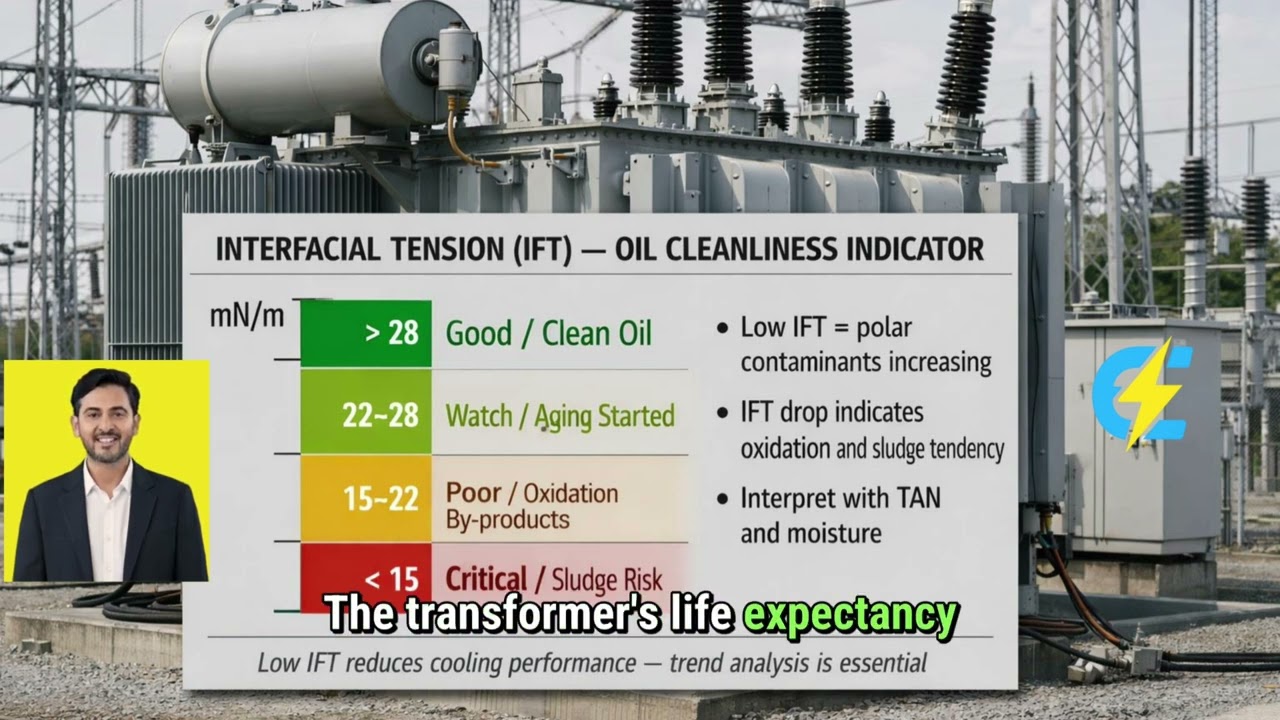
🔹 STANDARD LIMITS (IEC / ASTM PRACTICE)
Typical interpretation used worldwide:
• Healthy oil IFT above 28 mN/m
• Warning zone IFT between 22 and 28
• Severely degraded oil IFT below 22
When IFT drops below 22, sludge formation becomes very likely.
🔹 ENGINEERING INTERPRETATION (REAL FIELD LOGIC)
Case 1
High IFT Low TAN Good BDV
This indicates:
• Clean oil • No oxidation stress • Normal ageing
Case 2
IFT decreasing TAN increasing slowly
This indicates:
• Oxidation progressing • Contaminants accumulating • Oil quality declining
This is the best intervention window.
Case 3
Low IFT High TAN High power factor
This indicates:
• Advanced oil degradation • Sludge already forming • Paper ageing accelerating
At this stage, simple filtration is useless.
🔹 WHAT TO DO IF IFT IS LOW?
Correct engineering actions:
Correlate with TAN and PF IFT alone is never judged
Plan oil reclamation Before sludge becomes irreversible
Check breather and sealing system Oxygen accelerates IFT collapse
Avoid delaying action Low IFT means time is already lost
IFT is a point-of-no-return indicator.
🔹 PRACTICAL FIELD ADVICE (VERY IMPORTANT)
Many failures happen not because oil was bad…
but because IFT was ignored for years.
TAN warns early. IFT confirms damage.
Повторяем попытку...
Доступные форматы для скачивания:
Скачать видео
-
Информация по загрузке: