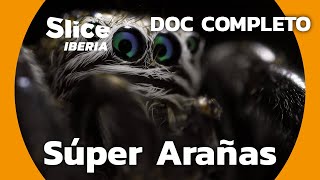
Todos los Arácnidos (PARTE 2)
Автор: Palaeos
Загружено: 2020-06-22
Просмотров: 94025
Описание:
Esta es la segunda parte de un video doble sobre arácnidos. Si no has visto la primera parte, te invito a verla haciendo clic aquí: • Todos los Arácnidos (PARTE 1)
En esta segunda parte, abordaremos a los tres últimos grupos de arácnidos vivos y exploraremos a otros tres, que no poseen parientes vivos. Y entre ellos, los ancestros de las arañas.
Agradecemos a Julio F. Garza por su apoyo con la ilustración del min 14:53. Pueden comisionarle paleoarte y otros proyectos, les dejo enlace a su página: / juliusart26
____________________________________________________________________
Referencias empleadas en este video:
Mayoral, J. G. (2015). Clase Arachnida. Orden Palpigradi. Manual. Ibero Diversidad Entomológica. Revista Electrónica IDE-SEA. 10:1-9.
Engel et al. (2016). The first Mesozoic microwhip scorpion (...). The Science of Nature, 103(3-4), 19.
Christian et al. (2014). Differentiation among cave populations of the Eukoenenia spelaea species-complex (…). Zootaxa, 3794(1), 52-86.
Hoffmann, A. (1999). El maravilloso mundo de los arácnidos. Fondo de Cultura Económica, La ciencia para todos. 116.
Valdez-Mondragón y Francke. (2011). Four new species of the genus Pseudocellus (…). The Journal of Arachnology, 39(3), 365-377.
Valdez-Mondragón y Francke. (2013). Two new species of ricinuleids of the genus Pseudocellus (…). Zootaxa, 3635(5), 545-556.
Valdez-Mondragón et al. (2018). New morphological data for the order Ricinulei (…). The Journal of Arachnology, 46(1), 114-132.
Fernández y Giribet (2015). Unnoticed in the tropics (…). Royal Society Open Science, 2(6), 150065.
Buckland, W. (1837). The Bridgewater Treatises on the Power, Wisdom and Goodness of God as Manifested in the Creation: Treatise 6. Geology and Mineralogy Considered with Reference to Natural Theology. Pickering.
Dunlop, J. A. (1996). Evidence for a sister group relationship between Rininulei and Trigonotarbida. Bulletin-British Arachnological Society, 10, 193-204.
Selden, P. A. (1992). Revision of the fossil ricinuleids. Earth and Environmental Science Transactions of The Royal Society of Edinburgh, 83(4), 595-634.
Rohdendorf, B. B., & Davis, D. R. (Eds.). (1991). Fundamentals of Paleontology: Arthropoda, Tracheata, Chelicerata. Amerind.
Peñalver et al. (2017). Ticks parasitised feathered (...). Nature communications, 8(1), 1-13.
Dunlop y de Oliveira Bernardi. (2014). An opilioacarid mite in Cretaceous (...). Naturwissenschaften, 101(9), 759-763.
Estrada-Peña, A. (2015). Clase Arachnida. Orden Ixodida: Las garrapatas. Manual. Ibero Diversidad Entomológica. Revista Electrónica IDE-SEA.
Raad et al. (2020). First Report of the Ticks Haemaphysalis punctata (…). Acta Parasitologica, 1-5.
Fernandez et al. (2018). Two new species of the family Nippobodidae (…). ZooKeys, (781), 109.
Dunlop y & Garwood. (2014). Tomographic reconstruction of the exceptionally preserved trigonotarbid (...). Acta Palaeontologica Polonica, 59(2), 443-454.
Dunlop, J. A. (1996). A trigonotarbid arachnid from the Upper Silurian of Shropshire. Palaeontology, 39(3), 605-614.
Jones et al. (2014). Trigonotarbus johnsoni (…). Zoological Journal of the Linnean Society, 172(1), 49-70.
Garwood y Dunlop. (2011). Morphology and systematics of anthracomartidae (…). Palaeontology, 54(1), 145-161.
Pollitt et al. (2003). The phylogenetic position of the extinct arachnid order Phalangiotarbida (…). Earth and Env. Sci. Tran. of The Royal Society of Edinburgh, 94(3), 243-259.
Beall et al. (1997). Arachnida. Richardson's Guide to the Fossil Fauna of Mazon Creek. Northeastern Illinois University Press, Chicago, 140-154.
Poschmann et al. (2005). Chelicerate arthropods, including the oldest phalangiotarbid arachnid (…). Journal of Paleontology, 79(1), 110-124.
Poschmann y Dunlop. (2012). Reassessing Devonotarbus (…). Paläontologische Zeitschrift, 86(4), 377-387.
Dunlop, J. A. (1999). A redescription of the Carboniferous arachnid Plesiosiro madeleyi (…). Earth and Env. Sci. Tran. of The Royal Society of Edinburgh, 90(1), 29-47.
Shear et al. (1987). New terrestrial arachnids from the Devonian of Gilboa (…). Ame. Mus. Nov., 2901, 1-74.
Eskov y Selden. (2005). First record of spiders from the Permian (…). Bull. Brit. Arach. Soc., 13, 111-116.
Selden et al. (2008). Fossil evidence for the origin of spider spinnerets (…). Proceedings of the National Academy of Sciences, 105(52), 20781-20785.
Huang et al. (2018). Origin of spiders (...). Nature ecology & evolution, 2(4), 623-627.
Wang et al. (2018). Cretaceous arachnid Chimerarachne yingi (...). Nature ecology & evolution, 2(4), 614-622.
____________________________________________________________________
Visítanos también en:
El blog:
http://palaeos-blog.blogspot.com
La página de Facebook:
/ palaeospag
El instagram:
/ palaeoshvt
Contacto oficial:
[email protected]
#EduTuber #Edutubers #Palaeos #Paleontología #Ciencia #Arachnida #Chelicerata #arácnidos #aracnología
Повторяем попытку...

Доступные форматы для скачивания:
Скачать видео
-
Информация по загрузке: