Semiconductor | One Shot video| Physics Baba|
Автор: Rankplus
Загружено: 2023-11-03
Просмотров: 49732
Описание:
#physics #study #physicsbaba
Semiconductors:
Semiconductors are materials that have electrical conductivity between that of conductors and insulators. They have a crucial role in modern electronic devices.
Intrinsic Semiconductors:
Intrinsic semiconductors are pure semiconducting materials, such as silicon (Si) and germanium (Ge). At absolute zero temperature, they have no free electrons or holes. However, as temperature increases, some electrons gain enough energy to break free from the valence band, creating electron-hole pairs. These thermally generated carriers increase the material's conductivity.
Extrinsic Semiconductors:
Extrinsic semiconductors are doped with specific impurities to enhance their conductivity. There are two types:
N-type Semiconductor: Doped with a group V element (e.g., phosphorus) that provides extra electrons, creating excess negative charge carriers.
P-type Semiconductor: Doped with a group III element (e.g., boron) that creates holes, which act as excess positive charge carriers.
Charge Carriers:
In semiconductors, charge carriers are of two types:
Electrons (e-): Negative charge carriers.
Holes (h+): Positive charge carriers resulting from missing electrons in the valence band.
Conduction in Semiconductors:
Drift Current: Occurs due to the motion of charge carriers in response to an electric field.
Diffusion Current: Occurs due to the concentration gradient of charge carriers. It is significant in non-uniformly doped regions.
P-N Junction:
A P-N junction is formed by joining a P-type and an N-type semiconductor. At the junction:
Electrons from the N-side diffuse into the P-side (recombination with holes), creating a depletion region.
This leads to the formation of a potential barrier, preventing further electron flow from N to P.
Under an external voltage, the potential barrier can be overcome, allowing current flow (forward bias) or increasing the barrier (reverse bias).
Diode:
A semiconductor diode is a P-N junction with distinct applications:
In the forward bias, it conducts and allows current to pass.
In reverse bias, it blocks current flow.
Half-Wave Rectifier:
A half-wave rectifier is a simple electronic circuit that converts the positive half of an AC input signal into DC output while blocking the negative half. It consists of a diode and a load resistor.
Operation:
During the positive half-cycle of the AC input, the diode conducts, allowing current to flow through the load resistor.
This results in a positive half-cycle of DC output across the load resistor.
Disadvantages:
It is not very efficient because it utilizes only half of the AC input.
The output waveform is not smooth, and there is a significant ripple (fluctuation) in the DC voltage.
Full-Wave Rectifier:
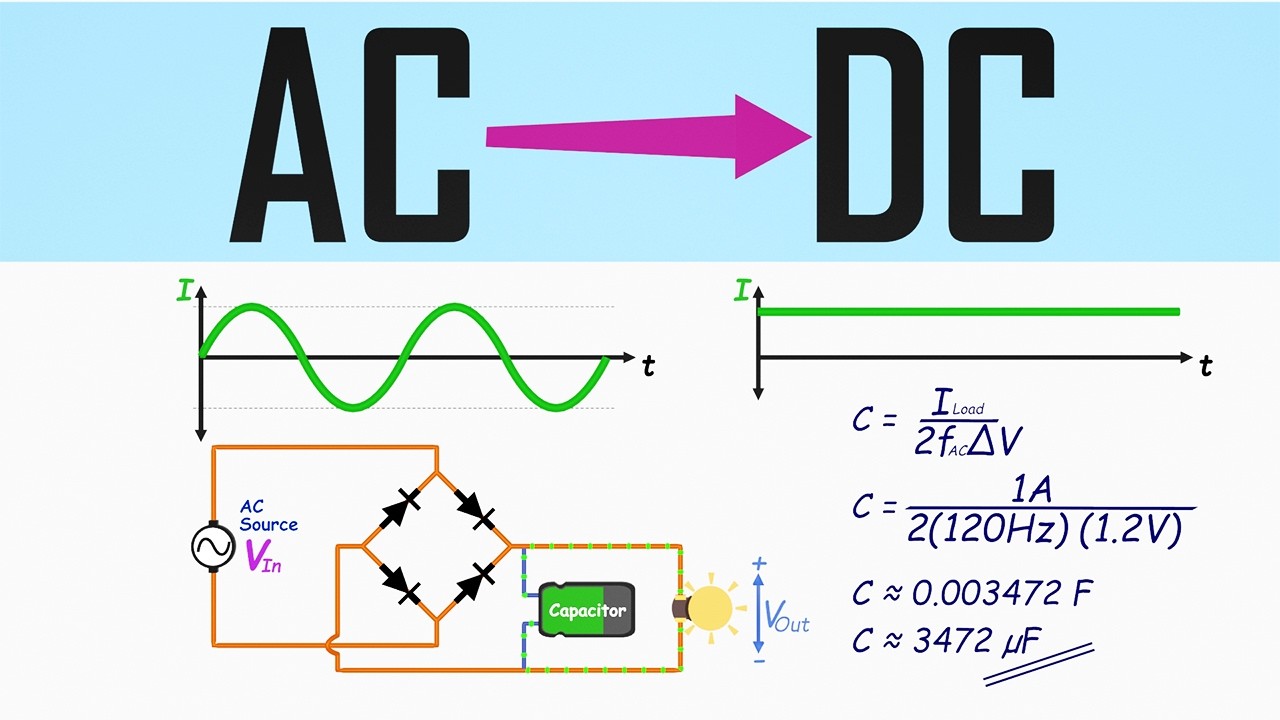
A full-wave rectifier is a more efficient circuit that converts both the positive and negative halves of the AC input signal into DC output. There are two common types: the center-tapped full-wave rectifier and the bridge rectifier.
Center-Tapped Full-Wave Rectifier:
It uses a center-tapped transformer and two diodes.
During the positive half-cycle of the AC input, one diode conducts, and during the negative half-cycle, the other diode conducts.
This results in two positive half-cycles of DC output for every complete AC cycle.
Bridge Rectifier:
It uses a bridge arrangement of four diodes.
Regardless of the polarity of the AC input, one diode always conducts, allowing the current to flow through the load resistor.
This results in a more continuous and smoother DC output.
Advantages of Full-Wave Rectifiers:
They are more efficient than half-wave rectifiers since they use both halves of the AC cycle.
The output DC voltage has less ripple, making it smoother.
Applications:
Both half-wave and full-wave rectifiers are used in power supplies and various electronic devices where a stable DC voltage is required.
App Link: https://play.google.com/store/apps/de...
Everyone wants to explain but not many have the talent, but I have it. I know the expectation and legacy. I know the history, what the students expect from me and I think this challenge does not make me nervous.
PHYSICS BABA
Links-
Our Facebook Page - / babagang
Our Instagram Handle - / babakagang
Our Website - www.physicsknowledge.com
Повторяем попытку...

Доступные форматы для скачивания:
Скачать видео
-
Информация по загрузке:






![Пожалуй, главное заблуждение об электричестве [Veritasium]](https://imager.clipsaver.ru/6Hv2GLtnf2c/max.jpg)