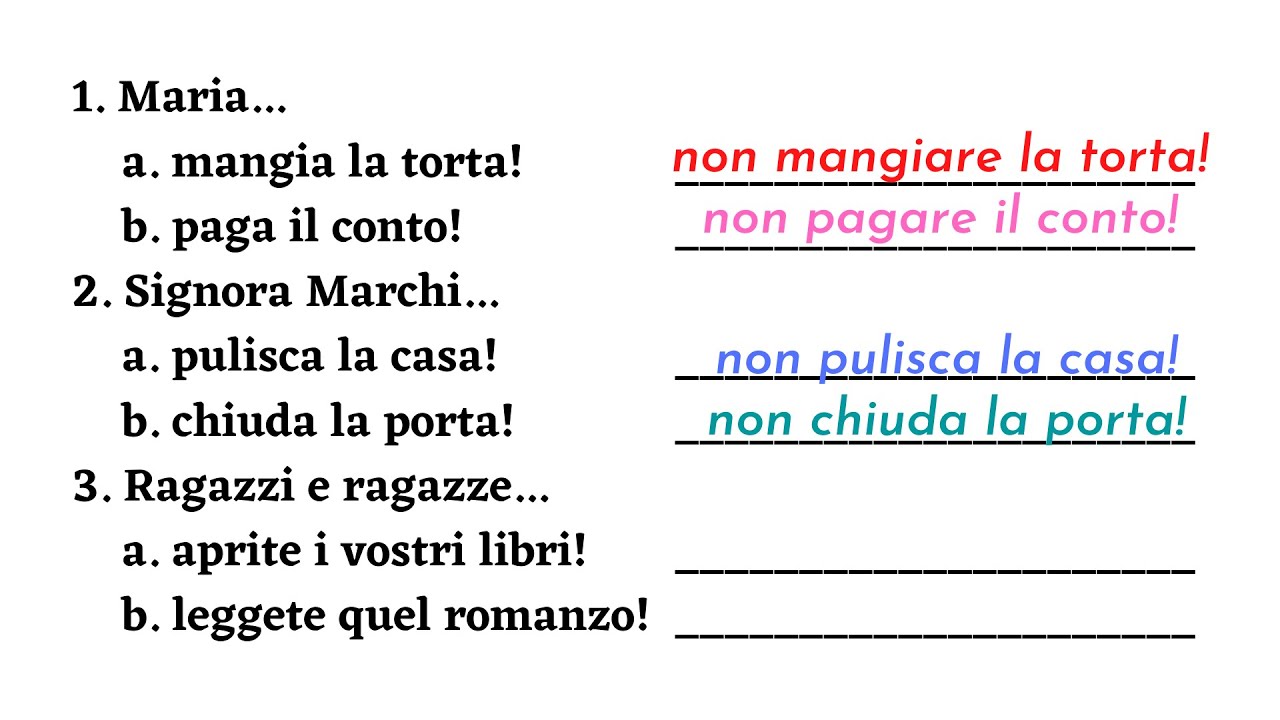
Italian imperative | Affirmative and negative | Grammar class level B1 | Learn italian free lessons
Автор: Hyperuran
Загружено: 2021-10-14
Просмотров: 109
Описание:
Italian class, learn italian, italian verbs, learn italian for beginners, affirmative, negative, imperative, grammar class, how to use imperative, #learnitalian, aprende italiano, italian grammar, italian language, italian lessons, indicative, subjunctive, learning italian, passato prossimo, subjunctive mood, تعلم الايطالية, a2 italian, italian b1, apprendre italien, aprender italiano, fill in the blanks, how to learn italian, italian language course, italian learning, italian online class free, italian prepositions, italian pronouns.
The imperative, imperativo, is used to express
• an order: Chiudi la porta! (Shut the door.)
• an invitation: State in silenzio, per favore. (Be silent, please.)
• a piece of advice: Fai piano! (Easy does it.)
• a ban: Non urlate! (Don’t shut!)
The imperative has only one tense, the present, and two persons: the second singular, tu, and the second plural, voi.
The verb is the variable part of the speech expressing actions, events and situations. It’s the most important element in a sentence: the verb is the centre around which are organized all the elements of the sentence.
In particular, the verb expresses:
an action made by the subject
an action received by the subject
an action reflected upon the subject
an event
how are and what are somebody or something
a possession of somebody or something
the existence of somebody or something.
Moreover, the verb gives information about the temporal collocation of the event, that can be situated:
nel passato, in the past
nel presente, in the present
nel futuro, in the future.
Finally, the verb gives information about the event’s way of happening, that can be considered:
a certain event
an hypothesis
an opinion
an impossibility
• The verb agrees with the subject and permits to recognize it. It has six different endings, related to the six different “persons” that can carry out the action.
• The verb can be analysed according to:
l’aspetto morfologico, the morphological aspects: la persona (person), il numero (number), il modo (mood), il tempo (tense), l’aspetto (aspect), la coniugazione (conjugation);
la funzione, the function, held in relationship with other verbs: ausiliare (auxiliary), servile (modal), fraseologico (phraseological);
il genere, the kind: transitivo (transitive) or intransitivo (intransitive);
la forma, the voice: attiva (active), passiva (passive), riflessiva (reflexive).
• The morphological aspects: o la forma del verbo
Also the verbs are composed by a root, invariable, and by a variable ending, that contains a lots of information. The ending of a verb shows:
• La persona e il numero: the person who constitutes the subject can be:
the one who speaks, la persona che parla, known as prima persona, first person, singolare or plurale: io (I), noi (we);
the one who listens, la persona che ascolta, seconda persona, second person, singolare or plurale: tu (you), voi (you);
the one or the thing is the sentence about la persona o la cosa di cui si parla, terza persona, third person, singolare or plurale: lui, lei, egli, ella, esso, essa (him, her), essi, esse, loro (they).
There are three persons singular and three persons plural.
For example: Io mangio. (I eat.)Tu dormi. (You sleep) Lui scrive. (He writes): Prima, seconda e
terza persona singolare.
Noi partiamo. (We leave) Voi uscite. (You go out) Essi leggono. (They read): prima, seconda e terza persona plurale.
• Il genere: sometimes is possible to understand if the subject performing the action is masculine or feminine. This happens only in past participle tense and in compound tenses.
For example: seduto, seduta, seduti, sedute (sat): it’s evident in the participle the variation of
gender and number.
È partita. È partito. Sono partite. Sono partiti. (He/she left. They left) It’s evident the ending’s variation of number and gender in compound tenses, such as the present perfect.
Important: the endings of verbs change, depending on subject’s persons, numbers and gender.
Attention: the agreement between subject and verb occurs depending on the grammatical person.
• Il modo: the mood of the verb suggest if the action or the situation espresse in the sentence are considered a certainty, a possibility, a hope, a doubt, an order.
For example: mangio (certainty), mangerei (possibility), mangiassi (doubt), mangia! (order).
In italian exist seven moods: four finite, finiti, and three indefinite, indefiniti.
Die Sprache der Natur, Learn italian, Italian grammar, Italian exercises, Learn italian free, Learning Italian, Italian language, Italian lessons, Learn Italian, Speak italian, Learn italian in italian, How to learn italian, Italiano per stranieri, Italienisch lernen, Aprender italiano, Italiano, Imparare, Italiano, Learn, Italian, Aprender, Apprendre l’italien, Italian language.
Повторяем попытку...
Доступные форматы для скачивания:
Скачать видео
-
Информация по загрузке:


