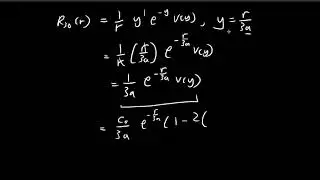
Problem 4.19 - Hydrogen Atom ⇢ Hydrogenic Atoms and Lyman Series: Introduction to Quantum Mechanics
Автор: Curious About Science
Загружено: 2024-03-08
Просмотров: 915
Описание:
⍟ 𝐏𝐃𝐅 ➜ https://tinyurl.com/mr4cxfs2 𝐃𝐨𝐧𝐚𝐭𝐞 ➜ https://buymeacoffee.com/curiousabout... 𝐂𝐡𝐚𝐩𝐭𝐞𝐫 𝐍𝐨𝐭𝐞𝐬 ➜ http://tinyurl.com/2nzeyr8p ⍟
----------------------------------------------------
⍟ 𝐀𝐛𝐨𝐮𝐭 𝐓𝐡𝐢𝐬 𝐕𝐢𝐝𝐞𝐨 ⍟
Hydrogenic atoms are those consisting of a single electron orbiting a nucleus with Z protons, where Z represents the atomic number. This class includes hydrogen (Z=1) and ions of other elements. The behavior of these atoms is largely described by the Bohr model, which provides equations for calculating various properties such as energy levels, radii, and binding energies.
One of the key features of hydrogenic atoms is their spectral lines, which result from transitions of electrons between energy levels. The most notable series is the Lyman series, characterized by transitions to the n=1, or ground state, energy level. These transitions typically occur in the ultraviolet region of the electromagnetic spectrum.
As the atomic number Z increases, spectral lines shift to shorter wavelengths. For example, in helium (Z=2) and lithium (Z=3), the Lyman series would still fall within the ultraviolet range but at shorter wavelengths compared to hydrogen.
In summary, hydrogenic atoms provide a fundamental framework for understanding atomic structure, and their spectra offer valuable insights into the behavior of electrons within atoms, contributing to our understanding of quantum mechanics and the electromagnetic interactions of matter.
• 𝙿𝚛𝚘𝚋𝚕𝚎𝚖 𝙱𝚛𝚎𝚊𝚔𝚍𝚘𝚠𝚗 𝚃𝚒𝚖𝚎 𝚂𝚝𝚊𝚖𝚙𝚜:
0:00 - Background.
1:04 - Problem Statement.
1:47 - Start of Solution.
5:33 - Rydberg Formula for λ.
8:10 - Edge Cases for λ.
9:17 - Hydrogenic Atoms.
12:06 - Graphical Results. Note ↦ https://www.nagwa.com/en/explainers/4...
16:15 - Concluding Remarks.
----------------------------------------------------
⍟ 𝐒𝐮𝐩𝐩𝐨𝐫𝐭 𝐓𝐡𝐢𝐬 𝐂𝐡𝐚𝐧𝐧𝐞𝐥 ⍟
• ▶️ 𝘚𝘶𝘣𝘴𝘤𝘳𝘪𝘣𝘦 ▶️ ➜ http://tinyurl.com/4kd8wahb
• 🔎 𝘗𝘢𝘵𝘳𝘦𝘰𝘯 🔍 ➜ / curiousaboutscience
• ☕ Buy Me a Coffee ☕ ➜ https://buymeacoffee.com/curiousabout...
• 📖 𝘈𝘮𝘢𝘻𝘰𝘯 𝘉𝘰𝘰𝘬 𝘓𝘪𝘯𝘬𝘴 📖
↳ QM ➜ https://amzn.to/48Xu8mx
↳ EM ➜ https://amzn.to/3TYJ8MN
• ⚙️ 𝘈𝘮𝘢𝘻𝘰𝘯 𝘎𝘦𝘢𝘳 𝘓𝘪𝘯𝘬𝘴 ⚙️
↳ 💻 ➜ https://amzn.to/3OZ5lqR
↳ 🎙️ ➜ https://amzn.to/49ryumD
----------------------------------------------------
⍟ 𝐋𝐞𝐭'𝐬 𝐂𝐨𝐧𝐧𝐞𝐜𝐭! ⍟
• 𝘐𝘯𝘴𝘵𝘢𝘨𝘳𝘢𝘮 ➜ / curiousaboutscience
• 𝘛𝘸𝘪𝘵𝘵𝘦𝘳/𝕏 ➜ / sciencenerd_cas
----------------------------------------------------
⍟ 𝐌𝐢𝐬𝐬𝐢𝐨𝐧 ⍟
Science is a phenomenal exploration of nature. We hope to hone our skills of problem solving by exposing ourselves to multiple contexts. In doing so, it can sometimes be challenging to see the connection between topics. I yearn to understand 𝙝𝙤𝙬 these aspects of physics, unite together. To accomplish this, I'll cover all of my old textbooks through QFT; the convergence point of the many modern scientists! These posts are very much in a "𝘯𝘰𝘵𝘦𝘴 𝘵𝘰 𝘴𝘦𝘭𝘧" style. 𝙈𝙮 𝙝𝙤𝙥𝙚 is that by sharing this exploration, I can help others navigate the beautiful world of mathematics & physics through problems and examples, connecting the mathematical tools to their physical ramifications.
#Curiousaboutscience
• Stay Curious & Happy Learning!
⇢ Share knowledge - tag a friend!
⇢ Subscribe for more!
⇢ Don't forget to turn on video notifications!
----------------------------------------------------
⍟ 𝐂𝐫𝐞𝐝𝐢𝐭𝐬 ⍟
◉ ☞📚📖📓= Griffiths, David J., and Darrell F. Schroeter. “Chapter 4 Quantum Mechanics in Three Dimensions.” 𝘐𝘯𝘵𝘳𝘰𝘥𝘶𝘤𝘵𝘪𝘰𝘯 𝘵𝘰 𝘘𝘶𝘢𝘯𝘵𝘶𝘮 𝘔𝘦𝘤𝘩𝘢𝘯𝘪𝘤𝘴, 3rd ed., Cambridge University Press, 2018, pp. 131–197.
◉ ☞ 🖼 📸 = http://tinyurl.com/4v9nef5k
----------------------------------------------------
Повторяем попытку...

Доступные форматы для скачивания:
Скачать видео
-
Информация по загрузке:


![Как сжимаются изображения? [46 МБ ↘↘ 4,07 МБ] JPEG в деталях](https://image.4k-video.ru/id-video/Kv1Hiv3ox8I)


![Самая простая нерешённая задача — гипотеза Коллатца [Veritasium]](https://image.4k-video.ru/id-video/QgzBDZwanWA)