Breeding and Genetics in Livestock Production Module 3 Breeding Systems and Mating Designs in Live
Автор: EarthTab Business School
Загружено: 2025-12-15
Просмотров: 3
Описание:
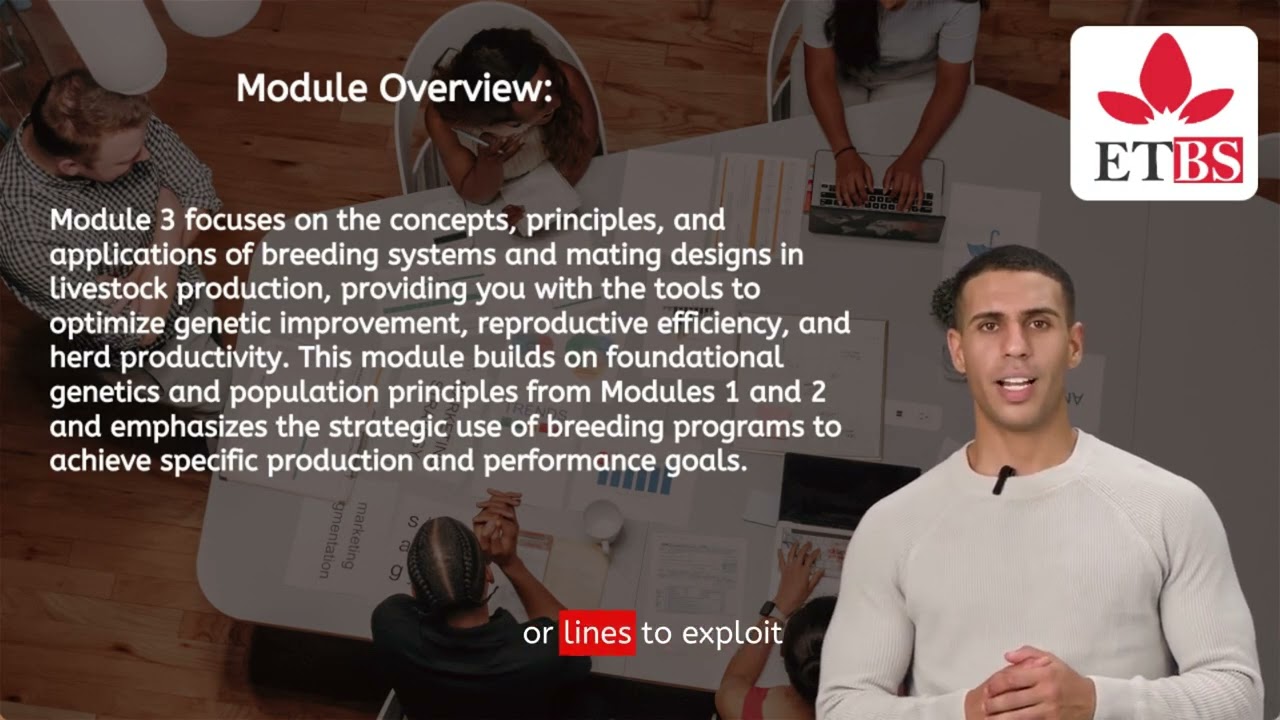
Module 3 focuses on the concepts, principles, and applications of breeding systems and mating designs in livestock production, providing you with the tools to optimize genetic improvement, reproductive efficiency, and herd productivity. This module builds on foundational genetics and population principles from Modules 1 and 2 and emphasizes the strategic use of breeding programs to achieve specific production and performance goals.
The module begins by introducing the major types of livestock breeding systems, including purebreeding, crossbreeding, rotational breeding, and synthetic breed development. You explore the advantages and disadvantages of each system, particularly in relation to genetic gain, heterosis (hybrid vigor), inbreeding control, and adaptation to environmental conditions. For instance, purebreeding maintains breed purity and predictability of traits, while crossbreeding exploits heterosis to improve growth rates, fertility, and disease resistance in commercial herds.
A significant portion of the module is devoted to mating designs, which are structured plans for pairing males and females to achieve desired genetic outcomes. You study random mating, assortative mating, linebreeding, inbreeding, outcrossing, and rotational mating, examining the genetic consequences, risks, and benefits of each approach. The module emphasizes that mating designs must balance genetic improvement, diversity, and the avoidance of inbreeding depression.
The module also introduces selection strategies in mating programs, including mass selection, family selection, and progeny testing. Individuals analyze how these strategies contribute to the accuracy of breeding value estimation and the efficiency of genetic improvement, especially for traits with low heritability. The concept of selection intensity versus selection accuracy is explored, highlighting the trade-offs in practical livestock operations.
Advanced topics include line and synthetic breed development, where you explore how to combine multiple breeds or lines to exploit complementary traits while maintaining long-term sustainability. The module provides insights into recurrent selection, rotational crossbreeding, and composite populations, emphasizing their application in beef, dairy, poultry, and small ruminant production systems.
Another key component of the module is the management of reproductive technologies to enhance mating systems, such as artificial insemination (AI), multiple ovulation and embryo transfer (MOET), and semen and embryo cryopreservation. These technologies allow breeders to maximize the use of superior genetics, increase selection intensity, and propagate desirable traits more rapidly than conventional natural mating.
By the end of this module, you will be able to design, implement, and manage effective breeding programs that maximize genetic potential, exploit heterosis, and maintain population health and diversity. They will also understand the economic, environmental, and management considerations that influence the choice of breeding systems and mating designs in practical livestock operations.
Key Learning Outcomes
After completing Module 3, you will be able to:
Identify and compare the major livestock breeding systems and their applications.
Analyze mating designs and their effects on genetic improvement, inbreeding, and heterosis.
Apply selection strategies such as mass selection, family selection, and progeny testing in practical breeding programs.
Understand the principles and applications of line, composite, and synthetic breed development.
Integrate reproductive technologies (AI, MOET, cryopreservation) into mating programs to enhance genetic gain.
Evaluate trade-offs between selection intensity, accuracy, and genetic diversity in designing breeding programs.
Develop strategies to control inbreeding, optimize heterosis, and sustain population performance.
Understand the economic and management implications of different breeding and mating systems in commercial livestock production.
Повторяем попытку...
Доступные форматы для скачивания:
Скачать видео
-
Информация по загрузке: