The Architecture of Logic: Gentzen's Proof Theory and Computing
Автор: ThoughtLab
Загружено: 2025-09-04
Просмотров: 169
Описание:
The source explores the foundational crisis in early 20th-century mathematics and David Hilbert's ambitious project to rebuild it on unshakable logic, leading to the birth of proof theory. It highlights Gerhard Gentzen's revolutionary contributions in the 1930s, particularly his conceptualization of proofs as flexible, branching structures, which led to the development of Natural Deduction and Sequent Calculus. The explanation emphasizes cut elimination as Gentzen's key to ensuring consistency in logical systems by removing shortcuts in proofs. Finally, the source connects these historical developments to modern computing through the "proofs as programs" correspondence, demonstrating Gentzen's lasting legacy in programming languages, bug detection, and the logical foundations of artificial intelligence.
Glossary of Key Terms
Foundational Crisis (in Mathematics): A period in the early 20th century where new mathematical ideas, especially set theory, led to paradoxes, causing mathematicians to question the fundamental soundness and consistency of their field.
Proof Theory: A field of mathematical logic that studies the nature and structure of mathematical proofs themselves, rather than just using proofs to establish the truth of statements. It examines the "blueprint for certainty."
David Hilbert: A prominent German mathematician who, in the early 20th century, launched an ambitious program to establish a completely rigorous and self-consistent foundation for all of mathematics.
Formal System: A system consisting of an alphabet, a grammar for forming well-formed formulas, and a set of axioms and rules of inference, designed to express and deduce mathematical or logical statements rigorously.
Gerhard Gentzen: A brilliant German logician in the 1930s who made groundbreaking contributions to proof theory, particularly with his ideas on the structural analysis of proofs.
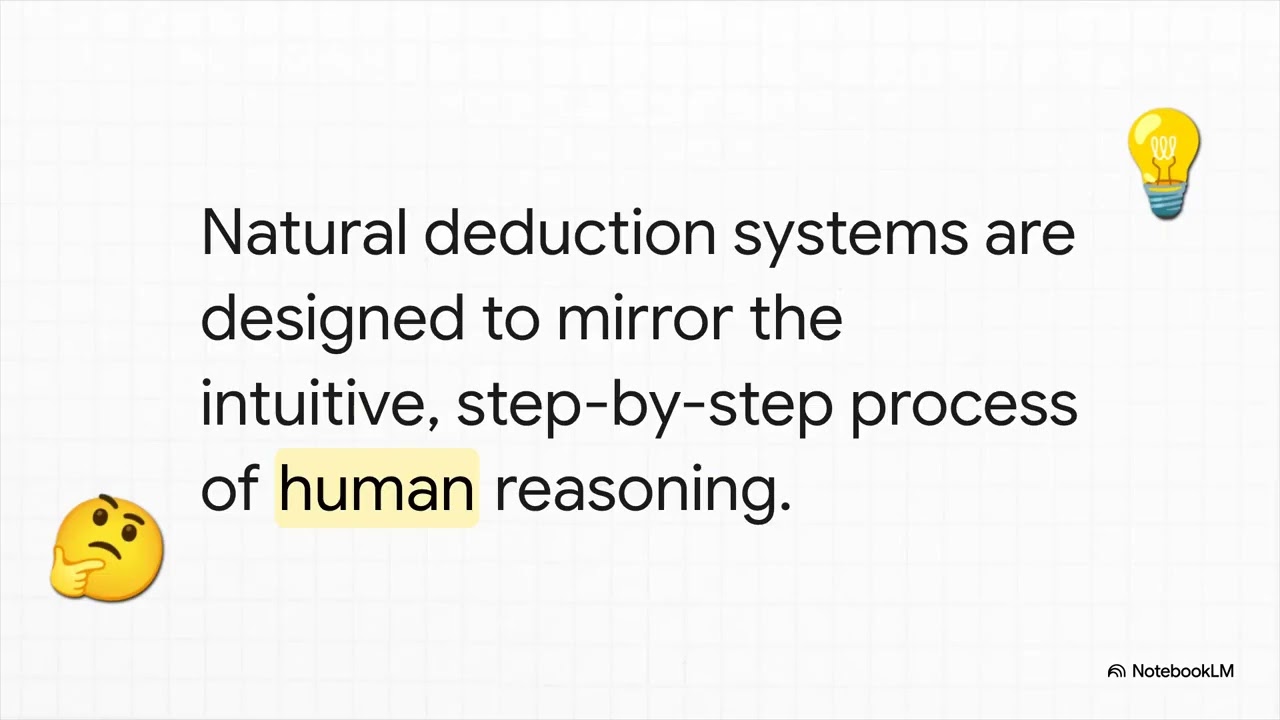
Natural Deduction: One of Gentzen's two core logical systems, designed to formalize the intuitive, step-by-step way humans construct and reason through arguments, with rules for introducing and eliminating logical connectives.
Sequent Calculus: Gentzen's other core logical system, a more abstract and powerful system engineered for the deep technical structural analysis of proofs. It treats assumptions and conclusions symmetrically, making structural differences between logics clear.
Cut Rule: A common logical shortcut or intermediate step used in proofs, stating that if a premise A is known, and A implies B, then B can be directly concluded. It is akin to using a lemma.
Cut Elimination: Gentzen's monumental proof that any logical proof employing the "cut rule" (shortcuts) can be systematically rewritten into an equivalent "cut-free" proof that builds its conclusion directly from basic assumptions without intermediate steps.
Cut-Free Proof: A proof that does not use the cut rule, meaning every part of its conclusion is derived directly from its initial premises, providing a strong guarantee of consistency.
Consistency: A property of a logical system indicating that it is impossible to derive both a statement and its negation within the system. Cut elimination provides a guarantee of consistency.
Proofs as Programs Correspondence: A deep, fundamental link discovered between the structure of a logical proof and the structure of a computer program. It implies that a proof can be read as an algorithm, and its conclusion as the type of data the program outputs.
Algorithm: A finite set of well-defined instructions for accomplishing a task, often implemented as a computer program. In the proofs as programs correspondence, a proof is seen as an algorithm.
Повторяем попытку...
Доступные форматы для скачивания:
Скачать видео
-
Информация по загрузке: