Gravity Works (Nobody Knows What It Is)
Автор: Wisdom of Light
Загружено: 2026-01-21
Просмотров: 26
Описание:
gravity, gravitation, Feynman, Newton, Kepler, Einstein, quantum gravity, Cavendish, tides, Neptune, orbit, Moon, relativity, physics, spacetime
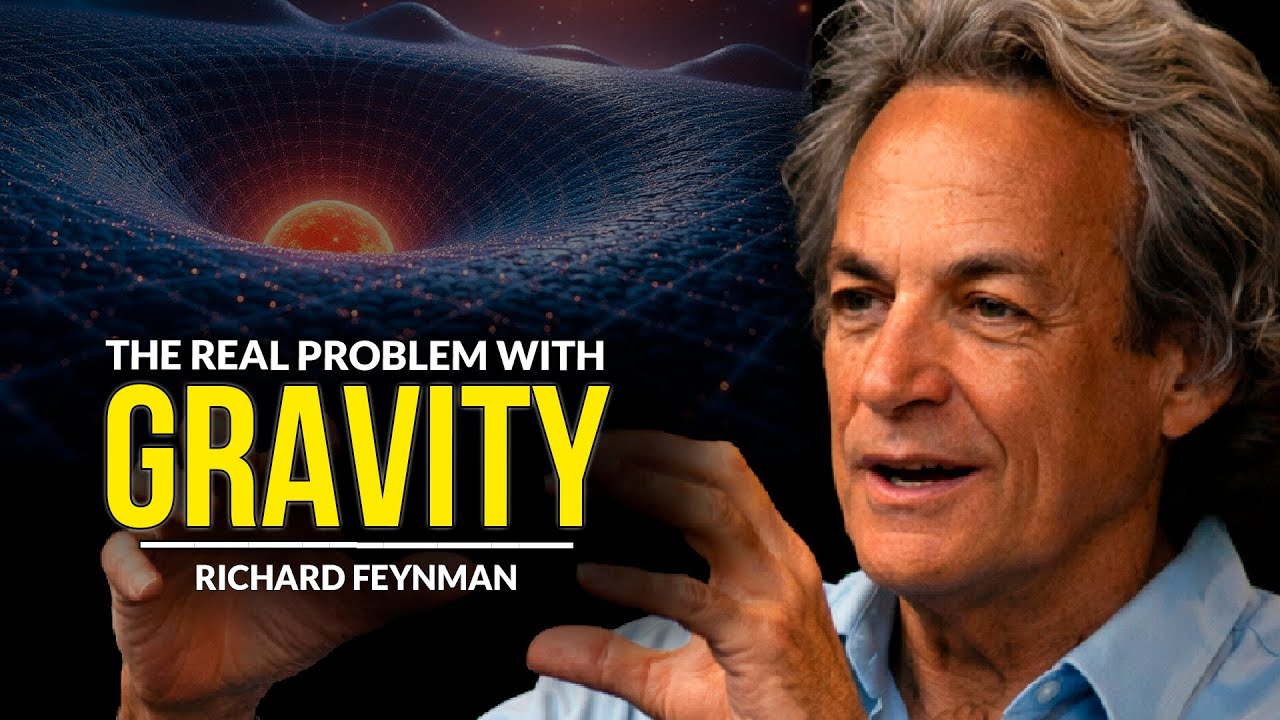
Gravity is the most successful law in physics… and yet nobody can say what gravity is in the deep sense. We can calculate gravity with absurd precision—orbits, tides, falls, planets, stars, galaxies—but when we ask the simplest question, gravity goes quiet.
Richard Feynman was brutally honest about this limit: gravity works, but gravity is not understood as a “mechanism”. Feynman shows how Newton turns Kepler’s patterns into gravity as a universal rule, how Cavendish makes gravity measurable, how tides reveal gravity’s uneven pull, and how Einstein forces gravity to respect the speed limit of information. And then Feynman leaves the uncomfortable bridge: if gravity looks like geometry itself, what does it even mean to quantise gravity?
This video follows Feynman’s path from sky-watching to prediction… and ends where gravity becomes a problem again.
Timestamps
00:00 Moon is falling
04:00 Newton's orbits
07:45 Cavendish experiment
10:55 Tides & Neptune
15:48 Gravity mistery
18:57 Einstein gravity
21:46 Quantum gravity
Topics Covered (What We Cover)
Gravity vs gravitation: what we can predict vs what we can’t explain
The “Moon is falling” idea: orbit as continuous fall
Kepler’s laws as patterns (rules without causes)
Galileo’s inertia: motion doesn’t need a cause, change does
Newton’s insight: force bends paths (radial pull), not “pushes forward”
Orbits and central forces: why planets don’t fly off in straight lines
Universal gravitation: mass attracts mass, and the pull weakens with distance
Why gravity feels invisible in everyday life (it’s extremely weak)
Cavendish torsion balance: measuring gravity in the lab
“Weighing the Earth” indirectly from a tabletop experiment
Two-body motion: Earth–Moon system and the shared centre of mass
Tides explained by uneven gravitational pull (two bulges, not one)
Rømer’s timing anomaly: light has a travel time (information has speed)
Neptune predicted from Uranus’ deviations: a planet found by a law
Gravity as a “prediction machine” across scales (planets → stars → galaxies)
The failure of simple “mechanisms” (push models / invisible rain ideas)
Gravity vs electricity: same distance behaviour, wildly different strength
The equivalence idea: gravitational pull tracks inertia (why free fall is universal)
Newton’s “instant action” problem and the speed limit of signals
Einstein’s upgrade: gravity as geometry (spacetime shapes paths)
Light bending near the Sun as a test of relativistic gravity
The open problem: why quantising gravity is hard (geometry vs quantum rules)
Bridge to quantum gravity and unification: why gravity remains “unfinished”
Names Mentioned (and who they are)
Richard Feynman — Physicist and storyteller of the problem: gravity works brilliantly, yet remains deeply unexplained.
Tycho Brahe — Precision sky-watcher whose measurements made Kepler’s laws possible.
Johannes Kepler — Found the mathematical rules of planetary motion (ellipses, equal areas, timing patterns).
Galileo Galilei — Established inertia: motion doesn’t need a cause; changes in motion do.
Isaac Newton — Turned Kepler’s patterns into a universal law: gravity as a central pull that bends paths into orbits.
Henry Cavendish — Measured gravitational attraction in the lab (torsion balance), making gravity a measurable constant and enabling an indirect “weighing” of Earth.
Ole Rømer — Used timing irregularities of Jupiter’s moons to show light has a travel time (information isn’t instant).
John Couch Adams — Co-predicted the existence/location of Neptune from Uranus’s orbital deviations.
Urbain Le Verrier — Independently predicted Neptune’s position mathematically; a famous triumph of prediction.
Albert Einstein — Reframed gravity to respect a speed limit: not instant action, but geometry of spacetime; predicts light bending near the Sun.
Loránd Eötvös — Tested with high precision that gravitational “pull” tracks inertia (equivalence idea).
Robert Dicke — Later refined equivalence tests to even higher precision.
Yuri Gagarin — Early spaceflight example: illustrates free fall in orbit (objects “float” because everything falls together).
Gherman Titov — Another early cosmonaut used as the same free-fall/orbit illustration
Inspired by the ideas, explanations, and reflections of Richard Feynman across his lectures and public teaching.
This video does not reproduce or replace the original material. It is reinterpreted, reorganised, and contextualised for education and analysis under fair use. Script, narration, and editing are original.
Повторяем попытку...
Доступные форматы для скачивания:
Скачать видео
-
Информация по загрузке: