Melting simulation in COMSOL Multiphysics. Phase change, solid to liquid.
Автор: Stager Educational Group
Загружено: 2023-01-01
Просмотров: 13140
Описание:
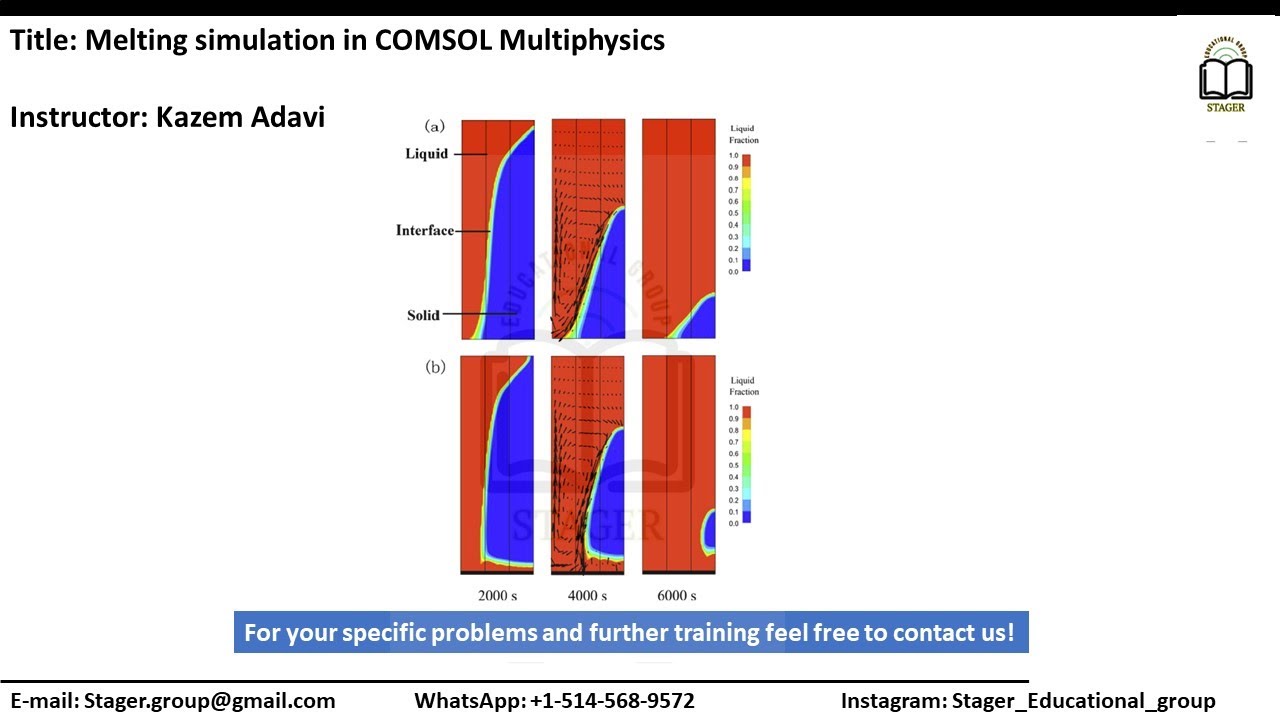
In the video demonstration, the melting procedure is simulated using COMSOL Multiphysics, showcasing the software's capabilities in modeling phase change phenomena. Melting is a complex process involving the transfer of heat from the surroundings to a solid material, causing it to change from a solid phase to a liquid phase. COMSOL's heat transfer module enables researchers to accurately model and analyze this phase change behavior, making it an indispensable tool in various engineering and scientific applications.
To simulate the melting procedure in COMSOL, researchers define the heat transfer equations that govern the heat conduction within the solid material and the convective heat transfer at the solid-liquid interface. These equations account for the latent heat released during the phase change, which is critical for accurately modeling the melting process.
Once the heat transfer equations are defined, researchers set up the initial conditions and boundary conditions to represent the initial temperature distribution and the heat flux at the boundaries. These conditions are crucial in determining the heat transfer rates and the progression of the melting front during the simulation.
Using COMSOL's numerical solvers, the software then solves the heat transfer equations over time, tracking the evolution of the solid-liquid interface as the melting process proceeds. Researchers can visualize the results using temperature contour plots, phase fraction plots, and melting front profiles, providing a comprehensive view of the melting behavior.
Additionally, COMSOL's post-processing capabilities allow researchers to extract valuable information from the simulation results, such as the total melting time, heat transfer rates, and temperature profiles. This data is essential for understanding the melting process and optimizing the design and operation of systems involving phase change, such as melting furnaces, microfluidic devices, and thermal energy storage systems.
Moreover, the simulation can be extended to study the effects of different parameters, such as material properties, initial temperatures, and external heating conditions, on the melting behavior. Parametric studies in COMSOL enable researchers to explore the sensitivity of the melting process to various factors, guiding design choices and process optimization.
In conclusion, the simulation of the melting procedure using COMSOL Multiphysics demonstrates the software's capabilities in modeling phase change phenomena with accuracy and precision. By defining heat transfer equations, setting appropriate conditions, and using numerical solvers, researchers can accurately simulate and analyze the melting process, gaining valuable insights into temperature distribution, heat transfer rates, and the progression of the melting front. COMSOL's post-processing tools further enhance the visualization and interpretation of the simulation results, aiding in the optimization of melting processes and the design of innovative thermal systems. This video demonstration highlights the utility of COMSOL Multiphysics as a powerful tool for studying complex heat transfer phenomena and understanding phase change behavior in a wide range of engineering and scientific applications.
For further training and getting advice regarding your COMSOL projects, feel free to contact us!
WhatsApp: +1-514-5689572
Instagram: stager_educational_group
Повторяем попытку...
Доступные форматы для скачивания:
Скачать видео
-
Информация по загрузке:


