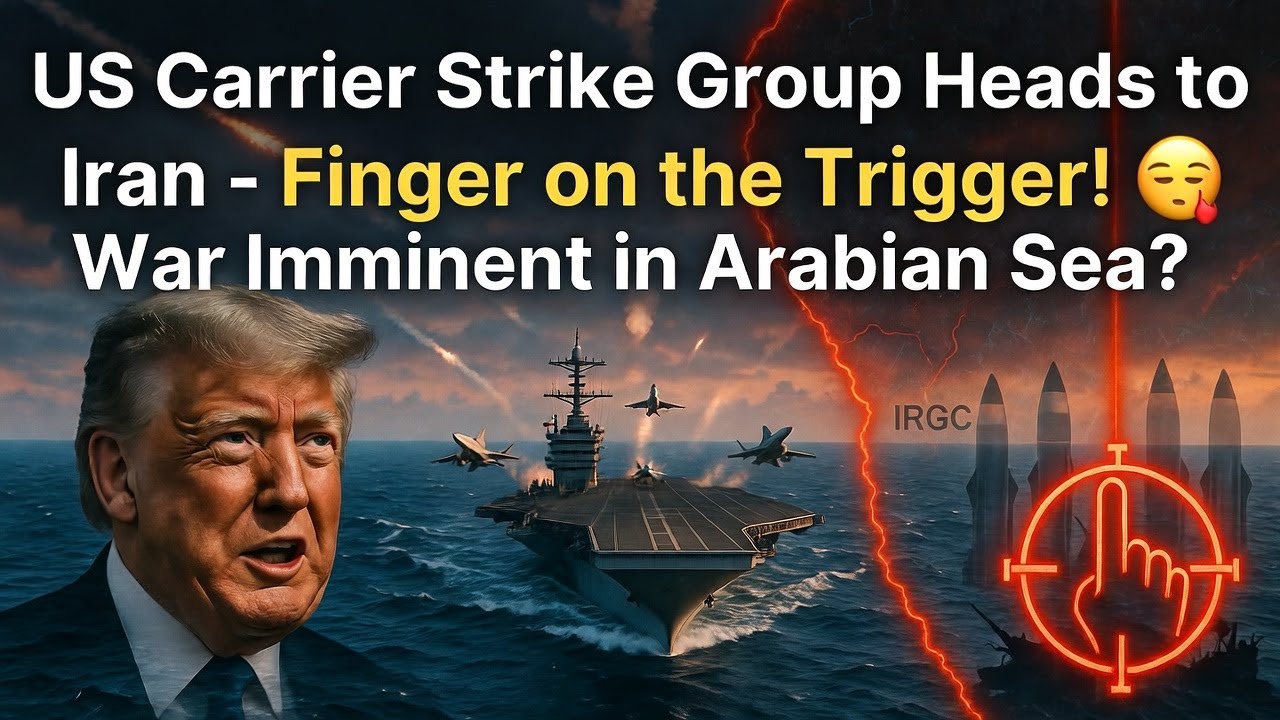
US Carrier Strike Group Heads to Iran – Finger on the Trigger! ⚠️War Imminent in Arabian Sea?
Автор: Lets Catch Up!!
Загружено: 2026-01-25
Просмотров: 23
Описание:
In this video on Lets Catch Up by Rahul, we analyze the rapidly escalating U.S.-Iran geopolitical tensions as of January 2026. President Donald Trump has confirmed the redirection of a major U.S. naval armada—including the USS Abraham Lincoln aircraft carrier strike group—from the South China Sea to the Arabian Sea and Gulf region. This significant military repositioning coincides with Iran’s severe internal crisis, where widespread protests since December 2025 have triggered a harsh security crackdown, resulting in thousands of reported deaths.
The protests stem from profound economic collapse, runaway inflation, soaring fuel prices, mass arrests, executions, and nationwide internet blackouts that have severely restricted accurate information. Credible estimates place casualties between several thousand and much higher figures in the most intense phases of suppression. U.S. assessments indicate that Iranian leadership is attempting to externalize responsibility—blaming America and foreign interference—to invoke nationalism and quell domestic unrest.
Trump has issued clear warnings: should Iran resume its nuclear program or persist in civilian killings, military action remains an option. At the same time, he stresses that the United States does not seek war, preserving a narrow path for diplomacy amid heightened deterrence. The USS Abraham Lincoln carrier strike group—supported by guided-missile destroyers, submarines, supply vessels, Patriot and THAAD missile defense systems, early-warning radars, and fighter squadrons at Gulf bases—grants the U.S. sea-launched air-strike capability, sustained operational endurance, and strong protection against potential Iranian missile, drone, or proxy threats.
Iran’s response has been resolute. Senior Islamic Revolutionary Guard Corps (IRGC) commanders have stated their forces are “finger on the trigger,” prepared for immediate retaliation against any U.S. or Israeli move. While a direct conventional conflict with a superpower is improbable, Iran’s likely strategies include asymmetric measures: mobilizing proxy forces such as Hezbollah, the Houthis, and Iraqi militias; conducting missile and drone strikes on Gulf oil infrastructure; disrupting maritime traffic in the Strait of Hormuz; and launching cyberattacks.
Israel remains on high alert, closely tracking developments, as escalation could directly implicate it. Israel may provide logistical and strategic assistance to the U.S. while seeking to prevent a multi-front engagement.
The regional stakes are exceptionally high. The Strait of Hormuz carries roughly 20% of global oil transit. Any interference—through conflict, blockades, or harassment—would drive sharp increases in fuel prices, trigger inflation, endanger expatriate populations (including India’s substantial Gulf diaspora), disrupt shipping lanes, and affect strategic initiatives such as Chabahar Port. For India, these developments pose serious challenges to energy security, economic stability, and the maintenance of strategic autonomy amid U.S.-Iran friction.
Is large-scale war inevitable? No definitive prediction is possible at this stage. Geopolitical outcomes are seldom absolute. The U.S. military buildup is tangible, substantial, and accompanied by explicit warnings, yet diplomatic avenues have not been closed. The trajectory will depend on the mutual responses of Washington and Tehran.
We conclude with an engaging geography question: Which mountain range forms the natural barrier between the Iranian Plateau and Mesopotamia? Share your answer in the comments—we will reveal it in the next video.
Timestamps:
0:00 – Welcome & Introduction
1:00 – Trump’s Shift to Arabian Sea Focus
2:20 – Iran Protests & Crackdown Recap
4:00 – U.S. Carrier Strike Group Deployment
5:40 – Iran’s “Finger on the Trigger” Warning
7:00 – Economic Crisis & Leadership Strategy
8:30 – U.S. Military Assets & Capabilities
10:10 – Trump’s Statements on Nuclear & Civilian Issues
11:40 – Iran’s Asymmetric Options
13:10 – Israel’s Alert Posture
14:30 – Strait of Hormuz & Global Oil Stakes
16:00 – Implications for India
17:40 – War Probability Assessment
19:00 – Geography Question & Closing
Subscribe to Lets Catch Up by Rahul for clear, in-depth coverage of breaking news, geopolitical analysis, current affairs explained simply, and international relations updates. Enable notifications to stay informed.
If this video clarified the situation for you, please like, share with others interested in global news, and comment below: Do you believe diplomacy can still de-escalate the crisis, or is conflict becoming unavoidable?
#IranUSTensions #TrumpIran #ArabianSeaArmada #USCarrierStrikeGroup #IranProtests #MiddleEastCrisis #StraitOfHormuz #Geopolitics #OilPrices #IndiaGulf #ChabaharPort #TrumpForeignPolicy #IRGC #FingerOnTheTrigger #BreakingNews #CurrentAffairs #InternationalRelations #LetsCatchUpByRahul #RahulGeopolitics
Повторяем попытку...
Доступные форматы для скачивания:
Скачать видео
-
Информация по загрузке: