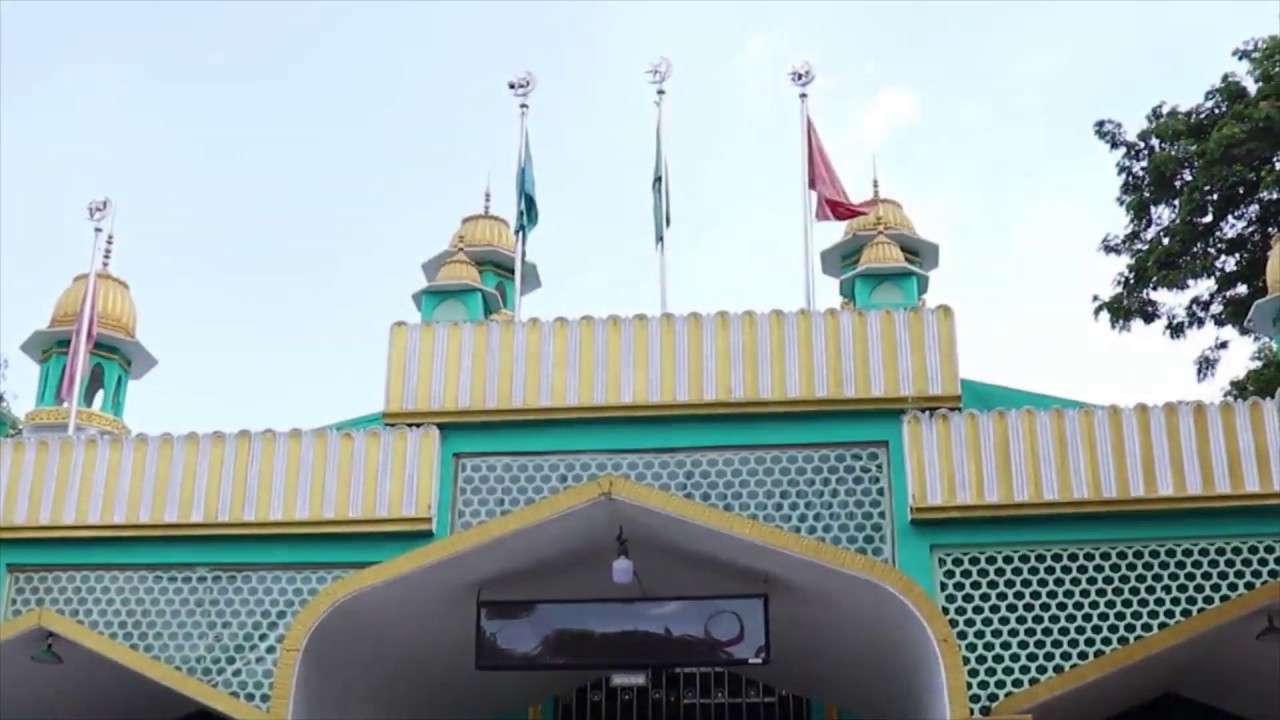
Tomb of Last Mughal Emperor of India - Bahadur Shah Zafar in Yangon Myanmar
Автор: VishLence
Загружено: 2019-11-10
Просмотров: 104408
Описание:
Bahadur shah zafar (1775- 1857) .
The last Emperor of the great Mughals, who saw the sun set on a majestic era, but never lost patience, never abandoned grace and never ceased being a mystical poet, had not given the importance and respect even after the death.!
For more than a century the last Mughal emperor was almost forgotten - but a chance finding of his grave helped resurrect the legacy of a man revered as a Sufi saint and one of the finest poets in the Urdu language.
Zafar's unassuming tomb in a quiet avenue in Yangon is a distressing and silent reminder of one of the most tumultuous periods of Indian history.
Though his rule could not compare with that of illustrious ancestors like Akbar or Aurangzeb, he became the rallying point for the failed "Indian uprising" of 1857, when soldiers from undivided India rose against the British East India Company - The Sepoy Mutiny.
After they lost, the emperor was not sentenced to death but exiled to Rangoon, Burma, NOW CALLED YANGON , MYANMAR. His wife Zeenat Mahal and some of the remaining members of the family accompanied him
Mirza Abu Zafar Sirajuddin Muhammad Bahadur Shah Zafar died at the age of 87 in 1862. With his death, one of the world's greatest dynasties – Mugal Dynasty came to an end..
That very day, his British captors buried him in an unmarked grave in a compound near the famous Shwedagon Pagoda.
The ceremony was attended by his two children and their servant but not Zafar's wife, Zinat Mahal.
It was also said that his death did not have any effect on the people of Rangoon, except for some Followers
Zafar's wife, Zinat Mahal, died in 1882 approximately 20 years after his death. When she died, the location of Zafar's grave had already been forgotten and "could not be located," so she was buried in a roughly similar position near a tree where his grave was assumed to be. Zafar's son, Mirza Jawan Bakht, died two years later and was also buried at the same site
In 1903, a group of visitors came from India to pay tribute to Zafar at his burial place. But at that time "even the exact location of Zinat Mahal's grave had been forgotten though some local guides pointed out the sight of the withered lotus tree."[4] In 1905, the Muslims of Rangoon protested and demanded that there should be some measure to demarcate Zafar's grave because "...As a man or as a king, Bahadur Shah was not to be admired, but he should be remembered."
This request was forwarded by the British to Calcutta and the reply was that it was "inappropriate for the Government" to construct "anything" over the remains of Zafar as a tomb "which might become a place of pilgrimage." This was followed by demonstrations and a "long series of newspaper articles" by which the British agreed in 1907 to erect a single stone slab in which it was engraved "Bahadur Shah, ex-King of Delhi died at Rangoon November 7th, 1862 and was buried near this spot.
In February 1991, workers who were digging for a drain discovered a "brick lined tomb." On top of it was an inscription and soon the body's identity was found. After a few years, a dargah or Islamic shrine was built, which was inaugurated on 15 December 1994.
Zafar is respected as an "Emperor-Saint," and hence this shrine has become an important place for pilgrimage by Muslims.[6]
Inside the two-story mausoleum are separate prayer rooms for men and women. The walls are adorned with engraved marble plaques. There are 9 steps to the crypt where people play drums and read the Quran.[6].[8]
Defeated, demoralised and humiliated, it was an inglorious end for a man whose Mughal ancestors had ruled a vast territory including modern-day India, Pakistan, large parts of Afghanistan and Bangladesh for 300 years.
If you are visiting the mausoleum, please be aware that you will be in the holy Islamic ground so you need to be dressed decently.
Finding Zafar’s Dargah at 6 Ziwaca Street near U Wisara Road in Dagon township – south from the Shwedagon Pagoda – isn’t difficult and definitely a worthwhile excursion, especially on the weekend.
The dargah is often visited by politicians and dignitaries from South Asia.
In a strange irony, Thibaw, the last King of Burma (1878-1885), was exiled twenty-seven years later in the opposite direction – from Burma to Ratnagiri, India, having suffered defeat in the Third Anglo-Burmese War and forced to abdicate the throne. He died there in 1916.
Camera & Voice :- Vishnu
Music: https://www.bensound.com
Повторяем попытку...
Доступные форматы для скачивания:
Скачать видео
-
Информация по загрузке:


