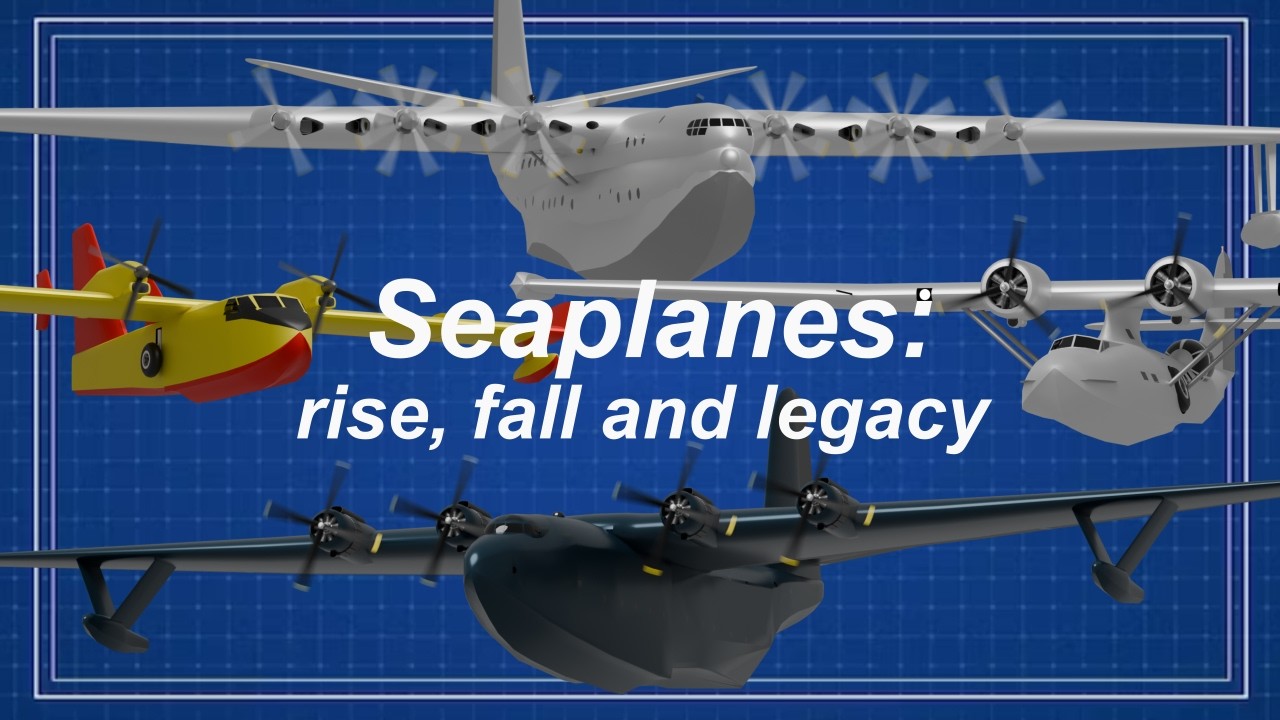
✈ Seaplanes: Rise, Fall, and Legacy ⚙
Автор: Aviation Nerd 🤓
Загружено: 2026-01-17
Просмотров: 167
Описание:
Seaplanes: Rise, Fall, and Legacy ⚙
00:00 - Intro
00:08 - Time card
00:19 - Introduction
00:35 - Why Seaplanes Were So Useful and Versatile
02:21 - Why Seaplanes Disappeared – Technology Caught Up
02:56 - WWII and the Explosion of Airports (Example: London)
03:41 - Who Replaced the Seaplanes
04:07 - Legacy – Seaplanes Never Fully Died
04:49 - Closing Thought
🟦1. Introduction
In the first half of the 20th century, seaplanes were some of the most important aircraft in the world. Before long runways existed everywhere, they used oceans, lakes, and rivers as natural runways, making global aviation possible long before modern airports.
🟦2. Why Seaplanes Were So Useful and Versatile
Seaplanes were dominant because they solved a huge early-aviation problem: lack of infrastructure.
· Military Use
During World War I and World War II, seaplanes were essential for naval operations:
Naval and coastal patrols – spotting enemy ships and protecting coastlines
Anti-submarine warfare – Protect Shipping and Supply **especially critical in WWII (PBY Catalina, Short Sunderland)
Reconnaissance and artillery spotting – directing naval gunfire
Search and rescue – recovering downed pilots and shipwreck survivors
Transport – supplying remote naval bases and outposts
**🎥 The famous Boeing 314 Clipper that flew around the world, the Pacific Clipper, was pressed into military transport duty for the U.S. government during World War II, flying troops and vital supplies after its historic circumnavigation in 1942, even though it was initially a luxury commercial aircraft
The most widely used military seaplanes historically include the American Consolidate PBY Catalina, known for extensive WWII anti-submarine warfare, and the British Short Sunderland, a massive flying boat used for long-range patrols
Their biggest advantage: they didn’t need runways, which made them invaluable for navies without aircraft carriers.
· Commercial and Civil Use
After and between the wars, seaplanes expanded into civilian aviation:
International passenger and mail transport – before airports were common
Transoceanic travel – Boeing 314, Dornier Do X
Cargo and logistics – serving hard-to-reach regions
Exploration, research, and development – the “golden age” aviation
The most widely used commercial seaplanes historically include the large "Clipper" flying boats for long-distance passenger travel and, later, versatile smaller amphibians like the Consolidated PBY Catalina for regional and bush services
Flying boats were among the largest aircraft of their time and formed the backbone of early long-distance airlines.
🟦3. Why Seaplanes Disappeared – Technology Caught Up
Seaplanes didn’t fail — they got outpaced.
Key reasons for their decline:
Massive airport construction during and after WWII
Improved land-based aircraft (DC-3, DC-4, Constellation, Stratocruiser)
Weather issues – rough seas grounded seaplanes, runways didn’t
Outdated designs – many flying boats were quickly becoming obsolete
By the late 1950s, most large flying boats were retired. Some military types stayed active into the 1960s, with civil operations lasting into the 1970s.
🟦4. WWII and the Explosion of Airports (Example: London)
World War II massively reshaped aviation infrastructure.
Thousands of airfields were built or expanded for military use
After the war, many were converted into civilian airports
London Case
London’s dense airport network exists largely because of WWII:
Heathrow – expanded from a pre-war airfield for military use
Stansted – opened in 1943 as RAF Stansted Mountfitchet
RAF Northolt, RAF Biggin Hill, and others – upgraded with concrete runways
By the end of the war, over 600 airfields existed in England alone (most of which were constructed during war). This made landplanes the obvious future.
🟦5. Who Replaced the Seaplanes
Attempts to modernize flying boats failed:
Saunders-Roe Princess
Hughes H-4 Hercules
Meanwhile, landplanes took over fast:
Douglas DC-3 → DC-4, DC-6, DC-7
Lockheed Electra, L-1049 Constellation
Breguet 763, Boeing Stratocruiser
They were faster, cheaper, easier to maintain, and didn’t need water access.
🟦6. Legacy – Seaplanes Never Fully Died
Seaplanes didn’t disappear — they found their niche.
· Modern Uses
Firefighting – CL-415 and CL-515
Heavy water bombers – Lockheed Martin JRM Mars (sadly retired in 2024 but still)
Remote transport – Alaska, Canada, island communities
Tourism – Maldives, resort destinations
They’re no longer the backbone of aviation, but they remain irreplaceable where runways don’t make sense.
🟦Closing Thought
Seaplanes weren’t a failed idea — they were a solution for their time. And in places where nature still beats infrastructure, they’re still winning.
#aviationgeek #aviation #blender3d #history #seaplane #seaplanes #blender
Повторяем попытку...
Доступные форматы для скачивания:
Скачать видео
-
Информация по загрузке:


