Little Moreton Hall (National Trust) moated half-timbered manor house in Cheshire, England
Автор: Visit Places
Загружено: 2025-06-24
Просмотров: 324
Описание:
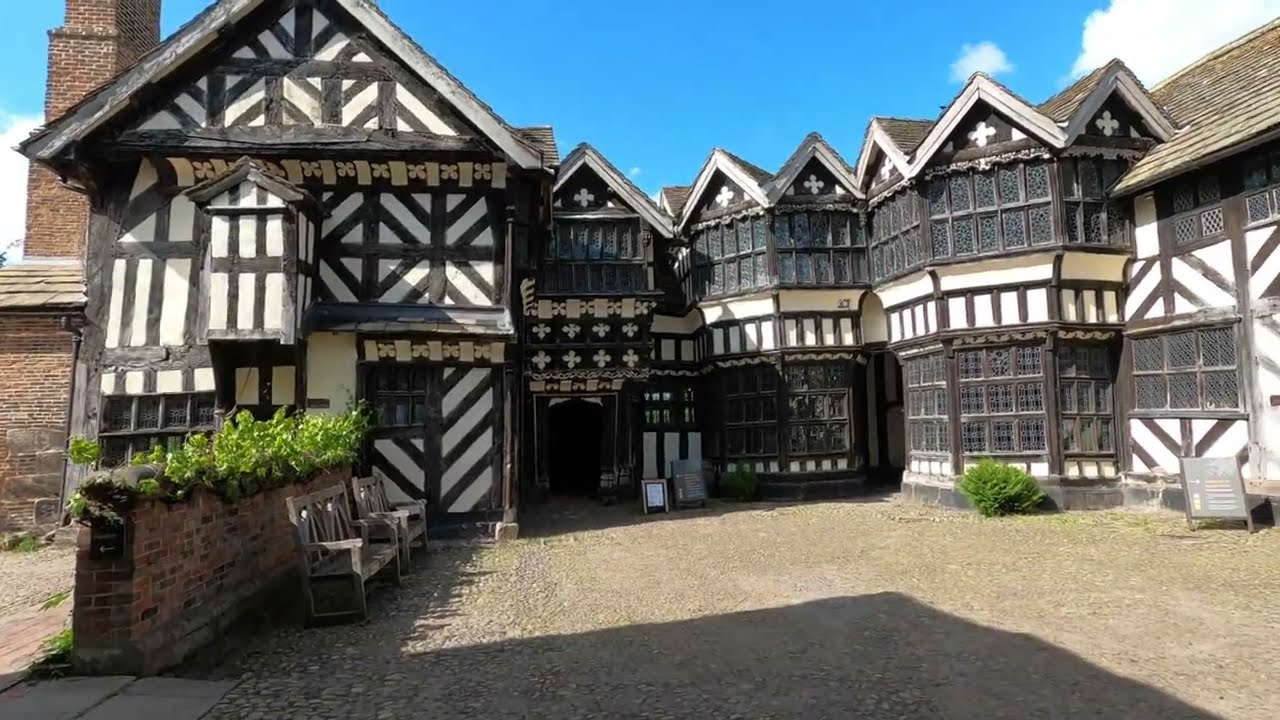
Little Moreton Hall, also known as Old Moreton Hall,[a] is a moated half-timbered manor house 7.2 km south-west of Congleton in Cheshire, England. The earliest parts of the house were built for the prosperous Cheshire landowner William Moreton in about 1504–08 and the remainder was constructed in stages by successive generations of the family until about 1610. The building is highly irregular, with three asymmetrical ranges forming a small, rectangular cobbled courtyard. A National Trust guidebook describes Little Moreton Hall as being "lifted straight from a fairy story, a gingerbread house." The house's top-heavy appearance, "like a stranded Noah's Ark", is due to the Long Gallery that runs the length of the south range's upper floor.
👉If you like, follow me❤️:
🎥YouTube: / @visitplaces
🛠Gear used GoPro Hero 8: https://amzn.to/3w4YuSJ
💳The credit card I recommend for travel: https://americanexpress.com/en-gb/ref...
💵The debit card I use when abroad without fee for the currency exchange: https://join.monzo.com/c/zxw5r4x
The house remained in the possession of the Moreton family for almost 450 years, until ownership was transferred to the National Trust in 1938. Little Moreton Hall and its sandstone bridge across the moat are recorded in the National Heritage List for England as a designated Grade I listed building; the ground on which Little Moreton Hall stands is protected as a Scheduled Monument. The house has been fully restored and is open to the public from April to December each year.
At its greatest extent, in the mid-16th century, the Little Moreton Hall estate occupied an area of 550 ha; it contained a cornmill, orchards, gardens and an iron bloomery with water-powered hammers. The gardens lay abandoned until their 20th-century re-creation. As there were no surviving records of the layout of the original knot garden, it was replanted according to a pattern published in the 17th century.
The 100-year construction of Little Moreton Hall coincided with the English Renaissance, but the house is resolutely medieval in design, apart from some Renaissance decoration such as the motifs on the Gatehouse, Elizabethan fireplaces, and its "extravagant" use of glass. It is timber-framed throughout except for three brick chimneybreasts and some brick buttressing added at a later date.
Simon Jenkins has described Little Moreton Hall as "a feast of medieval carpentry", but the building technique is unremarkable for Cheshire houses of the period – an oak framework set on stone footings. Diagonal oak braces that create chevron and lozenge patterns adorn the façades. The herringbone pattern with quatrefoils present at the rear, which can also be seen at Haslington and Gawsworth Halls, is a typical feature of 15th-century work, while the lozenge patterns, continuous middle rail and lack of quatrefoils in the front façade are typical of 16th-century early Elizabethan work. The south range containing the gatehouse, the last to be completed, has lighter timbers with a greater variety of patterns. The timber frame is completed by rendered infill and Flemish bond brick, or windows. The windows contain 30,000 leaded panes known as quarries, set in patterns of squares, rectangles, lozenges, circles and triangles, complementing the decoration on the timber framing. Much of the original 16th-century glazing has survived and shows the colour variations typical of old glass. Old scratched graffiti is visible in places. The older parts of the roof frame are decorated, and the brickwork of some of the chimneys has diapering in blue brick.
The house stands on an island surrounded by a 10 m wide moat which was probably dug in the 13th or 14th century to enclose an earlier building on the site. There is no evidence that the moat served any defensive purpose, and as with many other moated sites it was probably intended as a status symbol. A sandstone bridge leads to a gatehouse in the three-storey south range, which has each of its two upper floors jettied out over the floor beneath. As is typical of Cheshire's timber-framed buildings the overhanging jetties are hidden by coving, which has a recurring quatrefoil decoration. The Gatehouse leads to a rectangular courtyard, with the Great Hall at the northern end. The two-storey tower to the left of the Gatehouse contains garderobes, which empty directly into the moat. Architectural historian Lydia Greeves has described the interior of Little Moreton Hall as a "corridor-less warren, with one room leading into another, and four staircases linking different levels". Some of the grander rooms have fine chimneypieces and wood panelling, but others are "little more than cupboards". The original purpose of some of the rooms in the house is unknown.
Повторяем попытку...
Доступные форматы для скачивания:
Скачать видео
-
Информация по загрузке: