Subfinder Tutorial for Beginners: Passive Subdomain Enumeration Like a Pro
Автор: black world hackers
Загружено: 2026-04-21
Просмотров: 132
Описание:
bugbounty #subfinder #cybersecurity
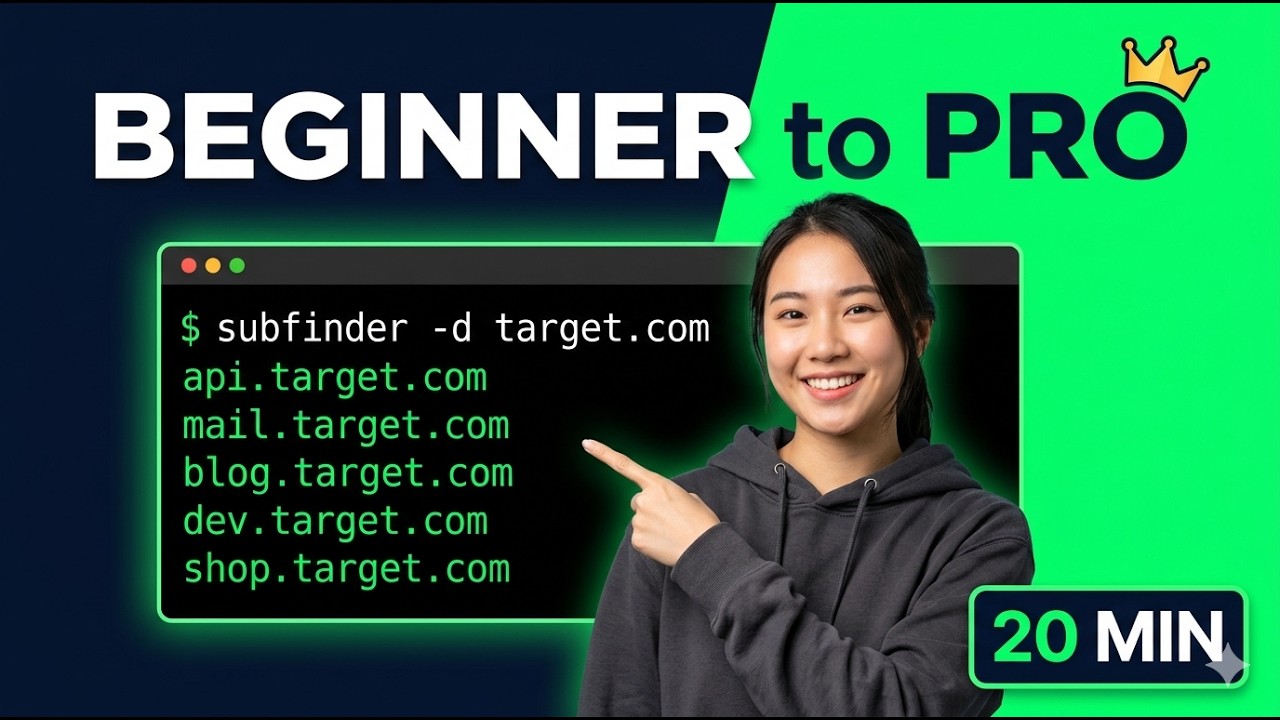
In this *Subfinder tutorial for beginners**, you'll learn **passive subdomain discovery* like a pro. Whether you're into *bug bounty recon* or just getting started, this *Subfinder full guide* covers everything from installation to advanced flags.
By the end of this video, you'll master *subdomain enumeration* using one of the most powerful *dns recon tools* from **project discovery subfinder**.
---
🔍 What You'll Learn:
✅ What is passive subdomain discovery and why it matters
✅ Subfinder active vs passive mode – key differences explained
✅ How to find subdomains passively without touching the target
✅ Subfinder flags explained – all 19 essential flags
✅ Subfinder recursive enumeration for deep subdomain discovery
✅ Subdomain discovery for beginners – step by step
✅ Subfinder vs Amass – which one should you use?
✅ Subfinder API key setup for premium sources
✅ Real-world bug bounty tools 2026 workflow
---
🛠️ Commands Used in This Video:
```bash
Basic passive scan
subfinder -d example.com
Save output to file
subfinder -d example.com -o subdomains.txt
Multiple domains at once
subfinder -dL targets.txt -o all_subs.txt
Use specific sources only
subfinder -d example.com -s crtsh,github,shodan
Exclude problematic sources
subfinder -d example.com -es zoomeyeapi,alienvault
Active DNS resolution mode
subfinder -d example.com -active -r 8.8.8.8,1.1.1.1
JSON output with source collection
subfinder -d example.com -oJ -cs -o output.json
Recursive enumeration
subfinder -d example.com -recursive
Custom resolvers
subfinder -d example.com -active -rL resolvers.txt
Filter results
subfinder -d example.com -match api.,admin. -filter test.
Rate limiting
subfinder -d example.com -rls github=30/m,shodan=1/s
Production-ready command
subfinder -d target.com -s crtsh,github,securitytrails -active -rL dns.txt -oJ -cs -filter test. -o final_output.json
In this complete walkthrough, I explain ALL 19 essential Subfinder flags – from passive enumeration to active DNS resolution, source control, rate limiting, JSON output, recursive mode, and real-world workflows.
📌 *Timestamps:*
0:00 – What is Subfinder?
1:20 – Passive vs Active (Why It Matters)
3:45 – Basic Syntax & First Command
5:30 – Multiple Domains (Batch Mode)
7:10 – Controlling Sources (-sources)
8:50 – Excluding Sources (-exclude-sources)
10:15 – Rate Limiting (-rls)
12:00 – Active Mode & DNS Resolution (-active)
14:20 – JSON Output (-oJ) & Collecting Sources (-cs)
16:00 – Custom Resolvers (-rL)
17:30 – Filtering Results (-match / -filter)
19:00 – Recursive Enumeration (-recursive)
20:15 – Provider Config (API Keys)
22:00 – Stats & Debugging (-stats / -v)
23:30 – Timeout & Max-Time Control
25:00 – Real-World Production Command
📂 *Useful Links:*
Subfinder GitHub: https://github.com/projectdiscovery/s...
💬 Questions?
Drop a comment below. I reply to every single one.
Which subdomain discovery tool do you prefer – Subfinder or Amass?
🔔 Subscribe for More:
More bug bounty recon tutorials, dns recon tool deep dives, and bug bounty tools 2026 updates coming every week.
🔔 *Subscribe for more bug bounty & recon deep dives.*
#subfinder #bugbounty #subdomainenumeration #recon #cybersecurity #bugbounty
#subfinder
#cybersecurity
#recon
#ethicalhacking
#infosec
#subdomainenumeration
#pentesting
#projectdiscovery
#dnsrecon
Повторяем попытку...
Доступные форматы для скачивания:
Скачать видео
-
Информация по загрузке: