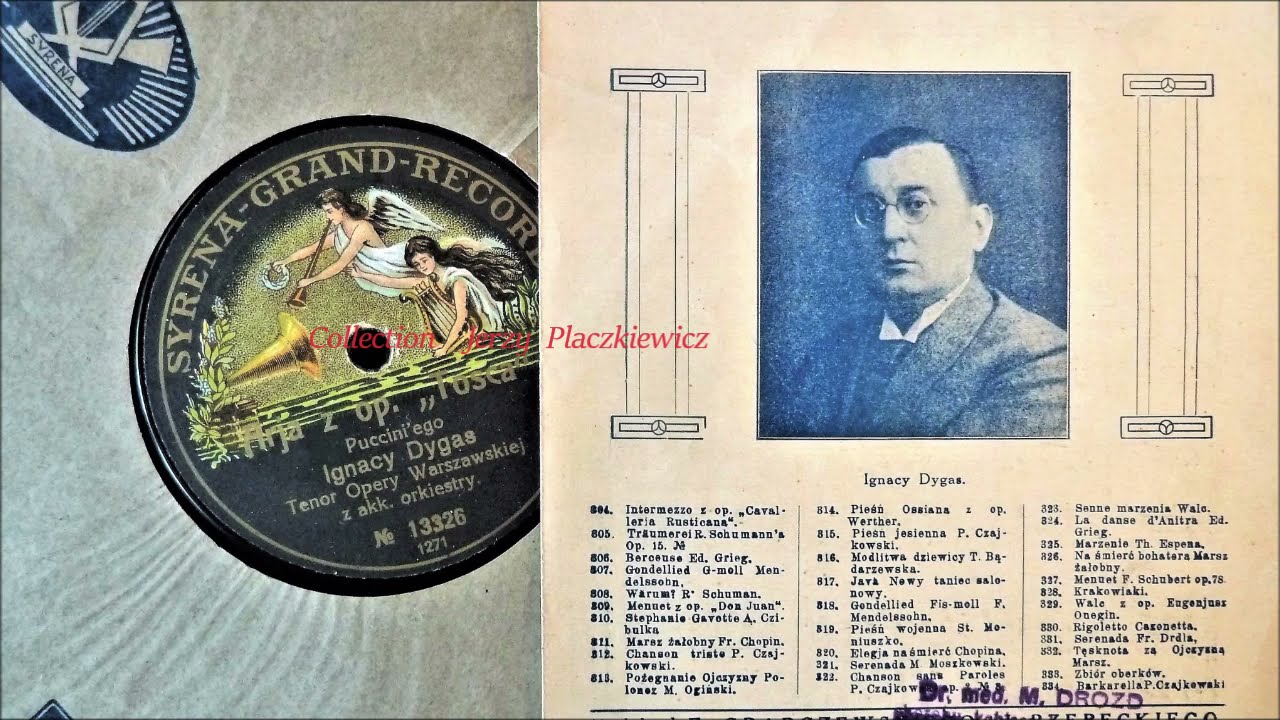
Ignacy Dygas in Polish: Puccini - TOSCA, "E lucevan le stelle", ca. 1912
Автор: jurek46pink
Загружено: 2021-11-20
Просмотров: 465
Описание:
Replayed with the speed as high as 83 rpm !
Recorded acoustically ca 1912 by the great Polish tenor - Ignacy Dygas for the Polish Syrena Grand Record label. The record is in a very good state but the type of shellac and/or pressing method were of rather poor quality what can be observed in the excess of hiss.
. . . . . . . . . . . . . . . . . . . . . . . . . . . . . . . . . . . . . . . . . . . . . . . . . . . . . . . . . . . . .
Ignacy Dygas, Polish singer (tenor). Born 1881 in Warsaw, died 1947 Warsaw. Initially, he was educated as a baritone at the Warsaw Conservatory. In 1905, he made his debut at the Warsaw Opera in the baritone party. He continued his vocal education under the direction of Witold Aleksandrowicz, who re-trained him as a tenor. As a tenor, he performed on May 10, 1905 in the role of Jontek in Halka by Stanisław Moniuszko at the Warsaw Opera (already under his own name).
In 1907 he left for Italy. In Parma, after the creation of the title role in Lohengrin, Richard Wagner, he was so successful that he was engaged to 14 subsequent performances there. In Milan, he was still exercising his voice with Giovanni Battista Lamperti.
He performed in many Italian cities - Genoa, Milan, Naples (Teatro San Carlo), Rome, Bologna and Palermo, as well as in Spain and Argentina (he triumphed in Teatro Colón in Buenos Aires, including Siegfried in the Wagner's Twilight of Gods to have been a partner of Salomea Kruszelnicka-Biccioni in the role of Brunhilda).
He also guested in Warsaw, and in the years 1911-14 he constantly cooperated with the Warsaw Opera.
During the First World War, Ignacy Dygas was in Russia. He was first a soloist of the private Zimin’s Theater, later the Sołodownikow’s Theater. In the years 1915-16 he was engaged by the Marinsky Theater in St. Petersburg, where he became famous as a performer of Herman's role in Piotr Tschaikowsky's The Queen of Spades.
In 1917 he sang at the Grand Theater in Moscow.
In 1918 he returned to Warsaw and became a member of the Warsaw Opera ensamble, sharing together with Stanisław Gruszczyński the position of the first heroic tenor.
In 1924 he toured the United States (New York, Chicago, Detroit) and Europe (Czechoslovakia, Yugoslavia, Austria, Scandinavian countries).
In 1937 he retired from the scene due to his illness. During World War II, the artist stayed in Warsaw.
In 1944 he worked as a teacher in Lublin.
In 1945 he took the singing class at the Fryderyk Chopin School of Music in Warsaw. Soon after the war he appeared for the last time in public during the celebrations of the 40th anniversary of his artistic activity.
* * * * * * * * * * * * * * * * * * * * * * * * * * * * *
Повторяем попытку...
Доступные форматы для скачивания:
Скачать видео
-
Информация по загрузке:




![ВЭКС №15 [ АУСЛЕНДЕР / БОРОДКИН ] День Иерусалима в Иране. 14.03.2026](https://imager.clipsaver.ru/AoCUNhEDCTU/max.jpg)