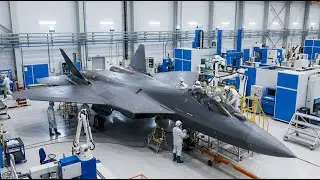
China’s WS-15 Breakthrough Sends a Warning Signal to GE. (''THEY ARE CLOSING THE GAP'')
Автор: FirstSpace
Загружено: 2026-01-13
Просмотров: 136
Описание:
China’s WS-15 Breakthrough Sends a Warning Signal to GE.
China’s WS engine program has just crossed a line few in the West ever expected it to reach. After decades of chasing GE’s lead, China finally hit a point where even GE had to admit the progress is real. For the first time in thirty years, the balance shifted — and the impact landed directly on GE.
What keeps people talking is how unlikely this moment seemed. How did a program that once barely survived end up rattling a company famous for engines with near-perfect reliability? And what changed inside China’s WS family that made GE pause and say something no one expected?
To understand why GE felt this in 2025, you have to go back to how uneven the fight looked at the beginning.
For years, China could build airframes, radars, and missiles. But the engines tying everything together kept coming up short. Western analysts often called engines China’s final missing link — and they were right. While GE and CFM powered aircraft that stayed on wing for tens of thousands of hours, China struggled with engines that sometimes failed after only a few dozen.
Every new fighter that rolled out of a hangar still depended on Russian or Western engines to reach full capability. Inside China, this weakness became more than technical. It turned into a national pressure point. Leaders wanted aircraft flying on domestic engines, not borrowed ones.
The early WS program was brutal. The WS-10, meant to close the gap, ran into problems that made the effort look doomed. Reports of short lifespans, instability, and sudden failures spread quickly. On one side stood GE, backed by decades of experience. On the other was a country pushing for a breakthrough with materials, processes, and skills still maturing.
That imbalance defined the next thirty years. It set the stage for a long struggle between a company that dominated engine design and a state program that refused to remain behind forever.
China’s engine troubles didn’t come from a single mistake. They came from a long series of setbacks that exposed how wide the gap really was. Through the 1990s and 2000s, China tried to replace Russian engines with domestic designs. The WS-10 was the main hope, but early results were disappointing.
Some engines reportedly lasted around thirty hours before requiring work — far below the roughly four hundred hours of the Russian AL-31. Engineers battled turbine blade issues, heat management problems, and inconsistent quality control. Meanwhile, GE and CFM were setting global standards. The CFM56 powered fleets worldwide with failure rates so low it became the benchmark for reliability.
China saw the numbers. The difference was undeniable.
By the early 2010s, it was clear the problem wouldn’t fix itself. In 2016, China consolidated most of its engine manufacturers into a single giant — the Aero Engine Corporation of China. Nearly 100,000 employees and massive funding were placed under one roof. This was no longer experimentation. It was a national mission to compete with GE, Rolls-Royce, and Pratt & Whitney.
The real change began when engines finally started staying in service, flying hard, and coming back with fewer issues. Progress was slow. It took years of incremental gains, failed tests, and quiet revisions. But by the early 2020s, the pattern was shifting.
Повторяем попытку...

Доступные форматы для скачивания:
Скачать видео
-
Информация по загрузке: