Psychology of People Who have High IQ (Neuroscience Explained)
Автор: Psy Reboot
Загружено: 2026-02-07
Просмотров: 342
Описание:
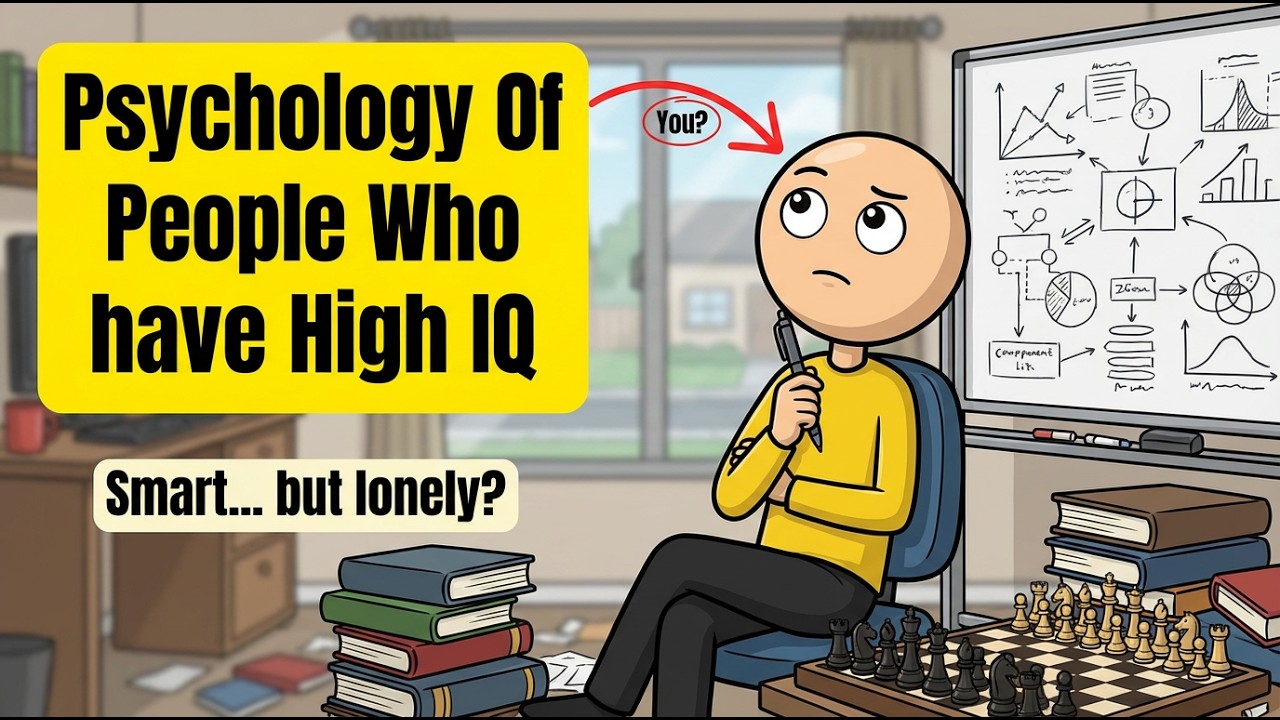
If you’ve ever felt bored, restless, or strangely detached from life despite being highly intelligent, the psychology of high IQ may explain why. This video explores how high-IQ brains predict outcomes faster—and how that changes motivation, emotions, and relationships.
Many people with high intelligence notice patterns early, lose interest quickly, or feel like life is running on repeat. Neuroscience reveals this isn’t laziness or arrogance—it’s how predictive brains are wired.
What you’ll learn in this video:
• How high IQ brains use predictive coding and working memory to simulate outcomes
• Why motivation drops when your brain “solves” rewards before they happen
• The neuroscience behind boredom, overthinking, and emotional flatness
• How theory of mind makes social interactions feel predictable
• Why life can feel muted when dopamine spikes shrink
• The difference between intelligence and wisdom in staying present
• Practical insight into turning prediction into fulfillment and depth
High IQ psychology is deeply tied to the prefrontal cortex, dopamine systems, and cognitive prediction loops. When your brain finishes the story before reality unfolds, excitement fades—not because you lack discipline, but because your brain optimized the uncertainty away. Understanding this explains why intelligent people often feel restless, under-stimulated, or disconnected from novelty.
If this experience sounds familiar, you’re not broken. Many high-IQ individuals struggle with motivation, boredom, rumination, and emotional saturation because their brains are designed to reduce uncertainty. This video reframes those traits as a cognitive design feature—not a personal flaw.
Watch until the end to understand how presence, depth, and wisdom can transform predictive intelligence into a powerful tool for fulfillment. #HighIQ #Neuroscience #Psychology #Intelligence #BrainScience #CognitiveScience
KEY REFERENCES & RESEARCH
• Predictive Coding Theory (Karl Friston, ~2010) – The brain is fundamentally a prediction machine, constantly generating models of the future to reduce uncertainty.
Relevance: This is the backbone of the script’s idea that high-IQ brains “see the ending early,” leading to reduced surprise and diminished emotional impact.
• Prefrontal Cortex & Working Memory (Baddeley & Hitch, 1974; Miller & Cohen, 2001) – The prefrontal cortex integrates working memory, planning, and prediction. Higher efficiency allows faster pattern recognition and mental simulation.
Relevance: Explains why high-IQ individuals close mental loops early and mentally finish tasks before they unfold.
• Dopamine & Reward Prediction Error (Schultz, Dayan & Montague, 1997) – Dopamine spikes are strongest when outcomes are uncertain; accurate prediction reduces dopamine release.
Relevance: Directly supports the script’s explanation of fading motivation, reduced excitement, and “solving the reward before it arrives.”
• Anticipatory Dopamine vs. Reward Consumption (Berridge & Robinson, 1998) – Dopamine is more about wanting and anticipation than pleasure itself.
Relevance: Reinforces why novelty and uncertainty drive motivation, and why prediction dampens excitement for high-IQ minds.
• Theory of Mind (Premack & Woodruff, 1978) – The ability to infer others’ mental states, intentions, and emotions.
Relevance: Grounds the script’s claim that high-IQ individuals anticipate social dynamics early, making interactions feel predictable or flat.
• Social Brain Network: TPJ & Medial Prefrontal Cortex (Saxe & Kanwisher, 2003) – Brain regions involved in simulating other people’s thoughts and intentions.
Relevance: Explains why social interactions can feel repetitive for highly predictive minds.
• Anhedonia (DSM-5; Treadway & Zald, 2011) – Reduced ability to experience pleasure, often linked to dopamine signaling changes.
Relevance: Supports the “anhedonia-lite” concept used to describe muted emotional highs without clinical depression.
• Rumination & Default Mode Network (DMN) (Raichle et al., 2001) – Overactivity in self-referential thought networks leads to constant mental simulation.
Relevance: Explains why high-IQ individuals may struggle to inhabit the present moment, living more in simulations than experiences.
• Mindfulness & Presence (Kabat-Zinn, 1994) – Psychological well-being improves when attention is anchored in present-moment experience rather than prediction.
Relevance: Underlies the script’s reframing of wisdom as “learning to stay” rather than think faster.
NOTES
This list focuses only on concepts explicitly mentioned or directly implied in the script.
The references are widely accepted, foundational, and accessible for viewers who want to explore further.
Disclaimer: This content is for educational purposes and does not substitute for professional psychological advice.
Повторяем попытку...
Доступные форматы для скачивания:
Скачать видео
-
Информация по загрузке: