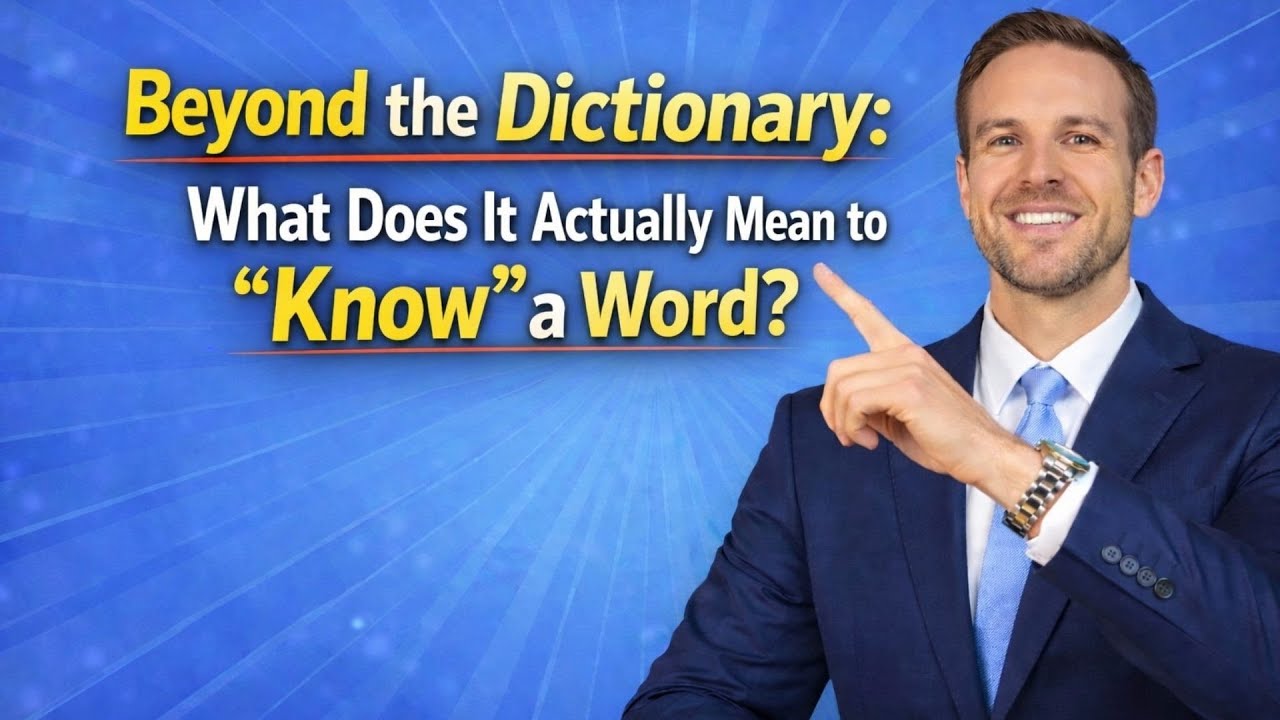
Beyond the Dictionary: What Does It Actually Mean to “Know” a Word?
Автор: English Language Studies
Загружено: 2026-01-27
Просмотров: 43
Описание:
Beyond the Dictionary: What Does It Actually Mean to “Know” a Word?
Ever wondered why some words just feel right while others seem out of place, even when the dictionary says they mean the same thing? Knowing a word is more than memorizing a definition. It’s a multi dimensional skill that involves understanding context, emotion, and grammar.
In this video, we break down the 8 Pillars of True Vocabulary Knowledge to help you move from basic translation to fluent, natural communication.
🔍 The 8 Pillars of Word Mastery
1. Polysemy (Multiple Meanings): Many English words change meaning depending on how they’re used. Take the word get. You can get mail, get angry, or get to the airport.
2. Denotation vs. Connotation: While a dictionary gives you the literal meaning (denotation), connotation refers to the emotional or cultural weight a word carries.
Example: “Skinny” and “slender” both mean thin, but one can sound insulting, while the other is often a compliment.
3. Spelling & Pronunciation: English is notoriously tricky. Mastering how a word looks on paper versus how it sounds in conversation is a critical step toward ownership.
4. Word Function: Understanding whether a word is a noun, verb, adjective, or adverb is essential. While nouns are often easiest to learn, adverbs can be the most challenging for language learners.
5. Frequency: Just because a word exists doesn’t mean it’s the best one to use. Native speakers often prefer common words (like starving) over rarer ones (like famished) in everyday conversation.
6. Context & Register: Knowing when to use a word is just as important as knowing what it means. Saying “kick the bucket” in a formal setting may sound disrespectful, whereas “passed away” expresses sympathy.
7. Collocation: These are “word partnerships.” Words that naturally go together. You commit a crime, but you don’t commit a joke.
8. Morphology (Word Families): Knowing wise is a great start, but true mastery also includes wisely (adverb) and wisdom (noun).
💡 Summary: It’s a Multi Part Skill
True vocabulary knowledge isn’t a one and done task. It’s an ongoing journey of learning how each word fits into the complex puzzle of human communication.
Small steps lead to big results!
Повторяем попытку...
Доступные форматы для скачивания:
Скачать видео
-
Информация по загрузке: