What is a Difference Equation?
Автор: Jonathan Mitchell
Загружено: 2014-05-19
Просмотров: 29646
Описание:
This animation, created using MATLAB, illustrates some of the basics of difference equations using the discrete logistic model as an example. The following is the audio explanation:
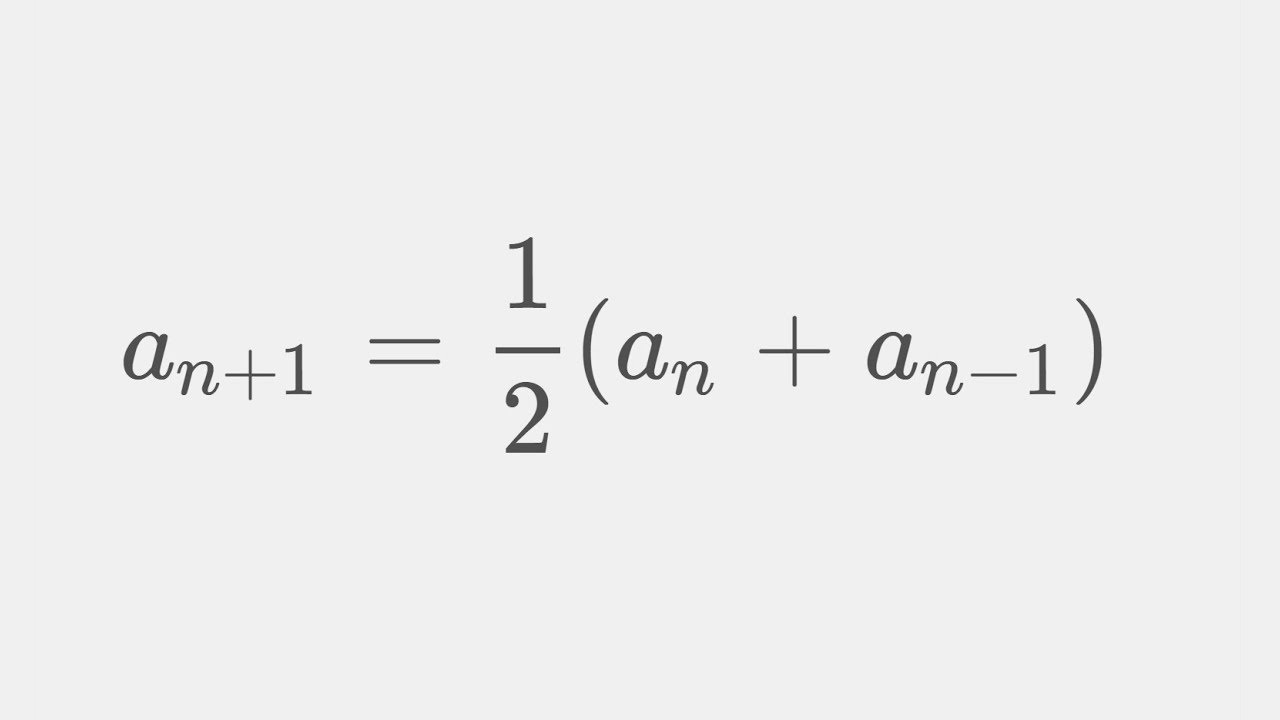
Difference Equations are typically introduced in an undergraduate differential equations course. So, we need to make the key distinction that DE's are continuous time while difference equations are discrete time. Most difference equations have the next generation x sub n plus 1, functionally dependent on the previous generation, x sub n. In this way, x 1 equals F of x 0, x 2 equals F of x 1, and so on. Different seeds, or initial values x 0, generate different orbits, shown by the distinct colors in these time-series plots. The discrete logistic model is used here primarily because of its rich dynamics. Notice that the four different relative growth rates produce four distinct long-term behaviors.
In a web diagram, we can illustrate an orbit by starting at the seed, x 0. F of x 0 yields x 1, which is the vertical height of the curve at x 0. The red "web" moves horizontally to the y equals x line, demonstrating that the output becomes the input. Every vertical movement is a function evaluation, and every horizontal movement is the output becoming the input for the next iterate. Because these movements are repeated over and over, it is typically looped using a computer. A fixed point is an x-value where F of x equals x, i.e. no change whatsoever. These are intersections between the dotted y equals x and the curve F of x. This first example of the discrete logistic has relative growth rate 0.8, implying the only nonnegative fixed point is zero. One can analyze its linear stability by evaluating F prime of zero. If the absolute value of F prime is less than 1, the fixed point is locally stable. If it is greater than 1, then it's locally unstable. And if it equals 1, then it is considered neutral and requires a more thorough analysis to determine stability. Notice that the orbits shown here approach zero confirming that it is in fact stable. Thus, the growth rate of 0.8 predicts population extinction.
This next example shows 2 nonnegative fixed points, zero and 4 over 9. The latter is stable since F prime of 4 over 9 is less than 1. Notice that all four orbits shown here are attracted to this stable fixed point. For growth rate 1.8, this model predicts nontrivial equilibrium.
Our third example has an unstable fixed point around 70 percent of the population. Notice in this case that orbits tend to approach periodic cycle. Although the discrete logistic can produce many different kinds of cycles, this example with growth rate 3.2 yields a 2-cycle between 51 and 80 percent of the population.
Finally, with growth rate 3.9, we observe no apparent pattern whatsoever. The fixed points are unstable, yet orbits do not seem to approach any sort of periodic cycle. This can be considered chaotic. It is a deterministic model with virtually unpredictable long-term behavior.
Повторяем попытку...

Доступные форматы для скачивания:
Скачать видео
-
Информация по загрузке: