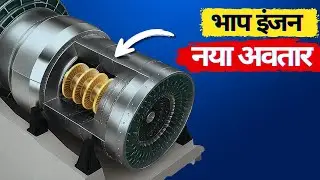
क्या S1500 Wind Turbine सोलर खत्म करेगा? | new solar technology | wind turbine | solar
Автор: Deepak chaudhary Nexus solar energy
Загружено: 2025-12-09
Просмотров: 37373
Описание:
Is the era of Solar Energy coming to an end? We all know that Solar Panels have one major weakness—they stop working at night. But China has just unveiled a revolutionary "Flying Wind Turbine" (S1500) that generates free electricity 24 hours a day, 7 days a week! 🎈⚡
Hello Friends! I am Deepak Chaudhary, and welcome to Nexus Solar Energy. Today, we are conducting a complete "post-mortem" of the world's largest and most unique energy invention—The S1500 Flying Wind Turbine. This is not a small drone; it is a massive airborne power plant the size of a basketball court that can single-handedly power 1,500 homes!
Does this technology actually work, or is it just another hype? Today, we will dive deep into the engineering, analyze the costs, and answer the biggest question: Should India shift from Solar Energy to Flying Turbines? This video contains a deep technical analysis, so make sure to watch until the end!
🚀 Video Highlights & Key Takeaways:
1. What is the S1500? (The Giant in the Sky) Imagine a structure as tall as a 13-story building floating in the air. Developed by Beijing Linyu Energy Technology, the S1500 is a massive helium-filled aerostat equipped with 12 powerful turbines. Unlike traditional windmills, this generator flies high among the clouds to produce electricity.
2. Ground vs. Sky (The Physics of Wind) Why go through the trouble of flying? Ground-level wind is turbulent due to trees, buildings, and mountains. However, at 1,000 meters altitude, we find 'Jet Streams'—winds that flow smoothly and constantly like a river. Physics dictates that if wind speed doubles, power generation increases by 8 times! This is why this flying turbine drastically outperforms traditional ground turbines.
3. Engineering Marvel (The Venturi Effect) The S1500 isn't just a balloon; its design utilizes a 'Duct' system that leverages the 'Venturi Effect'—funneling wind to increase speed and pressure. This allows it to generate 1.5 Megawatts (1500 kW) of power. considering the average Indian household load is 1kW, this single machine can power an entire small town.
4. Cost Analysis (Cheaper than Solar?) Traditional windmills require massive concrete foundations, steel towers, and cranes, costing crores. The S1500 requires no tower and no foundation. You simply load it onto a truck, fill it with gas, and launch it. The company claims it reduces costs by 30%. Most importantly, unlike Solar, it doesn't require expensive Battery Storage because it generates power all night long!
5. Is it Good for India? (Future Applications) Think about regions like Ladakh, Spiti Valley, or the Northeast, where solar panels get covered in snow during winter. This technology could be a blessing there. In disaster management scenarios—like cyclones or earthquakes where power grids fail—this portable power station can be deployed in 2 hours to power entire relief camps.
⏳ Timestamps (Chapters for Easy Navigation):
0:00 - Introduction: The Biggest Flaw of Solar Energy (Nighttime)
01:45 - The Reveal: What is the S1500 Flying Turbine? (Size & Specs)
03:30 - The Science Explained: Why Generate Power at 1km Altitude?
05:15 - Engineering Secrets: Venturi Effect & 12 Turbine Setup
07:00 - Gobi Desert Test: Did it Survive the Sandstorms? (Real Footage)
08:45 - Cost Comparison: Solar vs. Traditional Wind vs. S1500
10:30 - Why India Needs This? Solutions for Ladakh & Disaster Zones
12:15 - The Challenges: Safety Risks, Airspace & Cables
14:00 - Conclusion & Deepak Chaudhary's Verdict: Should Tata/Adani Invest?
🔍 Queries Solved in This Video :
We have answered all your burning questions in this detailed breakdown:
China's new flying wind turbine technology explained 2025.
How does the S1500 high-altitude wind turbine work?
Solar energy vs. Wind energy: Which is better for the future?
Price and specifications of the world's largest airborne wind turbine.
Can flying generators replace solar panels in India?
Future of renewable energy in India (2025-2030).
Beijing Linyu Energy Technology S1500 full review.
Cost of electricity generation: Airborne Wind vs. Solar.
Deepak Chaudhary's review of new energy technology.
Best power source for remote villages and islands.
Pros and cons of airborne wind energy systems (AWES).
Latest breakthrough in green energy generation.
Portable power stations for disaster relief in India.
Understanding Jet Stream energy potential.
📢 Connect with Deepak Chaudhary & Nexus Solar Energy
Disclaimer: This video is for educational and informational purposes only. The technical details and figures regarding the S1500 are based on publicly available data and claims made by the manufacturing company. Viewers are advised to conduct their own research before making any investment decisions in renewable energy.
Hashtags:
#FlyingWindTurbine #S1500 #FutureTech #SolarVsWind #DeepakChaudhary #NexusSolarEnergy #RenewableEnergy #GreenEnergy #Innovation #India #EngineeringMarvel #SustainableFuture
Повторяем попытку...

Доступные форматы для скачивания:
Скачать видео
-
Информация по загрузке: