X Christ's Epistle to Philadelphia
Автор: Shepherd's Fold Baptist Church
Загружено: 2020-09-07
Просмотров: 6
Описание:
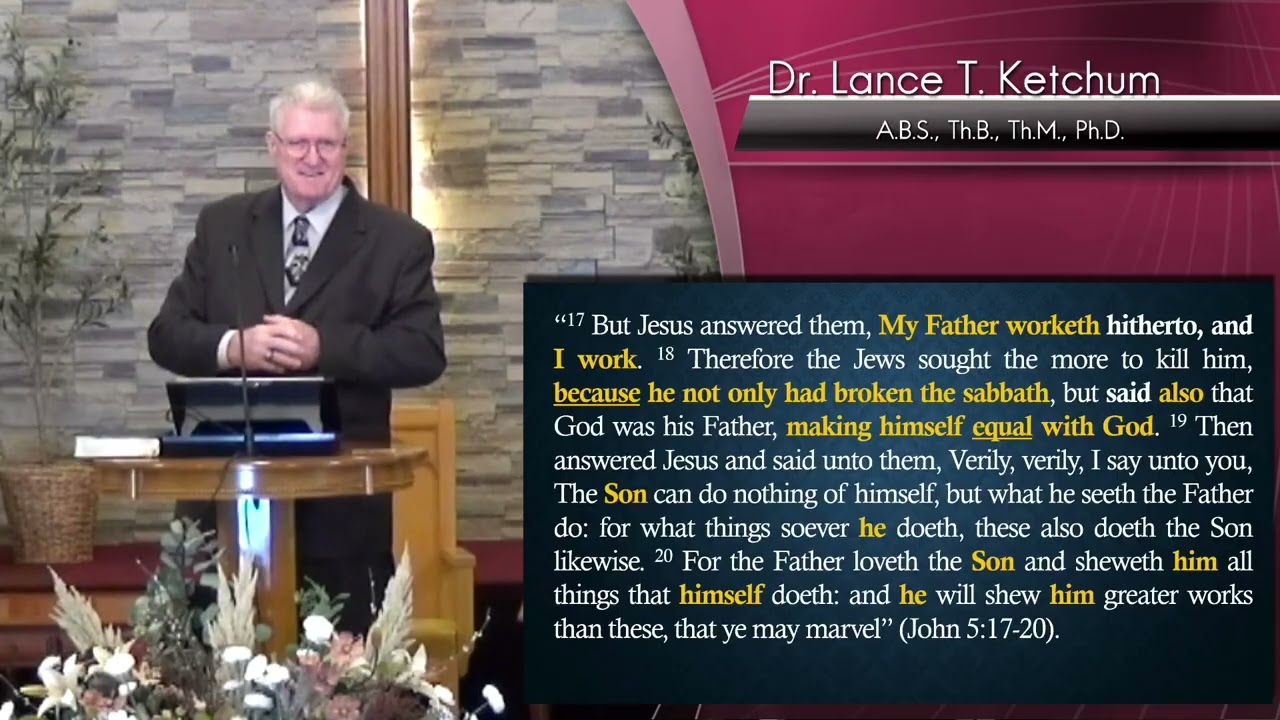
Unitarianism
Unitarians continue to claim they are Christians, even though they deny that Jesus was God incarnate in a human body. They believe Jesus was inspired by God in his moral teachings, and that Jesus is a savior, however that might be possible, but he is not a deity. Unitarianism is also known for the rejection of several other doctrines, including the doctrines of the curse of God upon the original Creation, all of humanity are conceived sinners, and the infallibility of the Bible. In this they agreed in most part with the Universalists, which would later lead to the creation of Unitarian Universalist churches.
In rejecting the infallibility of the Bible, their emphasis was then placed upon the ultimate role of reason in interpreting the Bible and the freedom of conscience in making ethical choices thereby giving credence and support to situation ethics. It is believed that the first Unitarian Church was established in 1774 on Essex Street in London, England spreading later into the New England states of what would become the United States of America. Unitarianism developed out of the Restoration Movement of the Reformation Movement. Unitarianism is connected theologically to ancient Arianism. Arianism was an influential heresy denying the divinity of Christ, originating with the Alexandrian priest Arius (A.D. 250 – 336). Arianism. maintained that the Son of God was created by the Father and was therefore not coeternal with the Father. Arianism has infiltrated almost every Christian denomination in the world thereby denying the Lordship of Jesus Christ.
The Grandville Sharp Rule of Greek syntax states that, “When the copulative KAI {and} connects two nouns of the same case, if the article HO {‘the’ as a definite article} or any of its cases precedes the first of the said nouns or participles, and is not repeated before the second noun or participle, the latter always relates to the same person that is expressed or described by the first noun or participle; i.e., it denotes a further description of the first-named person.” (A Manual Of The Greek New Testament, Dana & Mantey, p. 147; The words in {} are added.) An example is Titus 2:13. In this text “the great God and our Savior Jesus Christ” refer to the same Person. Another instance is II Peter 1:1.
“13 Looking for that blessed hope, and the glorious appearing of the great God and {no definite article} our Saviour Jesus Christ; 14 Who gave himself for us, that he might redeem us from all iniquity, and purify unto himself a peculiar people, zealous of good works” (Titus 2:13).
“Simon Peter, a servant and an apostle of Jesus Christ, to them that have obtained like precious faith with us through the righteousness of God and {no definite article} our Saviour Jesus Christ” (II Peter 1:1)
Повторяем попытку...

Доступные форматы для скачивания:
Скачать видео
-
Информация по загрузке: