REDOX REACTIONS IN TERMS OF ELECTRON TRANSFER REACTIONS PART 01
Автор: 7activestudio
Загружено: 2014-07-15
Просмотров: 22754
Описание:
For more information:
http://www.7activestudio.com
[email protected]
http://www.7activemedical.com/
[email protected]
http://www.sciencetuts.com/
[email protected]
Contact: +91- 9700061777,
040-64501777 / 65864777
7 Active Technology Solutions Pvt.Ltd. is an educational 3D digital content provider for K-12. We also customise the content as per your requirement for companies platform providers colleges etc . 7 Active driving force "The Joy of Happy Learning" -- is what makes difference from other digital content providers. We consider Student needs, Lecturer needs and College needs in designing the 3D & 2D Animated Video Lectures. We are carrying a huge 3D Digital Library ready to use.
REDOX REACTIONS: REDOX REACTIONS IN TERMS OFELECTRON TRANSFER REACTIONS
Half reactions that involve loss of electrons are called oxidation reactions. Similarly, the. half reactions that involve gain of electrons are called reduction reactionsWe have already learnt that the reaction.is redox reaction because in this reaction sodium is oxidised due to theaddition of either oxygen or moreelectronegative element to sodium.Simultaneously, chlorine, is reduced, theelectropositive element sodium has beenadded as sodium chloride, which is ioniccompound and perhaps better written asNa+Cl-- s.Development of charges on the speciesproduced suggests us to rewrite the reaction10 in the following manner :Each of the aboveprocesses can be considered as two separatesteps, one involving the loss of electrons andthe other the gain of electrons. Each of the above steps is called a halfreaction, which explicitly shows involvementof electrons. Sum of the half reactions givesthe overall reaction :In reactions 10sodium, which is oxidised, acts asa reducing agent because it donates electronto each of the elements interacting with it andthus helps in reducing them. Chlorineis reduced and act as oxidisingagent because it accept electrons fromsodium. Thus,
Oxidation: Loss of electron s by any species.
Reduction: Gain of electron s by any species.
Oxidising agent :Acceptor of electron s.
Reducing agent :Donor of electron s .
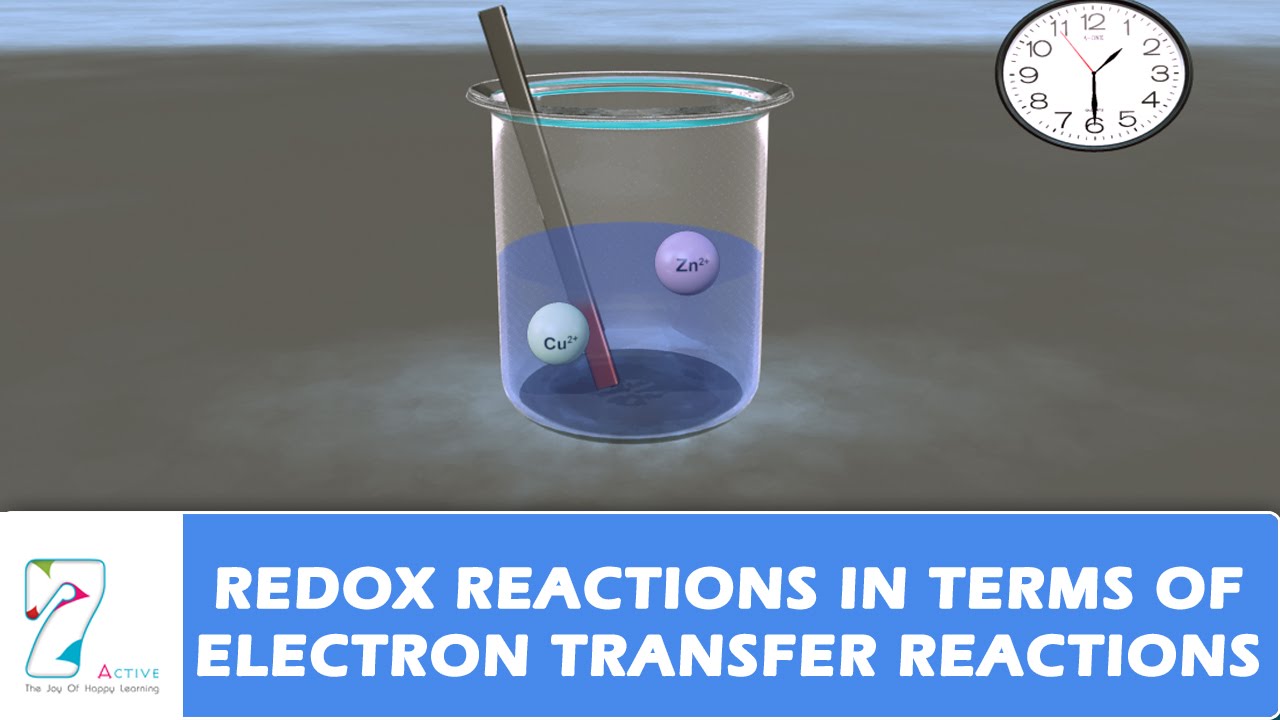
Competitive Electron TransferReactions. Place a strip of metallic zinc in an aqueoussolution of copper nitrate for about one hour. You may notice that thestrip becomes coated with reddish metalliccopper and the blue colour of the solutiondisappears. Formation of Zn2+ ions among theproducts can easily be judged when the bluecolour of the solution due to Cu2+ hasdisappeared. If hydrogen sulphide gas ispassed through the colourless solutioncontaining Zn2+ ions, appearance of white zinc. sulphide, ZnS can be seen on making thesolution alkaline with ammonia.The stateof equilibrium for the reaction represented byequation 11. For this purpose, let us placea strip of metallic copper in a zinc sulphatesolution. No visible reaction is noticed and. attempt to detect the presence of Cu2+ ions bypassing H2S gas through the solution toproduce the black colour of cupric sulphide,CuS, does not succeed.
Повторяем попытку...
Доступные форматы для скачивания:
Скачать видео
-
Информация по загрузке: