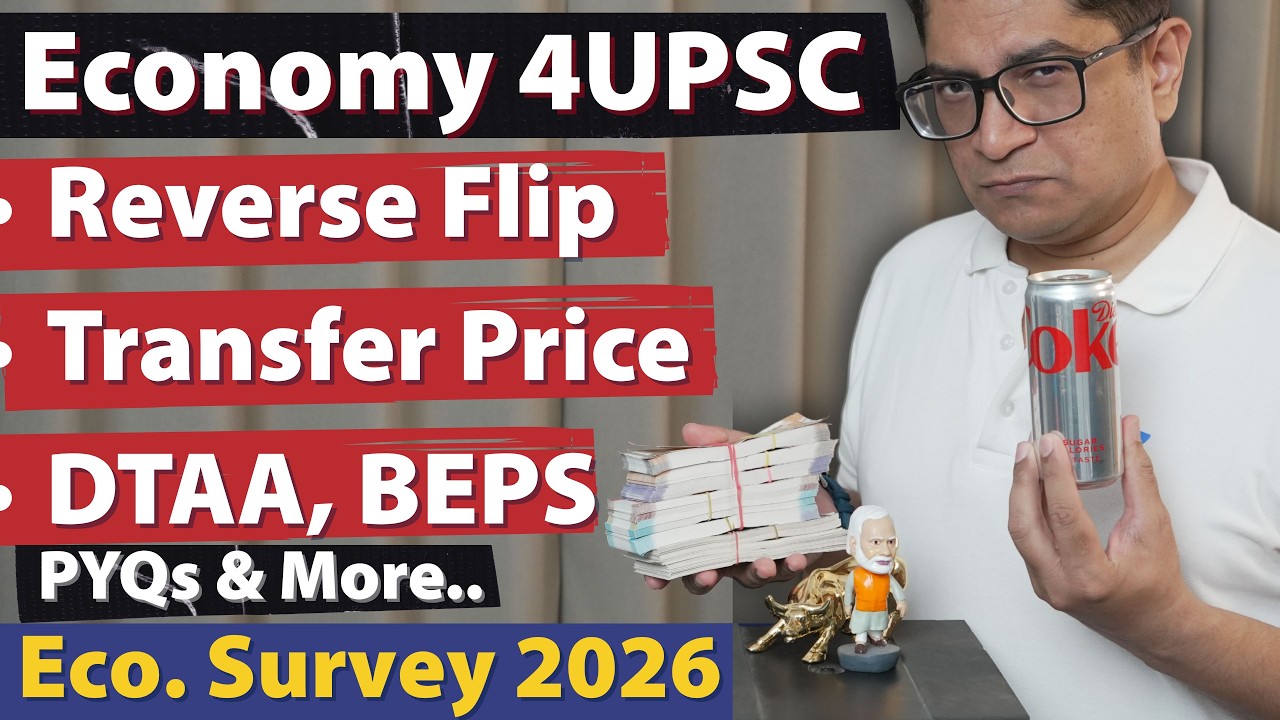
Economy terms: Reverse Flipping, Transfer Pricing, BEPS, DTAA & more for UPSC by Dr. Mrunal Patel
Автор: Mrunal Patel Unacademy
Загружено: 2026-02-20
Просмотров: 5062
Описание:
1. 👩🏻🏫 Prelims + Mains Coaching: https://unacademy.com/goal/upsc-civil...
2. 😵💫 UPSC Form filling helpline https://docs.google.com/forms/d/e/1FA...
3. 📰 Mrunal’s Win26 Economy Series mrunal.org/win26
4. 📘 Amazon pe Mrunal’s Economy Book: https://amzn.to/3Jb5rf7
Timestamps
0:00 Intro — Tax Jurisdiction & Scope
1:31 Transfer Pricing — PepsiCo Example
3:13 Exports — GST Customs, Corporation Tax
4:00 Parent/Subsidiary/Sister — Price Manipulation
5:13 Authority for Advance Ruling (AAR)
6:31 Economic Survey on Transfer Pricing & AAR
6:58 CBDT vs CBIC — Need for Convergence
8:15 Round Tripping — Mauritius Route
9:02 DTAA Explained
9:42 Capital Gains Tax & Round Tripping
10:22 FDI 36% from Mauritius & Singapore
11:51 Flipkart — Reverse Flipping
13:11 Vodafone Case — Indirect Transfer
14:00 Retrospective Tax & Rollback
14:22 Principal Purpose Test in DTAA
15:02 BEPS — Base Erosion & Profit Shifting
15:55 OECD & Global Minimum Tax 15%
16:26 Previous Year UPSC Questions
18:00 Free Economy Lecture Series 2026
Description
In this lecture, Dr. Mrunal Patel — UPSC Educator and Economy Expert — explains key international taxation concepts from the Economic Survey. Essential for UPSC CSE, SSC-CGL, State PSC, Banking, IBPS, RBI Grade B, CAPF, CDS, ACIO, APFC, and all competitive exams testing Economy.
Topics covered:
Transfer Pricing — how MNCs manipulate prices between parent, subsidiary, and sister companies to reduce taxable profits in India. Explained with a Rs.100 product example.
Authority for Advance Ruling (AAR) — binding quasi-judicial mechanism under Income Tax, GST, and Customs law that resolves transfer pricing disputes in advance.
CBDT vs CBIC — Economic Survey's recommendation for convergence between direct and indirect tax authorities.
Round Tripping — Indian black money routed via Mauritius or Cayman Islands shell companies, reinvested in India as FDI to exploit DTAA and avoid capital gains tax. Economic Survey: ~36% of India's FDI came from Mauritius and Singapore.
DTAA (Double Taxation Avoidance Agreement) — what it means, how it works, and how it is misused.
Reverse Flipping — how startups like Flipkart used Singapore holding structures for DTAA benefits and are now restructuring back to India for IPO access.
Vodafone Case — indirect ownership transfer via Cayman Islands, Supreme Court verdict, retrospective tax, Cairn Energy row, and eventual rollback.
BEPS (Base Erosion and Profit Shifting) — MNCs inflating fake costs to shift profits to tax havens. OECD's response and Global Minimum Tax of 15%.
Principal Purpose Test (PPT) — 2025 amendment making DTAA benefits conditional on genuine investment proof.
Previous Year UPSC Questions (2016, 2022) solved with option-elimination method.
Alternative Titles
1. How MNCs Evade Taxes in India? Transfer Pricing, DTAA, BEPS | UPSC Economy 2025-26 | Mrunal Patel
2. Tax Havens, Shell Companies & Round Tripping | UPSC Economy Lecture | Dr. Mrunal Patel
SEO Tags
Transfer Pricing UPSC, Round Tripping Economy, DTAA India, Double Taxation Avoidance Agreement UPSC, BEPS UPSC, Base Erosion and Profit Shifting, Tax Haven India, Shell Company UPSC, Authority for Advance Ruling, Place of Effective Management, Capital Gains Tax UPSC, Vodafone Tax Case UPSC, Flipkart Reverse Flipping, Retrospective Tax India, Global Minimum Tax UPSC, CBDT CBIC difference, MNC Tax Evasion India, Mrunal Economy Lecture, Mrunal Patel UPSC, UPSC Economy 2025 2026, UPSC Prelims Economy, UPSC Mains GS3 Economy, SSC CGL Economy, RBI Grade B Economy, Indian Economy Current Affairs, Corporate Tax India, Principal Purpose Test DTAA, Unacademy UPSC Economy, Free UPSC Lecture Economy
Повторяем попытку...
Доступные форматы для скачивания:
Скачать видео
-
Информация по загрузке: