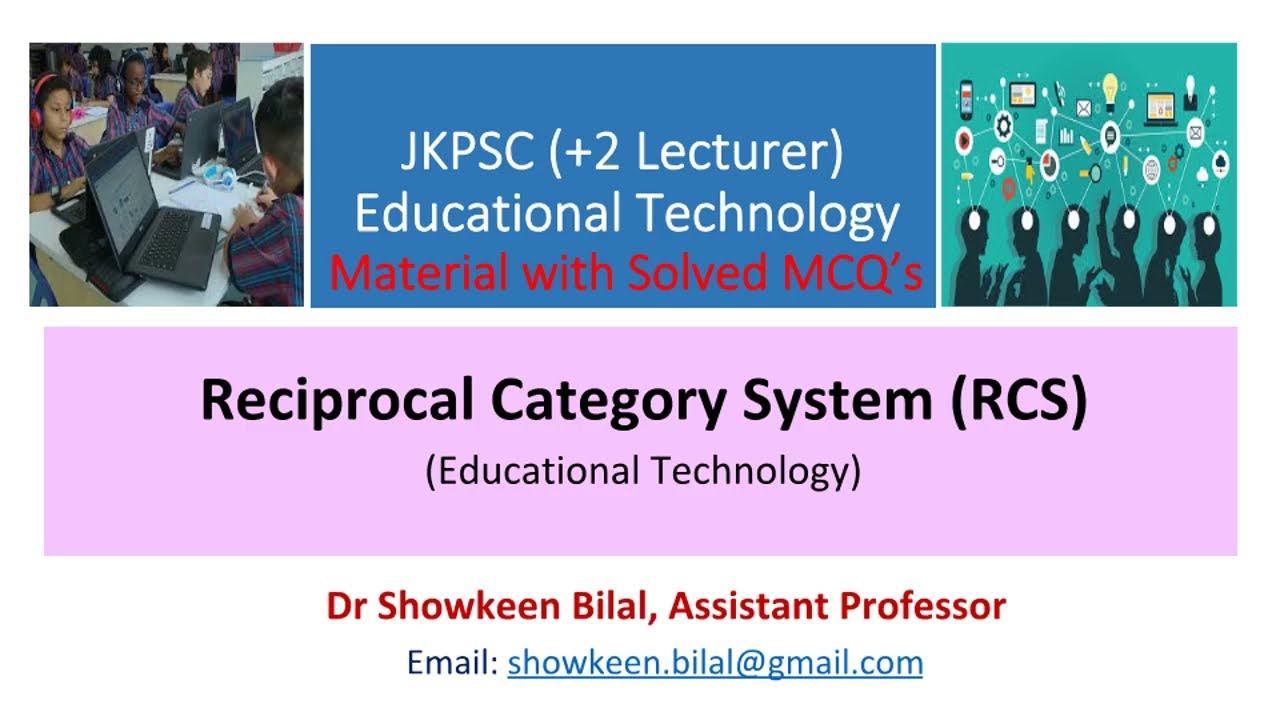
Reciprocal Category System (RCS) | Classroom Interaction Analysis | MCQs for Teaching Exams
Автор: Education and Teacher Education (UGC NETJRF)
Загружено: 2025-07-10
Просмотров: 1224
Описание:
Dear Viewers,
In today’s lecture, we are going to learn about the Reciprocal Category System (RCS), an important systematic classroom observation technique used to analyse teacher–student verbal interaction.
👉 Please watch the entire video carefully, as it is followed by important MCQs based strictly on the presentation.
🔹 Introduction to Reciprocal Category System (RCS)
Teaching–learning is a two-way interactive process.
The Reciprocal Category System (RCS) is one of the systematic observation techniques developed to analyse and assess verbal interaction between teachers and students in the classroom.
RCS was developed as an alternative to Flanders Interaction Analysis Categories (FIAC) to overcome its limitations.
While FIAC focused mainly on teacher verbal behaviour and grouped most student talk into limited categories, RCS provides a balanced and reciprocal account of classroom interaction by giving equal importance to both teacher and student contributions.
🔹 Development of Reciprocal Category System
During the 1950s and 1960s, educational researchers and psychologists showed increasing interest in scientific analysis of classroom verbal behaviour.
Ned A. Flanders (1960) developed FIAC, classifying classroom talk into 10 categories.
However, FIAC was criticised for:
Over-emphasising teacher behaviour
Grouping student talk into very few categories
Researchers argued that classrooms are social systems where:
Teacher and student behaviours mutually influence each other
Teaching is not merely information delivery, but a reciprocal communication process
Recognising this, Elizabeth Hunter, Edmund Amidon, and Dorothy Smith (1967) developed the Reciprocal Category System (RCS) at the University of Minnesota.
🔹 Purpose of Reciprocal Category System (RCS)
According to Hunter, Amidon, and Smith (1967),
the core purpose of RCS is to study teaching as an interactive process in which teacher and student behaviours respond to and influence each other.
🔹 Specific Objectives of RCS
1️⃣ To highlight the reciprocal nature of teaching
Teaching is not only content delivery but involves active participation of both teachers and students.
2️⃣ To provide a balanced analysis of classroom interaction
Unlike FIAC, RCS gives equal emphasis to teacher and student verbal behaviour, recognising students as active contributors.
3️⃣ To support reflective teaching practices
By analysing interaction patterns, teachers can reflect on how their:
Questioning
Explaining
Supporting behaviours
shape student engagement.
4️⃣ To improve teacher education and training
RCS is a valuable tool in teacher education programmes, helping trainee teachers understand:
Classroom dynamics
Effects of their behaviour on students
5️⃣ To enhance classroom communication
RCS identifies verbal behaviours that facilitate or hinder effective communication, helping teachers create a democratic, interactive, and supportive classroom environment.
Useful for Exams
✔ UGC NET / JRF (Education)
✔ B.Ed & M.Ed
✔ JKPSC / JKSSB
✔ Teacher Recruitment Exams
✔ Teaching Skills & Classroom Interaction Units
🙏 Thank you for watching
📌 Don’t forget to LIKE, SHARE & SUBSCRIBE
🎓 Education and Teacher Education
(NET / JRF / JKPSC)
🔖 Suggested Hashtags
#ReciprocalCategorySystem
#RCS
#ClassroomInteraction
#TeachingLearningProcess
#UGCNETEducation
#BEd
Повторяем попытку...
Доступные форматы для скачивания:
Скачать видео
-
Информация по загрузке: