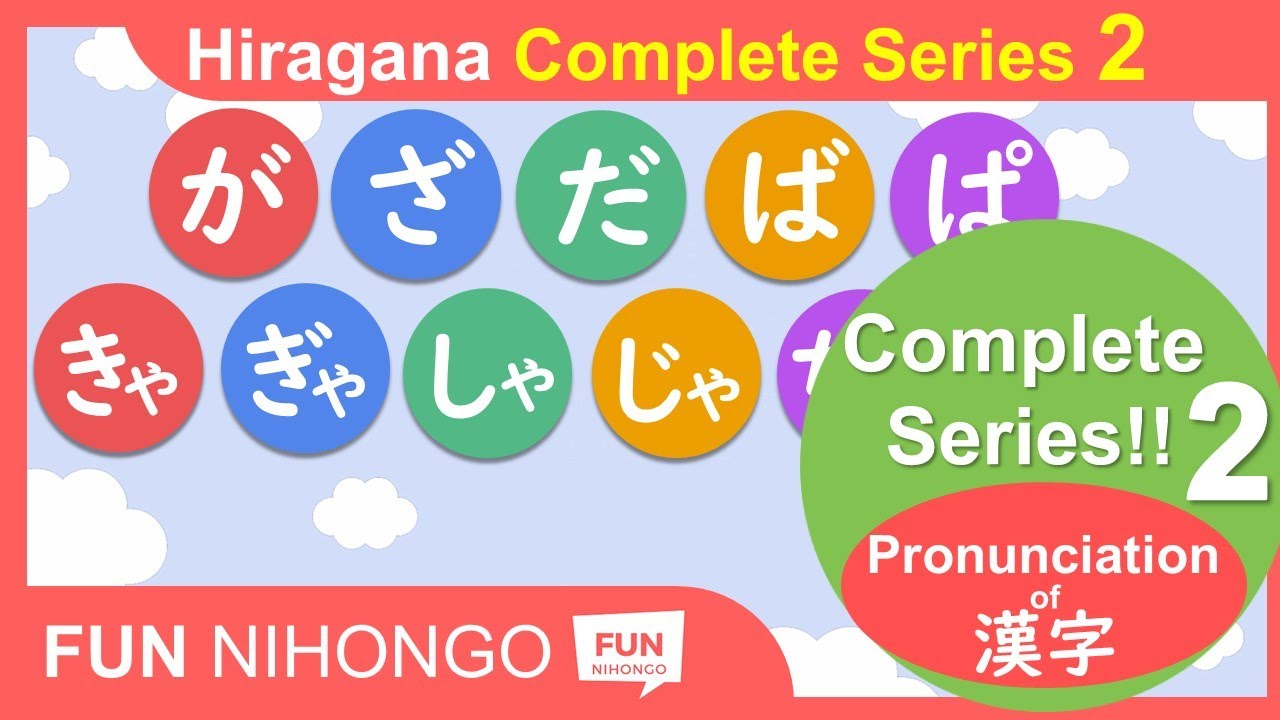
Kanji! Complete Series 2 AIUEO Song Ga, Za, Da, Ba, Pa, Kya, Gya, Sha, Ja, Cha row 150 words 30min!
Автор: FunNihongo
Загружено: 2023-07-29
Просмотров: 19087
Описание:
🌟📝🎬Lyrics for AIUEO Complete Series 2 (inc. links for each video): https://drive.google.com/file/d/1VJrd...
🌟Time Stamps
0:00 Opening
0:05 Ga row
2:40 Za row
5:15 Da row
7:51 Ba row
10:26 Pa row
13:02 Kya row
15:37 Gya row
18:14 Sha row
20:49 Ja row
23:25 Cha row
🌟The Complete Series 2! of AIUEO songs with Romaji subtitles has been released! With the romaji, you can learn the natural pronunciations of Japanese words easily. Romaji is a phonetic symbol written in the English alphabet, and it shows how to pronounce Japanese sounds easily and clearly. Within 30 mins, you can learn how to write (including stroke order) and pronounce all Hiragana Alphabets. This video will also help you learn 150 words starting with those characters!
This video is also good learning material for beginner-level and intermediate-level Japanese learners.
With a song like this, it will be easier to remember all the Hiragana! Enjoy!
🌟 Composer/Arranger: Mochi Pro LLC
https://www.mochipro.co.jp
Masahiro Mochizuki
/ receptorjp
🌟Animiation: Aigamokobo https://aigamokobo.com
🌟 Notes for Romaji Lyrics!!
For the subtitles of this video, the Hepburn style is used for the ‘Romaji (Roman letter)’ spelling.
‘Romaji’ is a phonetic symbol written with the English alphabet to show how to pronounce Japanese sounds and help Japanese learners pronounce Japanese words more easily.
For the Hepburn ‘Romaji’ subtitles/lyrics used here, please note that some modifications have been made to help you learn Japanese more easily and clearly.
(1) Long vowels
For long vowels, double vowels are used instead of macrons.
ā→aa
ī→ii
ū→uu
ē →ee
ō→oo
(Eg.) gakkoo for gakkō
ginkoo for ginkō
gitaa for gitā
(2) Double consonants
Assimilated sounds like ‘tt’ are shown by double consonants.
(e.g.) gakkoo (school)
(3) ‘N’
When ‘n’ comes before ‘b’, ‘p’ and ‘m’, ‘m’ are usually used in the Hepburn style. However, ‘n’ is used for all cases for simplicity (even when ‘n’ comes before ‘b’, ‘p’, and ‘m’).
(e.g.) jumbi for junbi (preparation)
tempura for tenpura
Повторяем попытку...
Доступные форматы для скачивания:
Скачать видео
-
Информация по загрузке:
![[30 min Complete Series with Romaji Lyrics] Learn how to read/write Japanese Hiragana AIUEO Song](https://imager.clipsaver.ru/bfFVkSfkqHo/max.jpg)

![[22년] 영어1(지학사) 1과 단어_01](https://imager.clipsaver.ru/AkHUROhRIVc/max.jpg)





![[5min] Months of the Year Song in Japanese Romaji -Japanese seasonal events Japanese culture](https://imager.clipsaver.ru/8YQBt5DiE00/max.jpg)