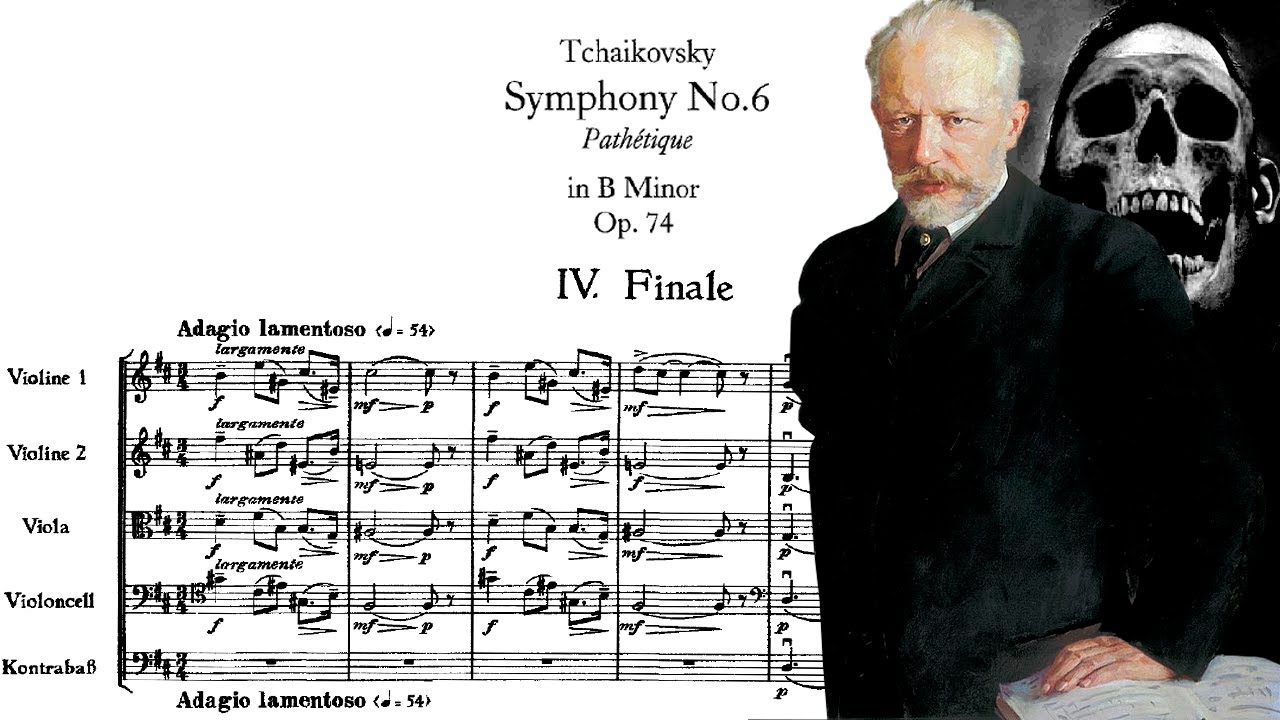
Tchaikovsky - Symphony No. 6 in B minor, Op. 74: IV. Adagio lamentoso (Score and Analysis)
Автор: Arne Korpen
Загружено: 2025-03-30
Просмотров: 116
Описание:
00:00 The false, "forcibly triumphant" march of the previous movement collapses under the weight of personal emotional turmoil. A descending, wailing phrase in the strings emerges, reminiscent in character of the main theme of the first movement, with its harmonic emphasis on dissonant chords, appoggiaturas, and speech-like intonations. It also lingers with a questioning intonation on the dominant, further highlighted by the "response" of the horn on an F# note. Its suffering character is further emphasized by the voice crossing, creating a sense of a fragmented, incoherent, and faltering phrase.
Following this, a majestic, mournful-triumphant theme unfolds. Alongside its gravitation towards diminished harmonies, there is a strong emphasis on painful, weeping suspensions of minor triads. This theme has a long-wandering nature—B minor does not achieve a cadential affirmation here; instead, it appears only within the secondary functions of other tonalities. The first phrase ends lingering on the subdominant. The second statement of the wailing phrase is intensified by the addition of nervous diminished harmonies in 16th-note passage. The second statement of the mournful theme establishes the tonic only “in passing,” once again lingering on the subdominant, which gradually transitions into the dominant of the secondary theme. This time, its majestic character gives way to a palpable exhaustion—sequential ascents are now replaced by an unrelenting descent, embodying sigh-like intonations, pulling the music down into the grim, grave-like lower register of the orchestra. The most expressive moment of this passage is the agonizing suspension of the tonic of E minor by the bassoon with the ninth, creating a piercing minor second dissonance in the upper voices (letter B).
04:23 Under the relentless dominant triplet rhythm, the most heartbreaking theme of the entire symphony unfolds. A comparison with the secondary theme of the first movement suggests itself—back then, it was an island of relative stability and joy. This theme, however, seems to express the feeling of irrevocable loss, as if memories of all that was once beautiful flood the consciousness in a single moment, accompanied by the realization that things will never be as good as they once were. Like the other significant themes of the symphony, it is built on long, lamenting intonations (here, perhaps, reaching their peak in expressive, speech-like quality) with heavy suspensions. The principle of suspensions is expanded to such an extent that, at times, the entire harmony seems to “waver,” as if the heavens themselves are about to collapse under unbearable wailing. A counter-melody further destabilizes the theme by shifting its inclination from major to minor. The second statement is intensified by the introduction of diminished harmonies, creating greater tension towards the tonic. The theme, now an octave higher with denser orchestration, strives for a climactic affirmation in major but instead crashes into a B minor climax with triplet rhythms and turbulent string passages.
07:49 A development section begins, in which the secondary theme is affirmed in the main key, divided by three grand pauses. The long wails here give way to an almost frenzied howl of despair, again rich with suspensions. Fragments of the main theme appear—its initial phrase, with each iteration, acquires an increasingly nervous diminished prefix. At one point, the suspension intonation seems to crystallize, forming a large-scale sequence that leads to a grand climax in A minor. This moment unmistakably echoes the climactic sections of the first movement: there is a direct juxtapunction of the descending string sequence with strong-beat appoggiaturas resolving downward and the ascending chromatic line in the brass. The sharpest point of tension arises at the crossing of these two lines, after which the music erupts into the reprise of the main theme. In a brutal transformation, the wailing phrase returns, met by an ominous or perhaps sarcastic reply from the stopped horn. After the decline, brief, laconic moans—suspensions—momentarily crystallize.
12:22 A trombone chorale, imitating a male choir and referencing similar episodes from the first movement, along with the first appearance of the tam-tam in the symphony, likely serve as harbingers of death.
13:36 The coda establishes the dominance of B minor, subordinating the secondary theme. Here, diminished subdominant tendencies prevail, and the triplet pedal point firmly rests on the tonic rather than the dominant. After the final, stern, and deathly grave presentation of the theme by the cellos, a plagal cadence confirms B minor, followed by a gradually slowing ostinato figure in the double basses. This figure fades to the softest possible piano (marked dying away), unmistakably evoking the association of a heartbeat coming gradually to a stop.
Повторяем попытку...
Доступные форматы для скачивания:
Скачать видео
-
Информация по загрузке: