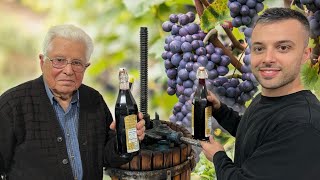
Chateau Margaux 1995 Bordeaux Trophy Wine Review (1st Growth)
Автор: Trophy Wine Hunter
Загружено: 2025-01-18
Просмотров: 1603
Описание:
The history of Chateau Margaux starts in the 12th century with a property was known under the name of “La Mothe de Margaux,” which was reserved for use by royalty (this was a separate site, not the existing Chateau Margaux vineyards). Successive owners of La Mothe de Margaux were various people of noble birth. When the Lestonnac family took over, the estate started resembling the existing Chateau Margaux property today. Successive owners continued to develop and grow the vineyard site and by the end of the 17th century, Chateau Margaux was about 265 hectares. One-third of that acreage was cultivated for grapes to produce wine. The remainder was devoted to parkland, greenery, and trees. The current vineyards is by and large this same as in the 17th century.
Following the confiscation of the estate during the French revolution, Chateau Margaux fell into a dilapidated state. In 1810, the Marquis de la Colonilla reinvigorated the estate and hired the architect Louis Combes to design a new chateau and cellars that are still used today at Chateau Margaux.
Chateau Margaux introduced bottling the wines starting in 1924 as a guarantee of authenticity for buyers. The depression caused the chateau to stop estate bottling until 1949. The Ginestet family purchased a portion of Chateau Margaux in 1934 and became the sole owner of Chateau Margaux in 1949. The Ginestet family was forced to sell Chateau Margaux to Andre Mentzelopoulos in 1977. At that time, Bordeaux wine prices were plummeting and the chateau has large debts.
Once the new owners took over, renovations were undertaken to modernize the winemaking facilities and cellars which were completed in 1982. In 1983, Paul Pontallier became the technical director of Chateau Margaux. He led Chateau Margaux to become one of the first estates to practice green harvesting, reducing their yields while increasing concentration in their wines.
Paul Pontallier served as the director of Chateau Margaux for 30 years until his death in 2016. 2015 was the final vintage of Chateau Margaux under Paul and to honor his achievements with Chateau Margaux, a special, etched, screen-printed, black label was produced for this vintage.
In 2009, Chateau Margaux : also added a gravity fed reception area and new vats. In 2015, Chateau Margaux completed a massive renovation of their cellars.
Philippe Bascaules was brought back to Chateau Margaux to replace Paul Pontallier in 2017 (Philippe Bascaules was previously the technical director for Chateau Margaux).
Chateau Margaux has 82 hectares of vineyard that is planted to 75% Cabernet Sauvignon, 20% Merlot, 3% Petit Verdot and 2% Cabernet Franc for the red wine grapes.
In order to combat global warming, between 1%-1.5% of their vines are now being planted from their south-west exposure (which maximizes sun and ripeness) to a north-east exposure, which provides cooler, more shaded conditions.
Vinification takes place in vats that are a combination of wood and stainless steel. They have 24 wood, 150 hectoliter vats and 95 stainless-steel tanks that range from 5 hectoliters to 180 hectoliters. The wine is aged in 100% new oak for 18-24 months, depending on the quality and character of the Bordeaux vintage. Chateau Margaux is one of the few Bordeaux estates with their own cooperage on the property.
Chateau Margaux has been involved in making sure that consumers purchase only, genuine bottles of Margaux since 1989, when they began laser etching their bottles. In 2011, Chateau Margaux strengthened their anti-counterfeiting program with the addition of a prooftag system.
The 1995 Margaux is a blend of 75% Cabernet Sauvignon, 17% Merlot, 5% Petit Verdot and 3% Cabernet Franc. It was aged 24 months in 100% new oak.
For more information about the winery, please visit their website at https://www.chateau-margaux.com/en
Повторяем попытку...

Доступные форматы для скачивания:
Скачать видео
-
Информация по загрузке: