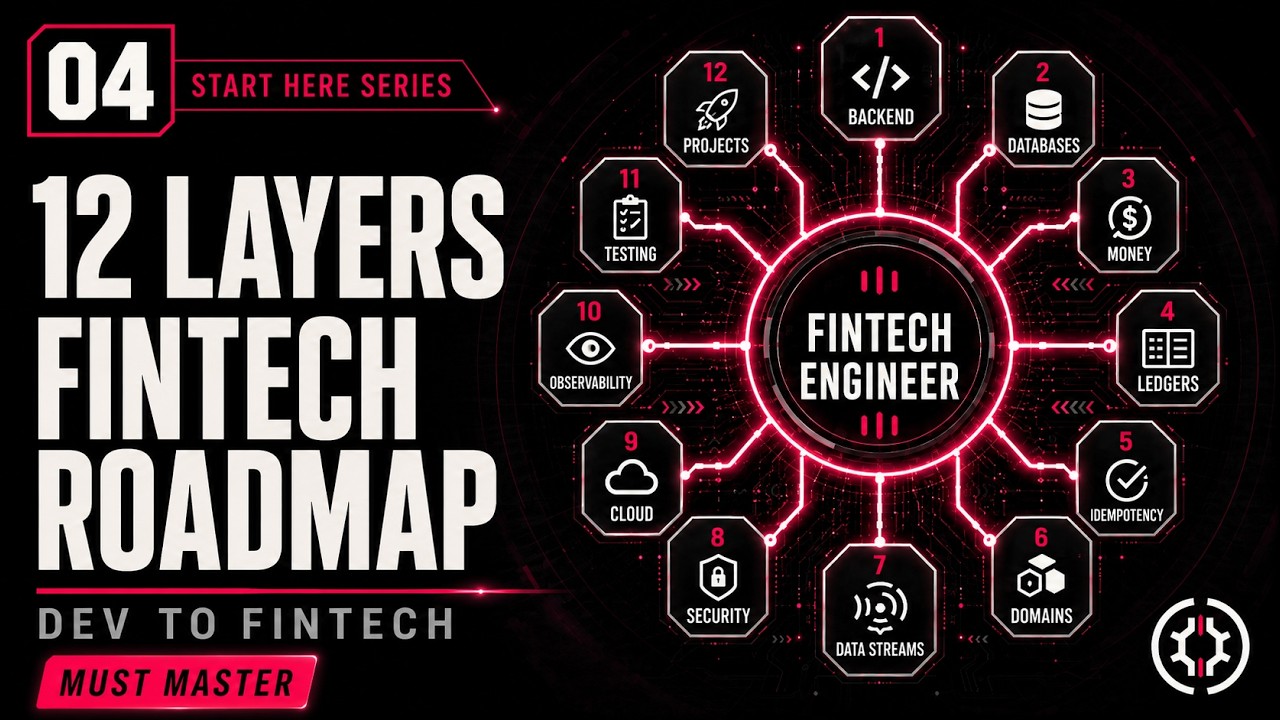
The 12 Layers of FinTech Engineering (Software Developer to FinTech)
Автор: The Fintech Builder
Загружено: 2026-08-12
Просмотров: 2533
Описание:
Transitioning from software engineering into FinTech isn't about memorizing syntax or learning a new programming language—it's about understanding financial precision, domain invariants, ledger architecture, and system failure modes.
In this guide, we break down the 12-Layer FinTech Engineering Roadmap from backend fundamentals all the way to production-ready financial systems. Every layer builds directly on top of the one below it.
🌐 Domain Atlas & Learning Resources
Follow along and map these engineering layers to 49 canonical territories on The Fintech Builder Domain Atlas:
Fintech Builder Domain Atlas: https://thefintechbuilder.com/domain-...
Fintech Builder Knowledge Library: https://thefintechbuilder.com/library
Fintech Builder Interactive Labs: https://thefintechbuilder.com/labs
⏱️ Video Timestamps & Roadmap Breakdown
00:00 - Introduction: The FinTech Learning Paradox
Why most developers stall when entering FinTech and how to choose the right starting layer.
00:34 - Layer 01: Backend Engineering
System boundaries, HTTP limits, queues, workers, and request hop lifecycle tracking.
01:09 - Layer 02: Relational Database Core
Database-enforced schema constraints, isolation levels, row locking, and atomic transactions.
01:43 - Layer 03: Money Representation
Why money is never a floating-point number. Minor units, integer math, and ISO 4217 exponents (USD, JPY, KWD).
02:07 - Layer 04: Ledgers & Auditability
Double-entry bookkeeping, balanced debit/credit pairs, derived balances, and deterministic audit trails.
02:37 - Layer 05: Reliability & Idempotency
Handling network failures, request retries, idempotency keys, and preventing duplicate charges.
02:57 - Layer 06: Domain Deep Dives
Picking one domain and going deep:
• Payments: Auth, capture, chargebacks, settlement chains
• Banking: Core accounts, transfers, interest accrual, reconciliation
• Lending: Credit decisioning engines, risk pricing, schedules
• Markets: Trades, order books, tick data, T+1 settlement
• Wealth: Portfolio composition, rebalancing, performance metrics
04:13 - Layer 07: Financial Data Streams
Normalizing event shapes across trades, quotes, authorizations, and settlements (Market Data Engineering territory).
04:35 - Layer 08: Security & Access Control
3-Gate pipeline: Identity (Who are you?), Permission (What can you do?), and Context (Should this action happen right now?) (Financial Cybersecurity territory).
04:56 - Layer 09: Cloud & Distributed Systems
Durable FIFO queues, event buses, and why modular monoliths beat tangled microservices.
05:18 - Layer 10: Financial Observability
Moving beyond CPU/RAM metrics to watch the health of the money: decline rates, settlement delays, ledger drift, and reconciliation mismatches.
05:39 - Layer 11: Testing Financial Invariants
Testing business truth (Debits = Credits, Sum = 100%, Reversal restores balance) and stress-testing edge cases (negative, out-of-order, oversized, closed market).
06:14 - Layer 12: Production Projects
Building systems that prove your knowledge:
Wallet & Double-Entry Ledger System
Payment Gateway Simulator
Market Data Pipeline
Portfolio Analytics Engine
07:20 - Conclusion: The Real Difference in FinTech Engineering
"A developer asks how to implement this. A FinTech engineer asks what the rule means, how the system should behave, and how we prove it was correct."
🔑 Key Engineering Takeaways
Money is Not a Float: Store currency using minor integer units (e.g., cents) or arbitrary-precision decimal contracts.
Double-Entry Enforcement: Every movement of value must have an equal and opposite entry (Debits = Credits).
Idempotency by Design: Assume every request will be retried; enforce single-execution guarantees at write-time.
Context Matters: A raw number (12.50) is meaningless without unit, currency, scale, and context (balance vs. price vs. spread).
Watch the Money, Not Just the Machine: Standard server uptime doesn't catch settlement delays or un-reconciled ledger drift.
📌 Connect & Explore Further:
• Website: https://thefintechbuilder.com
• Domain Atlas: https://thefintechbuilder.com/domain-...
Повторяем попытку...
Доступные форматы для скачивания:
Скачать видео
-
Информация по загрузке: