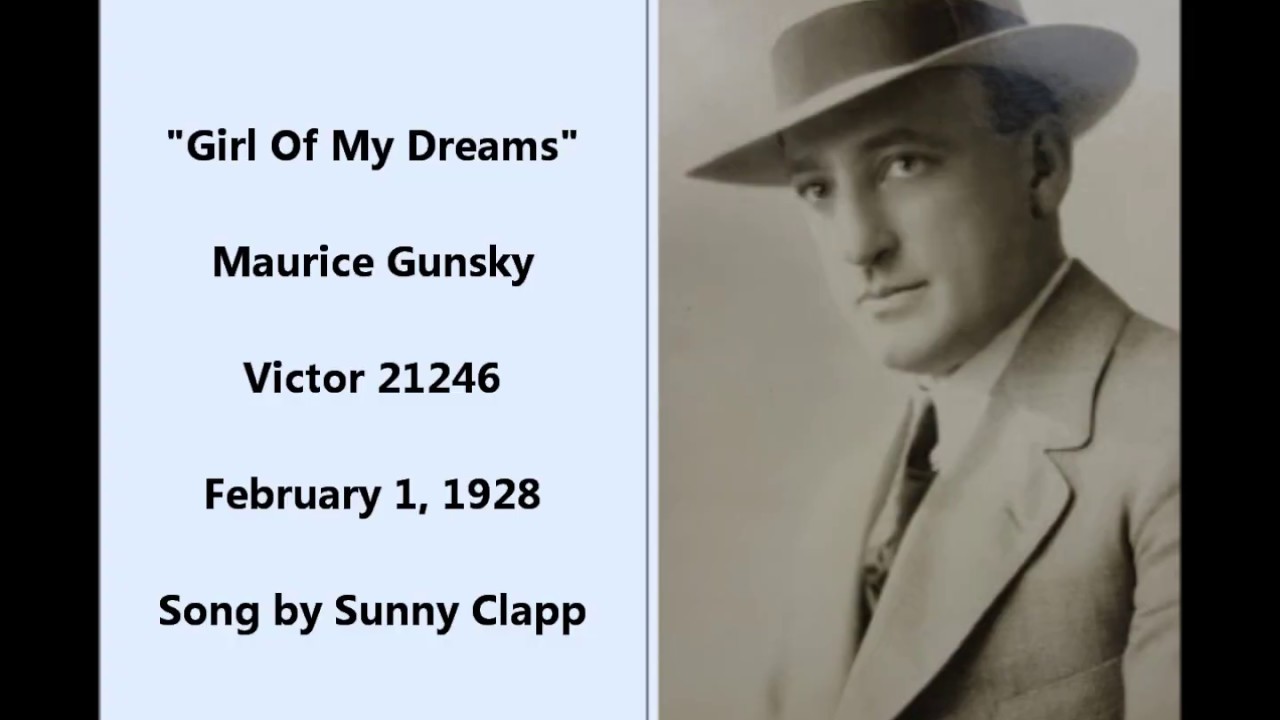
"Girl Of My Dreams" Maurice Gunsky on Victor 21246 (1928) Sonny Clapp song = San Francisco tenor
Автор: Tim Gracyk
Загружено: 2020-06-17
Просмотров: 338
Описание:
Dear, it seems years since we parted,
Years full of tears and regret;
I've been alone brokenhearted,
Trying so hard to forget:
Girl of my dreams I love you, honest I do,
You are so sweet,
If I could just hold your charms again in my arms,
Then life would be complete;
Since you've been gone dear, life don't seem the same,
Please come back again.
And after all's said and done, there's only one,
Girl of my dreams, it's you.
It's strange how life deals you sorrow,
Sunshine and joy always nigh;
We live and learn for tomorrow,
But sometimes the learning comes high:
Girl of my dreams I love you, honest I do,
You are so sweet,
If I could just hold your charms again in my arms,
Then life would be complete;
Since you've been gone dear, life don't seem the same,
Please come back again.
And after all's said and done, there's only one,
Girl of my dreams, it's you.
"Girl Of My Dreams" is sung by Maurice Gunsky on Victor 21246.
Recorded on February 1, 1928.
Song by Sonny Clapp.
Maurice J. Gunsky lived from 1888 to 1945.
He enjoyed equal success as a songwriter and singer. He was never a star, nor did he write songs that are remembered today, but he was popular in the San Francisco area in the 1920s, and he wrote songs covered by many artists.
The tenor's full name was Maurice Jacob Gunsky. He was born on August 10, 1888, into a family of five siblings: Louis, Amelia, Rachel, Maurice, and Sadie. The family lived in Petaluma, nearly 40 miles outside San Francisco.
His father died in 1900 when Maurice was age 12, and the family needed an income, so young Maurice worked hard in his early years to provide that income. He became a printer's apprentice, then a pressman who was a member of the San Francisco Printing Pressman's Union No. 24.
The San Francisco Chronicle newspaper tells of his performance for B'rith Abraham in San Francisco in 1909, suggesting Gunsky was Jewish.
His name is on sheet music published as early as 1912--"Keep On Lovin'" has Gunsky’s lyrics. Ernest Breuer wrote the music.
The young Gunsky struggled with stage fright, according to one source (California and Californians), but maybe that fright was due to Gunsky having a small voice--one that does not project on a stage. Gunsky's voice is light--he was a crooner. Microphones came into use by the mid-1920s, and at that point crooning caught on.
His mother died in 1914 when Maurice was 26.
An early success with his lyrics came in 1914 with "My 'Kewpie' Doll." Music was by theater impresario Nat Goldstein.
Goldstein and Gunsky wrote many songs together. Their songs were covered by various recording artists. "That Haunting Waltz" was recorded by Joseph M. Knecht and Waldorf-Astoria Dance Orchestra (1921). "Honolulu Blues" was recorded by the Oriole Terrace Orchestra (1922), the New Orleans Black Birds (1928), and Red Nichols and the Five Pennies (1931). "Alone in Lonesome Valley" was recorded as "Lonesome Valley" by Glen Rice and his Beverly Hillbillies. "Linger Longer" was recorded by the Graham Prince Palais D'Or Orchestra in 1932.
Gunksy as a lyricist and singer worked closely with Merton H. Bories, too. Bories was a composer but also a pianist who worked for KPO. The Healdsburg Tribune dated June 8, 1926, announces a radio program of Gunsky singing to the piano accompaniment of Bories.
As songwriters and performers, Gunsky and Bories were a successful team. The two men had connections with Villa Moret, the San Francisco sheet music publishing house.
Maurice Gunsky wrote the words to "Consolation," the most popular song by Gunsky and Bories.
Gunsky's heyday as a recording artist and radio star was the mid to late 1920s. He was most active in San Francisco and the wider Bay Area (including Oakland), working heavily in radio.
By September 1925 Gunsky was on the air (San Jose's station KJBS). He was soon heard on KFRC.
KPO's program director, pianist Jean Campbell Crowe, hired Gunsky by late November 1925.
His radio work promoted his published songs, and recordings tied in well with song publication and radio work.
His first disc featured "Lay My Head Beneath a Rose" and "Why Do I Always Remember?" They were recorded in Oakland on May 1, 1926.
Within a year he traveled to New York to make additional recordings, perhaps eager for national fame, but in 1928 he returned to the Bay Area.
Gunsky's popularity waned during the Depression. He slipped into obscurity.
At one point he was musical director for MacGregor and Sollie, which provided transcription services for radio stations.
Gunsky (at age 56) died on March 3, 1945, at St. Francis Hospital in San Francisco. He was survived by a widow named Florence and two sons.
"Girl Of My Dreams" Maurice Gunsky on Victor 21246 (1928) Sonny Clapp song = San Francisco tenor
Повторяем попытку...
Доступные форматы для скачивания:
Скачать видео
-
Информация по загрузке: