Signaling Pathway in Yeast Mating
Автор: Hussain Biology
Загружено: 2017-11-10
Просмотров: 24796
Описание:
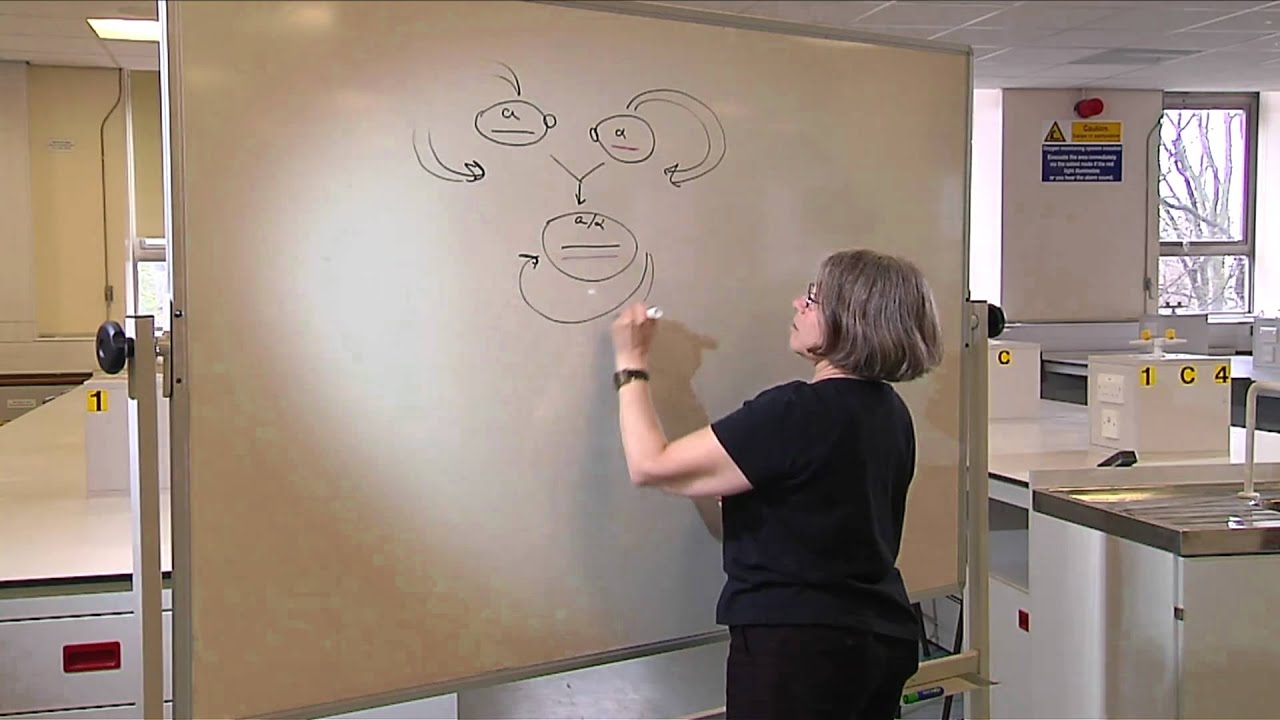
The yeast Saccharomyces cerevisiae is a simple single-celled eukaryote with both a diploid and haploid mode of existence. The mating of yeast only occurs between haploids, which can be either the a or α (alpha) mating type and thus display simple sexual differentiation. Mating type is determined by a single locus, MAT, which in turn governs the sexual behaviour of both haploid and diploid cells. Through a form of genetic recombination, haploid yeast can switch mating type as often as every cell cycle.
a cells produce ‘a-factor’, a mating pheromone which signals the presence of an a cell to neighbouring α cells. a cells respond to α-factor, the α cell mating pheromone, by growing a projection (known as a shmoo, due to its distinctive shape) towards the source of α-factor. Similarly, α cells produce α-factor, and respond to a-factor by growing a projection towards the source of the pheromone. The response of haploid cells only to the mating pheromones of the opposite mating type allows mating between a and α cells, but not between cells of the same mating type.
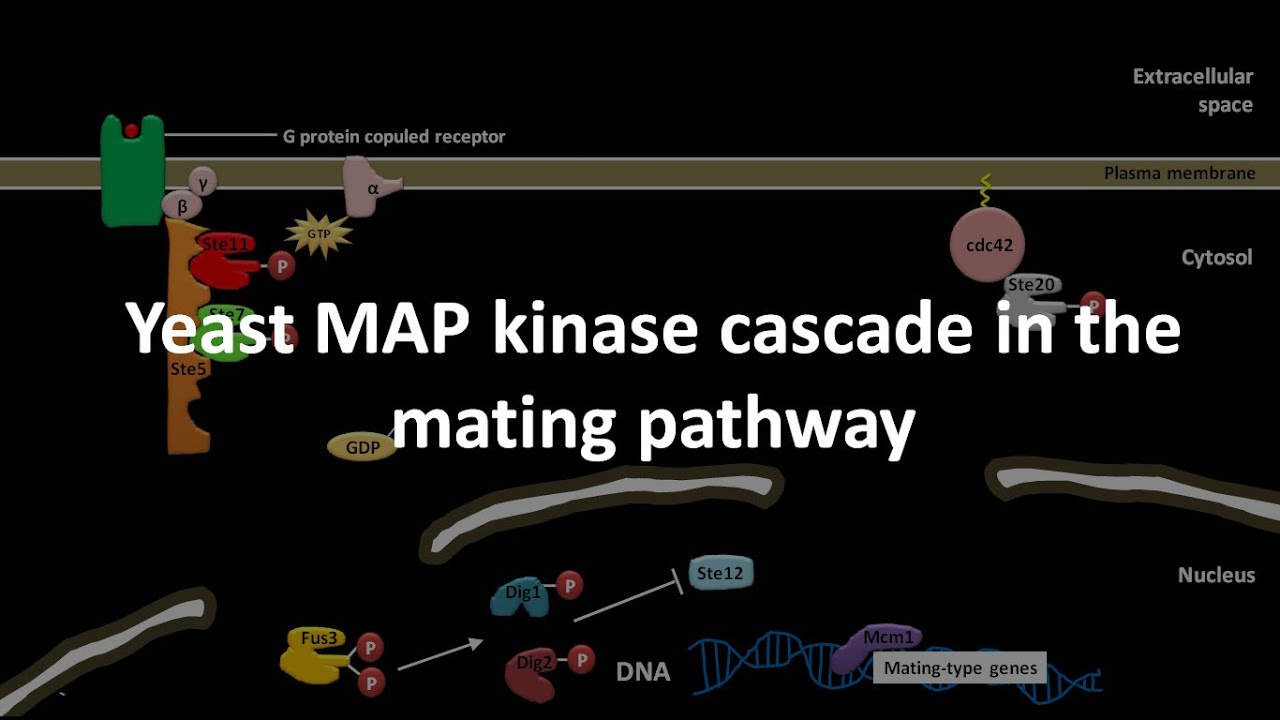
Mating in yeast is stimulated by the presence of a pheromone which binds to either the Ste2 receptor (in a-cells) or the Ste3 receptor (in α-cells). The binding of this pheromone then leads to the activation of a heterotrimeric G-protein. The dimeric portion of this G-protein recruits Ste5 (and its related MAPK cascade components) to the membrane, and ultimately results in the phosphorylation of Fus3.
The switching mechanism arises as a result of competition between the Fus3 protein (a MAPK protein) and the phosphatase Ptc1. These proteins both attempt to control the 4 phosphorylation sites of Ste5, a scaffold protein with Fus3 attempting to phosphorylate the phosphosites, and Ptc1 attempting to dephosphorylate them.
Presence of α-factor induces recruitment of Ptc1 to Ste5 via a 4 amino acid motif located within the Ste5 phosphosites. Ptc1 then dephosphorylates Ste5, ultimately resulting in the dissociation of the Fus3-Ste5 complex. Fus3 dissociates in a switch-like manner, dependant on the phosphorylation state of the 4 phosphosites. All 4 phosphosites must be dephosphorylated in order for Fus3 to dissociate. Fus3’s ability to compete with Ptc1 decreases as Ptc1 is recruited, and thus the rate of dephosphorylation increases with the presence of pheromone.
Kss1, a homologue of Fus3, does not affect shmooing, and does not contribute to the switch-like mating decision.
In yeast, mating as well as the production of shmoos occur via an all-or-none, switch-like mechanism. This switch-like mechanism allows yeast cells to avoid making an unwise commitment to a highly demanding procedure. However, not only does the mating decision need to be conservative (in order to avoid wasting energy), but it must also be fast to avoid losing the potential mate.
The decision to mate is extremely sensitive. There are 3 ways in which this ultrasensitivity is maintained:
Multi-site phosphorylation – Fus3 only dissociates from Ste5 and becomes fully active when all 4 of the phosphosites are dephosphorylated. Even one phosphorylated site will result in immunity to α-factor.
Two-stage binding – Fus3 and Ptc1 bind to separate docking sites on Ste5. Only after docking can they bind to, and act on, the phosphosites.
Steric hindrance – competition between Fus3 and Ptc1 to control the 4 phosphosites on Ste3
Note: a and α yeast share the same mating response pathway, with the only difference being the type of receptor each mating type possesses. Thus the above description, given for a-type yeast stimulated with α-factor, works equally well for α-type yeast stimulated with a-factor]
Shmoo projections
Повторяем попытку...

Доступные форматы для скачивания:
Скачать видео
-
Информация по загрузке: