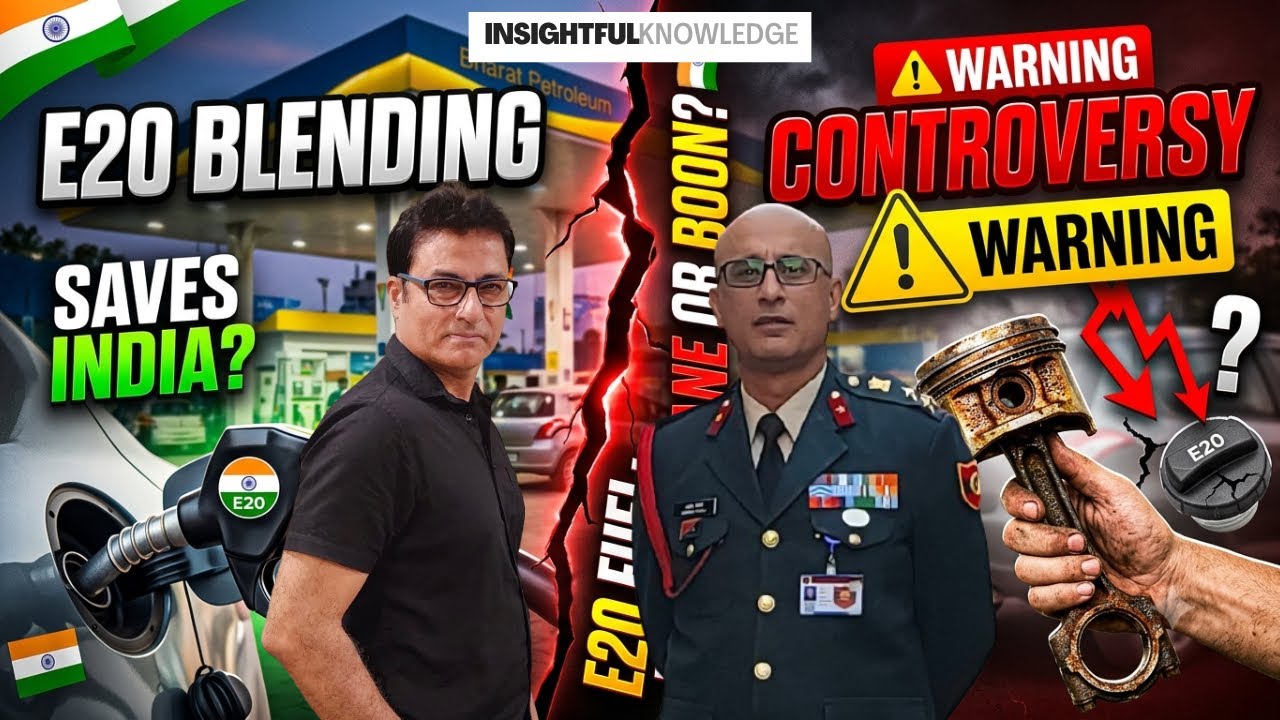
India's Ethanol Blending - Myth Vs Reality
Автор: Insightful Knowledge by Cdr Sandeep Dhawan
Загружено: 2026-07-11
Просмотров: 3524
Описание:
Welcome! In this in-depth video we unpack everything about E20 (20% ethanol blended petrol) — how it works, why it changes engine behaviour, the myths vs facts, and India’s 2G ethanol rollout. If you want a single, practical guide to understand E20 and what it means for cars, bikes, fuel stations and the biofuel industry — this is it.
Key points covered:
• Clear definition of RON (Research Octane Number) and why higher octane resists knocking.
• How knocking happens, why carbureted cars saw it more, and why modern ECUs reduce the risk.
• Ethanol raises octane (e.g., ethanol ≈108 RON) but has lower energy per litre, so blends reduce mileage per litre even while improving knock resistance.
• “Injector clogging” is usually a symptom of pre-existing deposits being dissolved by ethanol — E20 typically exposes issues rather than creates them in healthy, compatible systems.
• Phase separation (water + ethanol separating from gasoline) is a real risk in storage and can ruin fuel; best practices for storage and station management explained.
• Compatibility: many older vehicles (especially pre-E10/E20 era) may be more susceptible to seal, line or material issues; modifications or careful maintenance can mitigate risk.
• Insurance: using E20 alone does not automatically invalidate motor insurance, but claims depend on cause and policy terms — disputes can arise if damage clearly results from misuse in a non-compatible vehicle.
• Second-generation (2G) ethanol (cellulosic) uses non-food feedstock (straw, bagasse, bamboo) and reduces food-vs-fuel conflicts, but is more complex/expensive to produce.
• India’s 2G plants & ethanol story: Panipat (IOCL), Numaligarh (bamboo, Assam), Bathinda, Bargarh, Davangere — why they matter for self-reliance and blending targets.
• Energy arithmetic: typical energy values (petrol ~32–34 MJ/L, ethanol ~21–23 MJ/L, E20 ~30–31 MJ/L) and what that means for mileage and performance.
Call to action:
Like this video if you found it useful, subscribe for more explainers on fuel, engines and clean energy, and hit the bell to get notified.
Drop a comment with your experience using ethanol-blended petrol (E10/E20)
Повторяем попытку...
Доступные форматы для скачивания:
Скачать видео
-
Информация по загрузке: