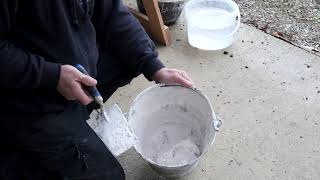
Lime Kiln 3/3 - quicklime, lime mortar
Автор: archanth
Загружено: 2011-03-04
Просмотров: 42346
Описание:
Play all 3 parts: http://www.youtube.com/user/archanth?...
Playlist: http://www.youtube.com/view_play_list...
A lime kiln is a kiln used to produce quicklime by the calcination of limestone (calcium carbonate). The chemical equation for this reaction is:
CaCO3 + heat → CaO + CO2
This reaction takes place at 900°C (at which temperature the partial pressure of CO2 is 1 atmosphere), but a temperature around 1000°C (at which temperature the partial pressure of CO2 is 3.8 atmospheres) is usually used to make the reaction proceed quickly. Excessive temperature is avoided because it produces unreactive, "dead-burned" lime.
Because it is so readily made by heating limestone, lime must have been known from the earliest times, and all the early civilizations used it in building mortars and as a stabilizer in mud renders and floors.
Knowledge of its value in agriculture is also ancient, but agricultural use only became widely possible when the use of coal made it cheap in the coalfields in the late 13th century, and an account of agricultural use was given in 1523. The earliest descriptions of limekilns differ little from those used for small-scale manufacture a century ago. Because land transportation of minerals like limestone and coal was difficult in the pre-industrial era, they were distributed by sea, and lime was most often manufactured at small coastal ports. Many preserved kilns are still to be seen on quaysides around the coasts of Britain.
The common feature of early kilns was an egg-cup shaped burning chamber, with an air inlet at the base (the "eye"), constructed of brick. Limestone was crushed (often by hand) to fairly uniform 20-60 mm (1 to 2.5 inch) lumps - fine stone was rejected. Successive dome-shaped layers of coal and limestone were built up in the kiln on grate bars across the eye. When loading was complete, the kiln was kindled at the bottom, and the fire gradually spread upwards through the charge. When burnt through, the lime was cooled and raked out through the base. Fine coal ash dropped out and was rejected with the "riddlings".
Only lump stone could be used, because the charge needed to "breathe" during firing. This also limited the size of kilns and explains why kilns were all much the same size. Above a certain diameter, the half-burned charge would be likely to collapse under its own weight, extinguishing the fire. So kilns always made 25-30 tonnes of lime in a batch. Typically the kiln took a day to load, three days to fire, two days to cool and a day to unload, so a one-week turnaround was normal. The degree of burning was controlled by trial and error from batch to batch by varying the amount of fuel used. Because there were large temperature differences between the center of the charge and the material close to the wall, a mixture of under-burned (i.e. high loss on ignition), well-burned and dead-burned lime was normally produced. Typical fuel efficiency was low, with 0.5 tonnes or more of coal being used per tonne of finished lime (15 MJ/kg).
http://en.wikipedia.org/wiki/Lime_kiln
Clip from Edwardian Farm
Farm series:
Tales from the Green Valley
• Видео
Tudor Monastery Farm
• Tudor - Monastery Farm, Feast
Victorian Farm
• Victorian Farm, Kitchen, Garden, Christmas...
Edwardian Farm
• Edwardian Farm, Larder, Treats; Beamish Mu...
Wartime Farm
• Wartime Farm, Kitchen & Garden (full): Per...
BBC Farm series:
Tales from the Green Valley
• Видео
Tudor Monastery Farm
• Видео
Victorian Farm
• Victorian Farm - Trailer
Edwardian Farm
• Edwardian Farm Episode 1
Wartime Farm
• Видео
Повторяем попытку...

Доступные форматы для скачивания:
Скачать видео
-
Информация по загрузке: