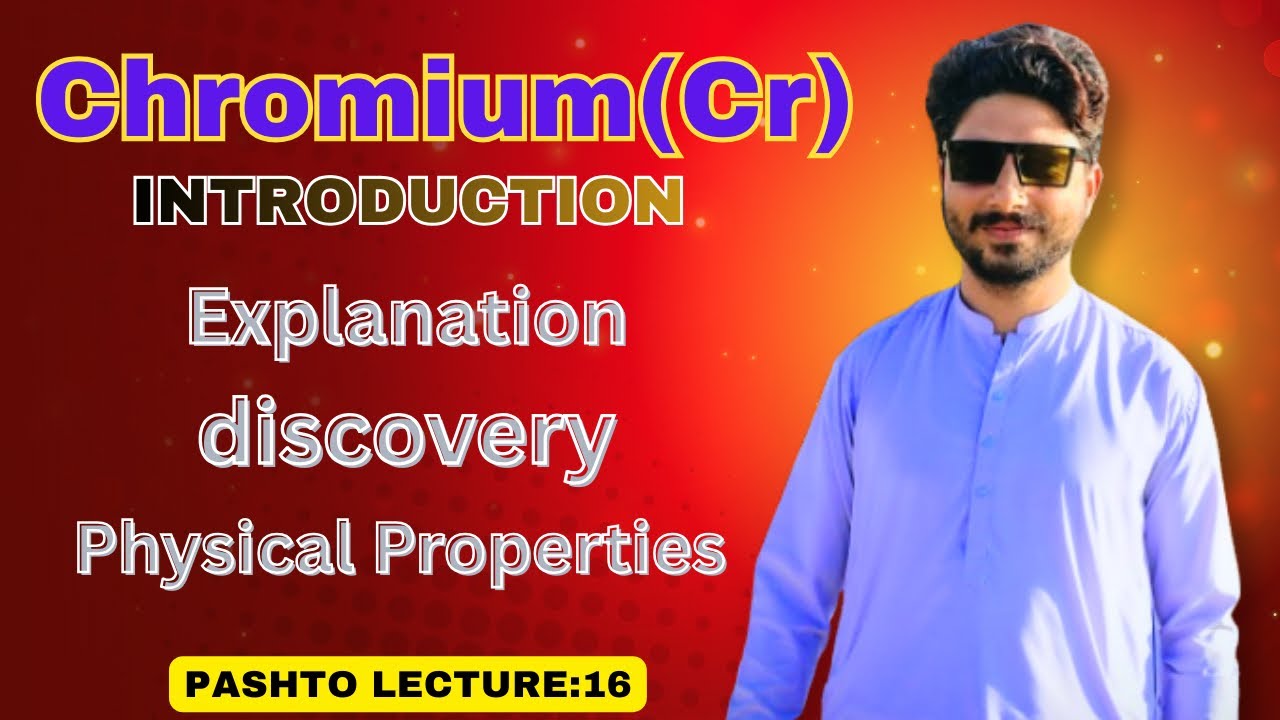
Chromium||Discovery|Physical Properties|Important Ore|Oxidation state|Electronic Congratulation
Автор: Xplore The World of Chemistry
Загружено: 2026-03-03
Просмотров: 35
Описание:
Chromium||Discovery|Physical Properties|Important Ore|Oxidation state|Electronic Congratulation
#chromium #disciveryofchromium #physicalpropertiesofchromium #oresofchromium #electronicconfigurationofchromium #chemistrywallah #pashtolecture #xploretheworldofchemistry #physics #elements #tariqpathan #drhadi #chemsexercises #pashtiwala
Chromium (Cr)
1) Discovery
Louis Nicolas Vauquelin discovered chromium in 1797.
He discovered it from the mineral crocoite (PbCrO₄).
The name chromium comes from the Greek word “chroma” meaning color, because chromium compounds show many beautiful colors.
2) Physical Properties
Atomic Number: 24
Atomic Mass: 52
Group: 6 (Transition metal)
Period: 4
Color: Shiny, hard, silvery-gray metal
Melting Point: 1907°C
Boiling Point: 2671°C
Density: 7.19 g/cm³
Very hard and corrosion-resistant
Used in stainless steel and electroplating
3) Important Ore
The most important ore of chromium is:
Chromite (FeCr₂O₄)
Other ores:
Crocoite (PbCrO₄)
Chromite is mainly found in countries like South Africa, Kazakhstan, and India.
4) Oxidation States
Chromium shows variable oxidation states because it is a transition element.
Common oxidation states:
+2 (Chromous compounds)
+3 (Most stable and common)
+6 (Chromates and dichromates)
Examples:
CrCl₂ → +2
CrCl₃ → +3
K₂Cr₂O₇ → +6
5) Electronic Configuration
Chromium has an exceptional electronic configuration.
Expected:
[Ar] 3d⁴ 4s²
Actual (Correct):
[Ar] 3d⁵ 4s¹
Reason:
Half-filled 3d⁵ subshell is more stable. That is why one electron shifts from 4s to 3d.
If you want, I can also provide:
✔ Chemical properties
✔ Uses of chromium
✔ Short exam questions
✔ Long detailed notes for 2nd year / FSc level
Just tell me 😊
Повторяем попытку...
Доступные форматы для скачивания:
Скачать видео
-
Информация по загрузке:





![Пожалуй, главное заблуждение об электричестве [Veritasium]](https://imager.clipsaver.ru/6Hv2GLtnf2c/max.jpg)