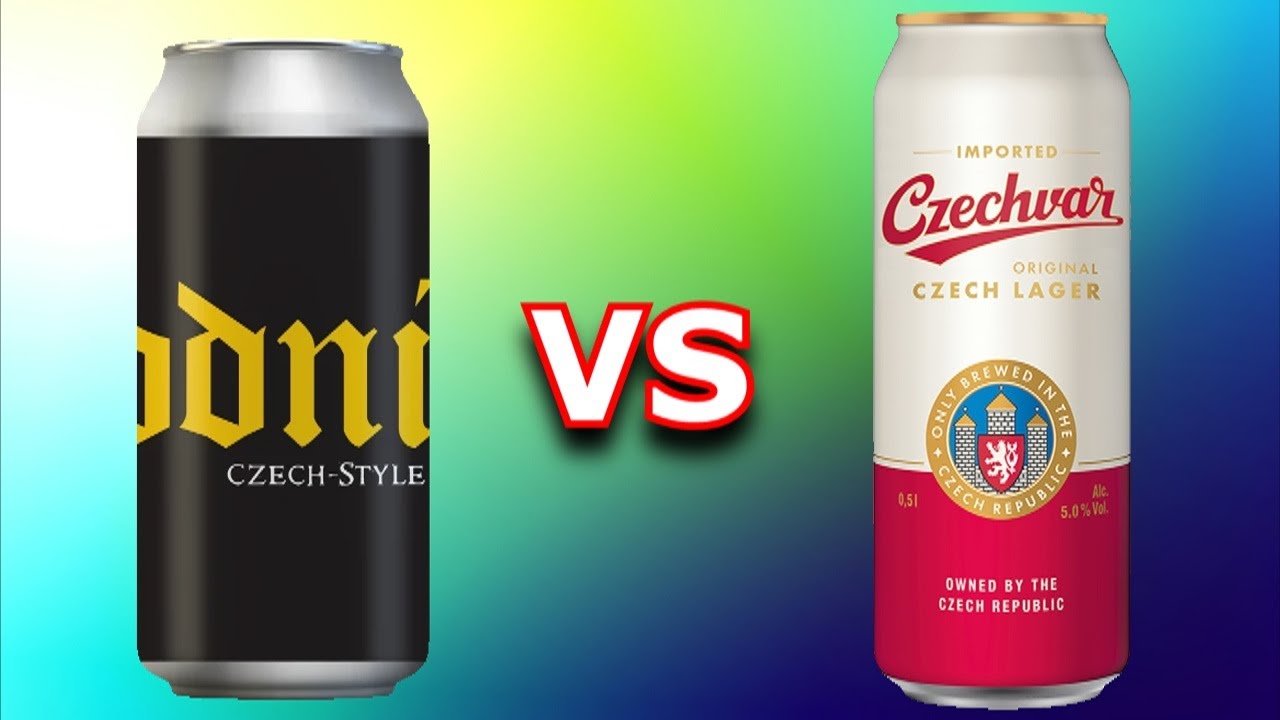
Angry Chair Vodnik vs Budvar Czechvar | USA Craft Beer vs Czech Lager
Автор: der Biergarten
Загружено: 2025-10-05
Просмотров: 12
Описание:
20240805 212453
Budvar (exported as Czechvar; BA score 82) and Angry Chair Vodnik (BA score 86) are both pilsner-style lagers brewed by distinct producers with different histories and ingredient lists: Budvar is brewed by the state-owned Budějovický Budvar in České Budějovice, Czech Republic, and traces its modern foundation to 1895 while building on a local brewing tradition that goes back centuries; it is produced as a classic Czech pale lager using traditional infusion mashing of Moravian pale malts and Pilsner-type barley, Saaz noble hops for bitterness and aroma, a bottom-fermenting lager yeast strain, and the brewery’s soft local artesian water, fermented at cool temperatures and matured by extended cold lagering to produce a clear deep-gold pour with a firm white head, an aroma of cracker/bready malt and floral/spicy Saaz hop character, and a flavor profile that shows a fuller malt backbone balanced by pronounced Saaz bitterness and spicy hop notes, its commercial ABV is approximately 5.0% while the brewery does not publish a standard IBU figure;
Angry Chair Vodnik is brewed by Angry Chair Brewing (Tampa, Florida) as a Czech-style pilsner and is produced by conventional modern lager methods, mashing on pilsner malt (the brewery advertises 100% German Pilsner malt), cool bottom fermentation with a lager yeast strain, dry-hopping with Czech Saaz (and sometimes Perle reported in some listings), and cold conditioning, resulting in a clear pale-straw to light-gold beer with a substantial white head, an aroma of floral and grassy Saaz hops over light cracker/bread malt, a clean, crisp, moderately bitter flavor with prominent hop aroma and a dry finish, and a published ABV of about 5.6% with no universally published IBU value.
Munich dunkel, built largely on Munich malt (often with some Pilsner; tiny color malts like Carafa may be used only for hue), noble German hops, clean lager yeast, and traditionally a decoction mash; expect deep copper, dark brown beer with bread-crust/melanoidin aromatics, low hops, and a soft, malt-forward palate; typically 4.5-5.6% ABV and 18-28 IBU. Traditional bock is a stronger, darker, malt-centric lager whose roots trace to Einbeck in Hanseatic-era northern Germany and later Munich adaptations; it commonly uses Munich/Vienna malts, decoction and long boils to deepen melanoidins, with continental noble hops kept supportive; look for light copper to brown color, rich toasty aromatics, smooth body, and 6.3-7.2% ABV, 20-27 IBU. Doppelbock is the yet-bigger sibling, originating with the Munich monks of St. Francis of Paula (Paulaner Salvator), brewed with Pils/Vienna for pale versions or Munich/Vienna for dark versions, noble hops, clean lager yeast, and traditionally decoction-mashed; it pours deep gold to dark brown (often ruby-tinged), smells and tastes intensely malty (toasty/melanoidin, optional light chocolate in dark versions) with smooth alcohol, and typically 7-10% ABV and 16-26 IBU. Pilsner Urquell doesn’t have its own PDO (Protected Designation of Origin)/PGI (Protected Geographical Indication); its GI connection is via the umbrella PGI “České pivo” (Czech Beer), an EU-registered protected name for beers brewed in Czechia to a defined spec (ingredients, process, and sensory profile). The Czech food-inspection authority’s official list of products bearing “České pivo” explicitly includes “Plzeňský Prazdroj, Pilsner Urquell, pivo ležák světlý,” i.e., Pilsner Urquell qualifies to use that PGI. The PGI itself is recorded in the EU’s eAmbrosia register; Prazdroj also explains on its site that “České pivo” is an EU PGI introduced in 2008 and not all Czech-brewed beers may use it. For context, another Czech beer GI is “Českobudějovické pivo” (a separate PGI tied to Budweis, or České Budějovice). When a beer uses the “České pivo” designation, Czech inspectors specify how the PGI symbol/wording must appear near that designation on the label. The Czech government created Budějovický Budvar as a state enterprise in 1967, the Ministry of Agriculture set up “Budějovický Budvar, národní podnik” as the legal successor to the earlier joint-stock and city breweries and took over their protected trademarks, and it has deliberately kept it in public ownership ever since, chiefly to safeguard the brewery’s valuable Budweiser/Budvar trademarks and related geographical indications in long-running global disputes. Budvar is owned on behalf of the state by the Ministry of Agriculture, was removed from the privatization list in 2001 and repeatedly declared “not for sale” by later governments (e.g., 2014), in part because it is both profitable and culturally emblematic.
Повторяем попытку...
Доступные форматы для скачивания:
Скачать видео
-
Информация по загрузке: