Shake Table Test: Circular vs. L-Shaped Buildings | Rotational vs. Translational Seismic Effects
Автор: Structural Mind
Загружено: 2025-02-01
Просмотров: 53
Описание:
🔬 Seismic Behavior of Circular vs. L-Shaped Buildings Under Shake Table Test 🏗️🌍
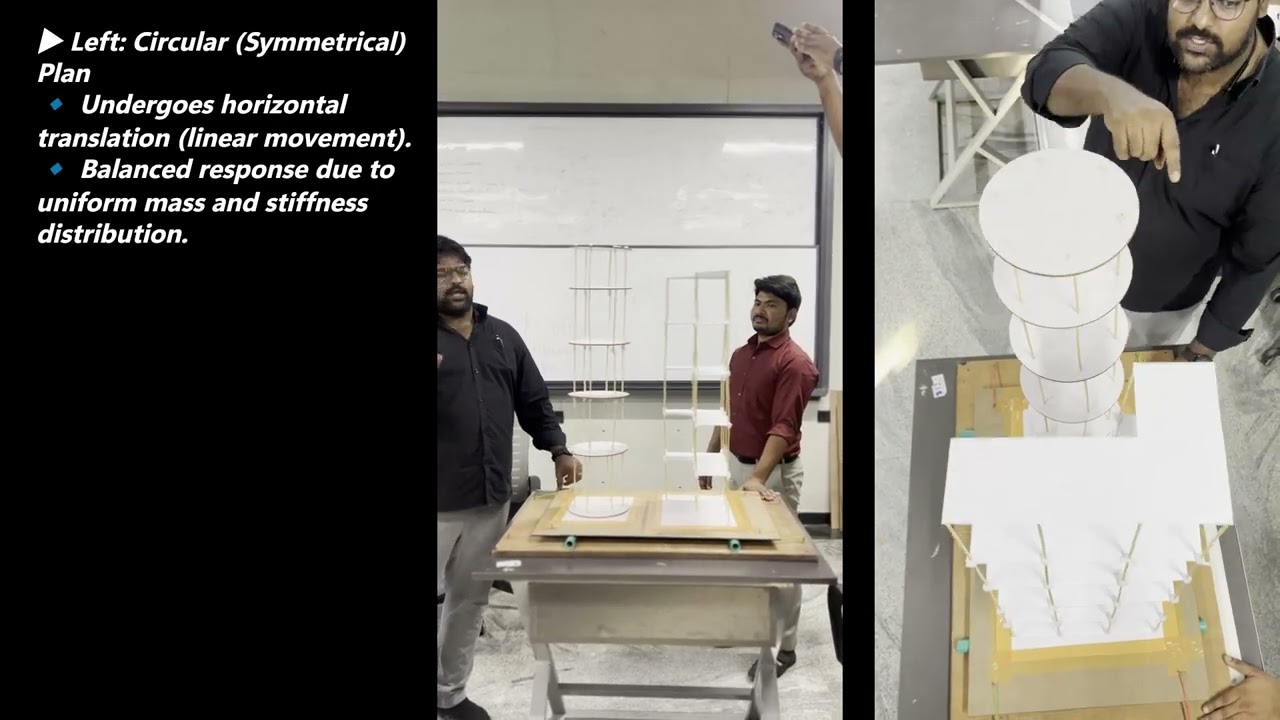
In this experiment, we analyze how building shape affects seismic performance using a shake table test. We compare a circular plan building with an L-shaped building, observing key differences in their response to earthquake-like motions.
📌 Key Highlights:
✅ Rotational Effect in L-Shaped Buildings – Due to the mismatch between the Center of Mass (CoM) and Center of Resistance (CoR), the L-shaped structure exhibits rotational motion.
✅ Translational Motion in Circular Buildings – With a symmetrical shape, the circular building primarily undergoes translational movement, reducing rotational instability.
✅ Shake Table Seismic Simulation – Watch how different building geometries influence stability and response to seismic forces.
✅ Engineering Insights for Seismic-Resistant Design
🔎 Key Insight: Irregular building shapes like L-shaped structures experience rotational effects due to uneven mass and stiffness distribution, whereas circular buildings mainly undergo uniform translational motion. Understanding these behaviors is crucial for earthquake-resistant design!
📢 Like, Comment, and Subscribe for more structural experiments and earthquake engineering insights!
#ShakeTableTest #SeismicDesign #EarthquakeEngineering #BuildingShapes #RotationalEffect #TranslationalMotion #CircularBuilding #LShapedBuilding #StructuralStability 🚀
Повторяем попытку...
Доступные форматы для скачивания:
Скачать видео
-
Информация по загрузке: