Switch Transformers: Top-1 Sparse MoE Explained
Автор: Latent AI
Загружено: 2026-07-30
Просмотров: 0
Описание:
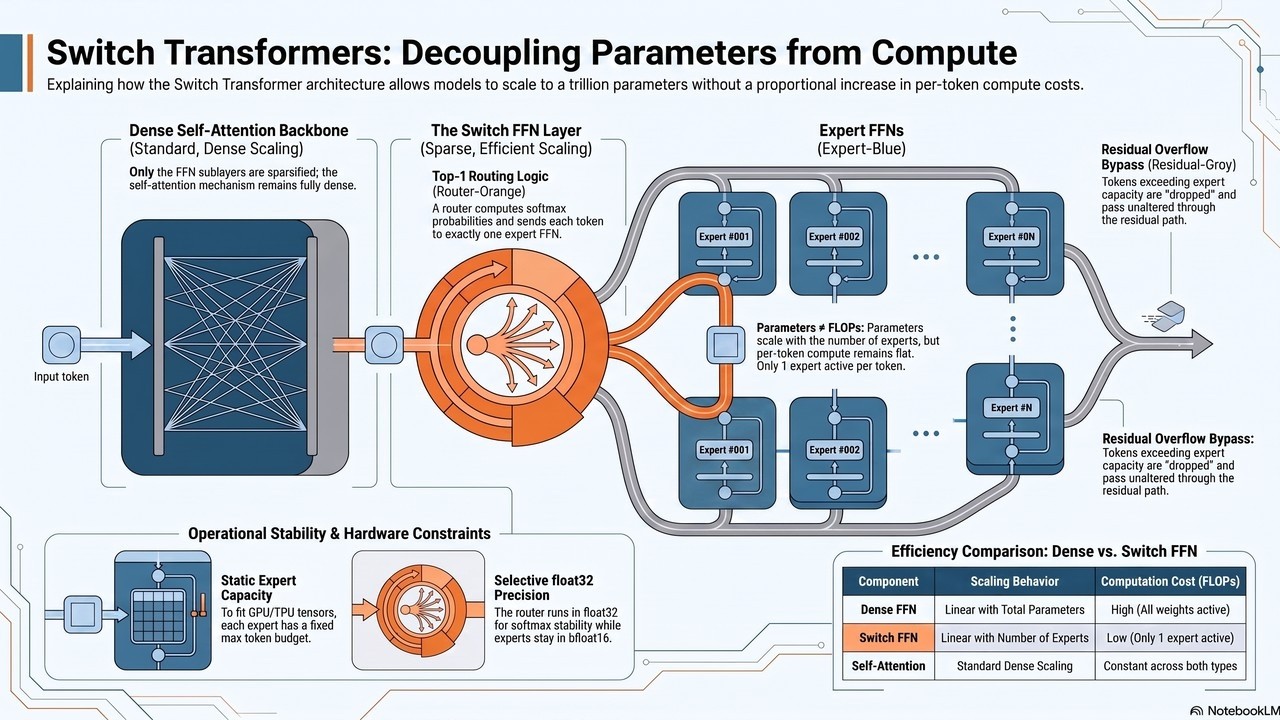
Switch Transformer scales toward a trillion parameters without a proportional rise in per-token compute. It keeps self-attention dense and replaces only the feed-forward sublayer with a Switch FFN layer: many independent experts plus a Top-1 router that sends each token to exactly one expert. This breakdown covers the sparse block, the Top-1 router and its gate value, the fixed expert-capacity rule and how overflow tokens ride the residual connection, and the selective float32 precision that keeps the router's softmax stable under bfloat16. The one-sentence takeaway: sparsity is the lever that decouples parameter count from per-token FLOPs.
In this deep dive, we explore the monumental Switch Transformers paper introduced by Fedus et al. Scaling up neural networks has consistently yielded better performance, but traditional dense models require computational resources proportional to their parameter count. Switch Transformers shatter this limitation by leveraging a sparse architecture, specifically a Mixture-of-Experts (MoE) design, to scale to over a trillion parameters while maintaining the computational cost of a much smaller model. The key innovation lies in simplifying the MoE routing mechanism. While previous models routed tokens to multiple experts (e.g., top-2), the Switch Transformer routes each token to a single, most relevant expert.
This "Top-1" routing is not just a minor tweak; it significantly reduces routing computation, lowers communication costs across devices, and maintains model quality. We meticulously analyze the architecture, showing how standard Transformer feed-forward layers are replaced by these Switch FFN layers. We also address the common pitfalls of sparse models, such as load imbalance among experts. The authors introduce a fixed expert-capacity rule to ensure no single expert becomes a bottleneck. If an expert exceeds its capacity, the overflow tokens cleverly bypass the expert computation entirely, riding the residual connection to the next layer without loss of information.
Furthermore, training instability is a notorious challenge with MoE models. We discuss how the authors tackled this by using selective float32 precision within the router. By casting the routing logits to full precision before the softmax operation, the model achieves the stability necessary for training massive architectures using efficient bfloat16 formats elsewhere. The result is a highly scalable, efficient, and stable architecture that paves the way for the next generation of massive language models.
Повторяем попытку...
Доступные форматы для скачивания:
Скачать видео
-
Информация по загрузке: