Vascular Anatomy, Human Anatomy, USMLE Step 1 - Full Vignette with Extended Explanations
Автор: EndlessMedical.Academy
Загружено: 2026-02-07
Просмотров: 0
Описание:
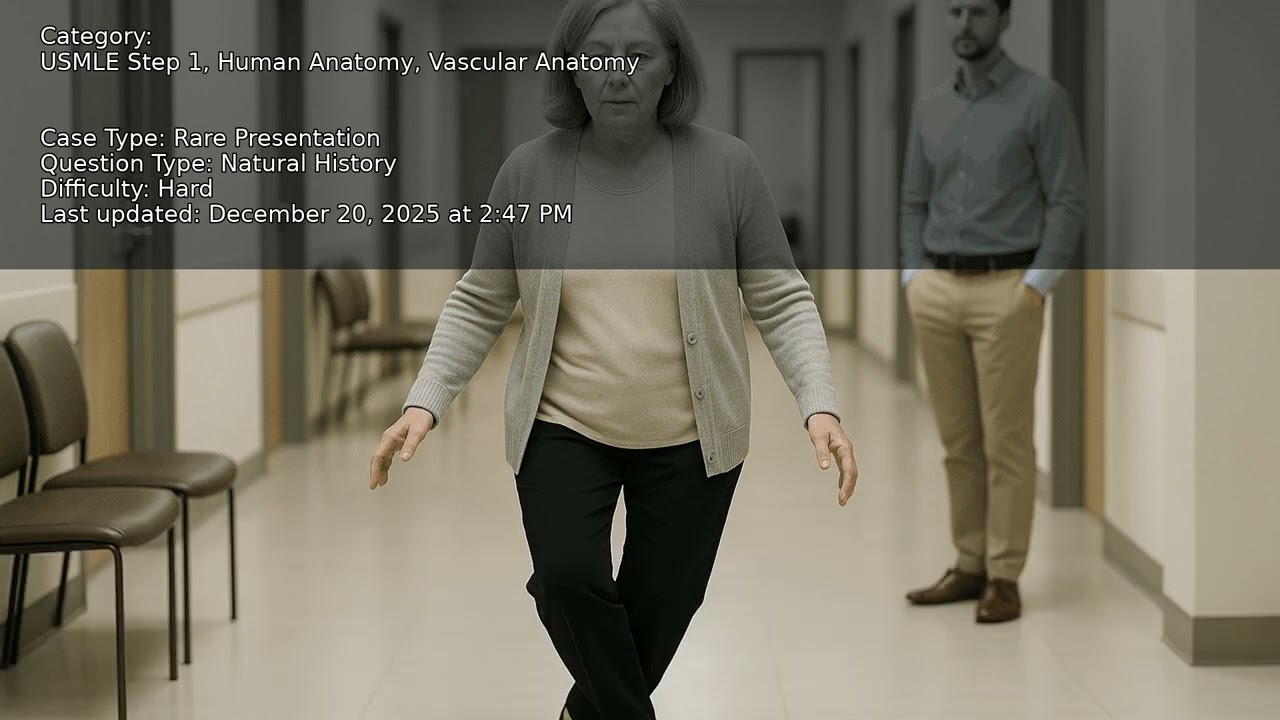
A 59-year-old woman experiences months of worsening gait difficulty, urinary urgency progressing to retention, heavy and tight legs, and nocturnal calf cramps. Neurologic exam reveals spastic paraparesis, sensory changes to T10, hyperreflexia, sustained clonus, and a stiff, scissoring gait. MRI shows long-segment thoracic hyperintensity with perimedullary flow-voids. How should you interpret the evolving clinical and imaging findings? What clues from her history and exam inform your understanding of this pathologic process?
VIDEO INFO
Category: Vascular Anatomy, Human Anatomy, USMLE Step 1
Difficulty: Hard - Advanced level - Challenges experienced practitioners
Question Type: Natural History
Case Type: Rare Presentation
Explore more ways to learn on this and other topics by going to https://endlessmedical.academy/auth?h...
QUESTION
A 59-year-old woman presents with 7 months of insidiously progressive gait difficulty and urinary urgency that has progressed to intermittent retention requiring occasional self-catheterization. She reports legs that feel heavy and tight by late afternoon, worse after prolonged standing or stair climbing, and transient nocturnal calf cramps. She has no fever, weight loss, night sweats, or recent infections. She denies alcohol use; she stopped methamphetamine use 18 years ago....
OPTIONS
A. Without definitive fistula disconnection, venous hypertensive congestive myelopathy typically progresses in a stepwise fashion to severe, often irreversible paraparesis with sphincter failure; longer pre-treatment symptom duration strongly predicts incomplete recovery even after cure.
B. Untreated course is a relapsing-remitting inflammatory myelitis with near-complete recovery between attacks after corticosteroids or plasmapheresis; durable disability is uncommon if immunotherapy is used early.
C. Natural history reflects anterior spinal artery arterial-steal ischemia that stabilizes spontaneously within weeks; bladder function is usually spared and most patients recover baseline strength without intervention.
D. Most cases follow a monophasic demyelinating trajectory triggered by infection; cerebrospinal fluid oligoclonal bands persist and long-term outcome depends primarily on steroid responsiveness rather than timing of any vascular procedure.
CORRECT ANSWER
A. Without definitive fistula disconnection, venous hypertensive congestive myelopathy typically progresses in a stepwise fashion to severe, often irreversible paraparesis with sphincter failure; longer pre-treatment symptom duration strongly predicts incomplete recovery even after cure.
EXPLANATION
This patient s examination and thoracic MRI point to venous hypertensive congestive myelopathy from a spinal dural arteriovenous fistula. The key natural-history teaching point is that, without definitive disconnection of the fistula, symptoms generally progress in a stepwise manner to severe, often irreversible paraparesis with sphincter dysfunction. Stepwise dips after exertion or prolonged upright posture reflect dynamic worsening of cord venous congestion and reduced arteriovenous perfusion gradient. CSF is typically bland or shows only mild protein elevation, oligoclonal bands are usually absent, and MRI often demonstrates long-segment central T2 cord hyperintensity with perimedullary serpiginous flow voids. Longer time from symptom onset to treatment predicts worse functional recovery even after anatomical cure, because chronic venous ischemia leads to irreversible cord injury....
Further reading:
Links to sources are provided for optional further reading only. The questions and explanations are independently authored and do not reproduce or adapt any specific third-party text or content.
---------------------------------------------------
Our cases and questions come from the https://EndlessMedical.Academy quiz engine - multi-model platform. Each question and explanation is forged by consensus between multiple top AI models (i.e. Open AI GPT, Claude, Grok, etc.), with automated web searches for the latest research and verified references. Calculations (e.g. eGFR, dosages) are checked via code execution to eliminate errors, and all references are reviewed by several AIs to minimize hallucinations.
Important note: This material is entirely AI-generated and has not been verified by human experts; despite stringent consensus checks, perfect accuracy cannot be guaranteed. Exercise caution - always corroborate the content with trusted references or qualified professionals, and never apply information from this content to patient care or clinical decisions without independent verification.
Clinicians already rely on AI and online tools - myself included - so treat this content as an additional focused aid, not a replacement for proper medical education. Visit https://endlessmedical.academy for more AI-supported resources and cases.
This material can not be treated as medical advice. May contain errors.
-------
Повторяем попытку...
Доступные форматы для скачивания:
Скачать видео
-
Информация по загрузке: