Hyperspectral Reflectance - Principles of Environmental Measurement Lecture 8
Автор: Apogee Instruments Inc.
Загружено: 2017-06-28
Просмотров: 4652
Описание:
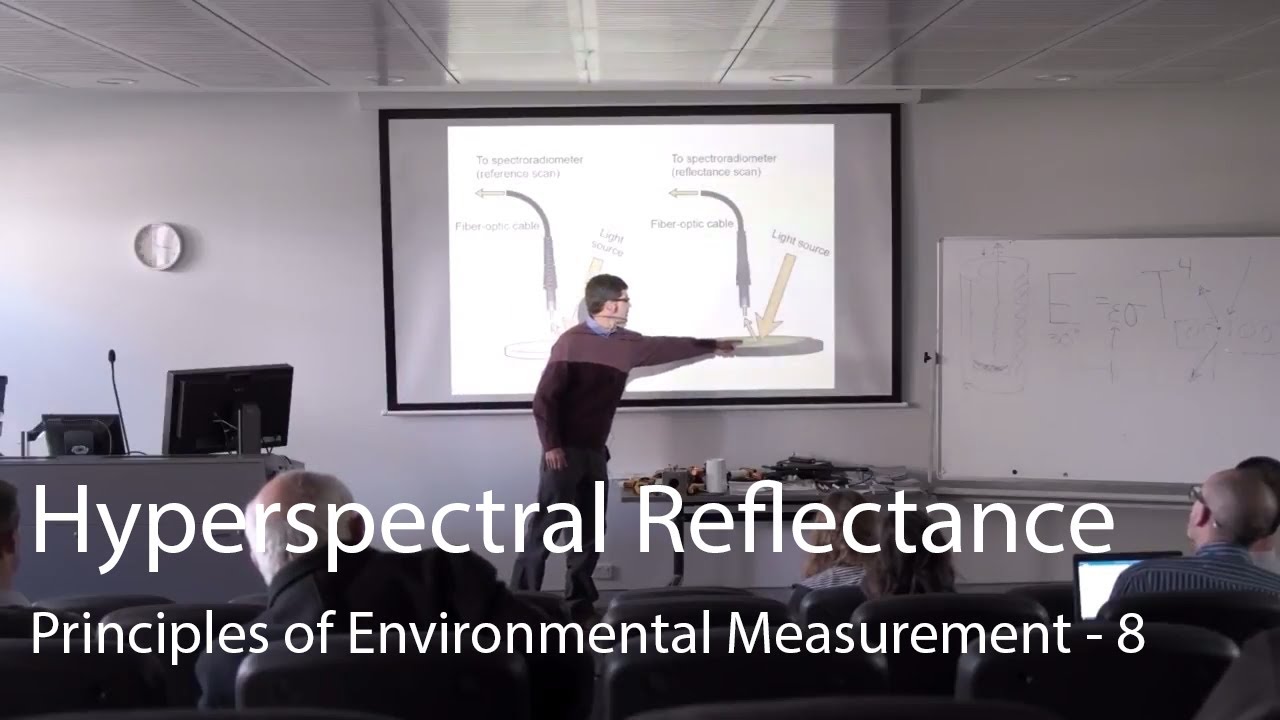
Mark Blonquist discusses spectral reflectance and different types of spectroradiometers in part 8 of 9 in the ICT International and Apogee Instruments lectures that took place at the Hawkesbury Institute for the Environment campus of the Western Sydney University.
VIDEO CONTENT
01:04 WHAT IS REFLECTANCE?
Reflectance is a pretty simple concept. We just divide the reflected radiation, everything that’s bouncing off the surface and coming back, by the radiation that is incident on the surface. It is simple but powerful because we can learn a lot about surface properties, surface conditions, based on how the reflectance signal changes.
01:44 Reflectance of shortwave radiation
02:30 USING REFLECTANCE TO CHARACTERIZE SURFACES
Reflectance can be used to characterize surface. Reflective signatures are very different when we move from one surface to the next. This slide shows reflectance of water, soil, a plant canopy, and snow.
03:15 COST OF SPECTRORADIOMETERS
Price of spectroradiometers scales with the amount of information that you are measuring. As instruments cover a larger wavelength range the price increases. We are going to mostly talk about the 350 to 1000 nm range because that is the more affordable range and that is the type of instrument that we typically deal with at Apogee.
04:20 REFLECTANCE SPECTRUM FOR A PLANT CANOPY
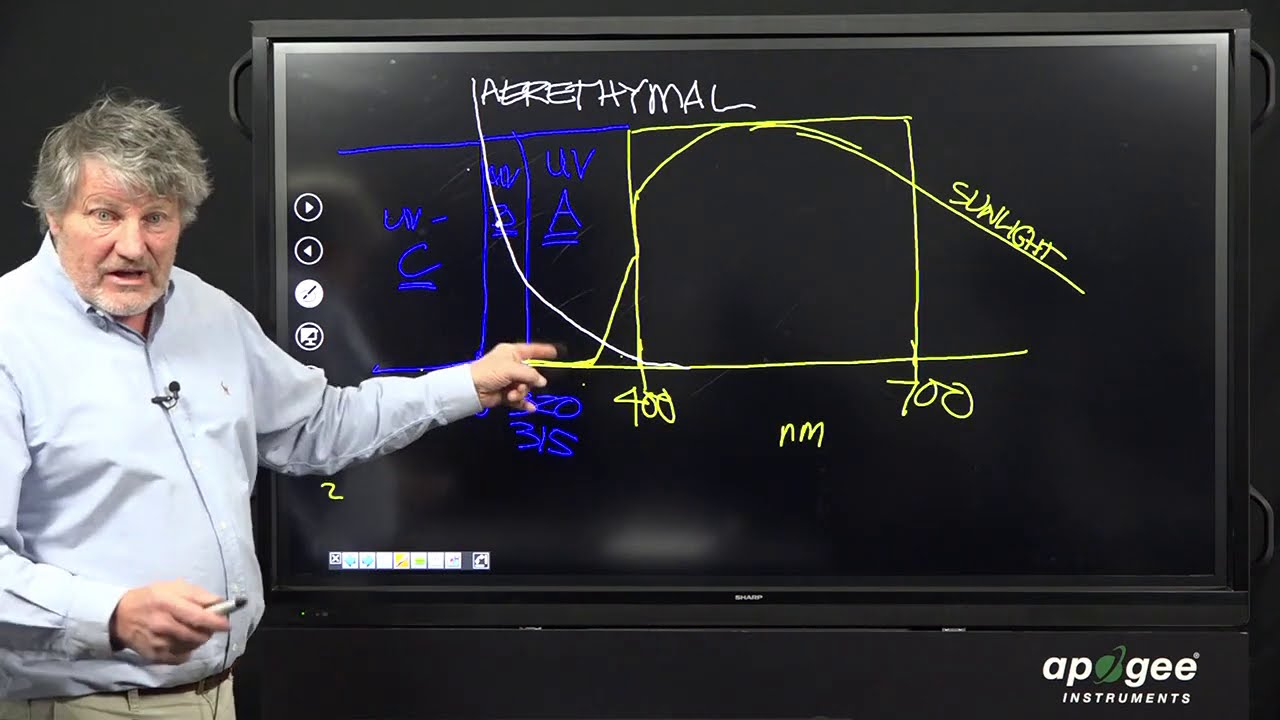
You can see there are a lot of unique features in the reflectance spectrum. Looking at the photosynthetically active radiation range, 400 to 700 nm, you can see it is lower that a lot of other parts of the spectrum. This is because leaves have a lot of chlorophyll in them and the chlorophyll is absorbing all of the photosynthetic photons for photosynthesis. This portion of the spectrum has small values because all of the photons are being absorbed for photosynthesis.
From the red edge, the point where we transition from the photosynthetically active range to the near-infrared range, there values are higher because everything beyond about 700 nm are non-photosynthetic photons. Once you get into the near infrared range water bands can be see because it is a pretty good absorber and healthy plant leaves tend to have a lot of water in them. You can see a water band around 970 nm, 1100 nm, 1400 nm, and 1900nm. From the plant reflectance, we can learn something about photosynthesis, water, and other variables.
06:19 REFLECTANCE OF A SINGLE LEAF
Reflectance of a single leaf is typically done in a laboratory and requires an artificial light source. An example of how you would measure reflectance of a single leaf in a lab is shown. 09:16 Reflectance spectra of two leaves: a well fertilized leaf with a high nitrogen content and one that shows potential of nitrogen deficit. Taking plant canopy reflectance measurements in the field is similar to taking measurements of a single leaf.
10:44 NORAMALIZED DIFFERENCE VEGETATION INDEX (NDVI)
NDVI is a greenness index; it can be used to show how much leaf area is covering a surface or how green the surface is. Spectroadiometers can be used to measure NDVI or it can be measured using a small device that is designed to specifically measure NDVI. This is an instrument from Decagon Devices that measures the red range and near-infrared range, and does a calculation internally to output an NDVI value. 12:16 There are other devices made to measure other indices, such as PRI (Photochemical Reflectance Index).
14:08 A list of simple reflective indices that can be measured is available at http://wwww.apogeeinstruments.com/con...
15:50 SPECTRORADIOMETERS
Spectroradiometers measure the entire spectrum. The Apogee field spectroradiometer was designed to overcome challenges and limitations of other spectroradiometers. Our goals were to make an instruments that was low-cost, small, and lightweight. You can see its size comparison to a couple of quantum sensors.
17:23 APPLICATIONS OF SPECTRORADIOMETERS
Some applications include measurement over plant canopies, precision agriculture, and rapid field phenotype of crop plants.
18:15 REFLECTANCE MEASUREMENTS WITH A SPECTRORADIOMETER
Spectroradiometers can be used to measure reflectance by mounting one instrument level looking up and another instrument pointing down at the plant canopies. This gives you the incoming spectrum and reflected spectrum, and the ratio of the two gives a reflectance measurement. It is important to note that before making a reflectance measurement this way you have to match the spectroradiometers. The steps to match the spectroradiometers are explained in the video.
21:20 Reflectance data over turf grass using the field spectroradiometer.
-------
More information on Apogee's spectroradiometers can be found at https://www.apogeeinstruments.com/spe...
------
More videos on spectroradiometers can be found at • Видео
Повторяем попытку...
Доступные форматы для скачивания:
Скачать видео
-
Информация по загрузке: