Brighton Tour 08 Oct - Brighton Pier, Royal Pavilion.
Автор: Suraj V
Загружено: 2012-01-27
Просмотров: 3958
Описание:
Brighton Tour 08 Oct - Brighton Pier, Royal Pavilion.
--------------------------------------------------------------------------
A brisk trip by me to Brighton Pier and Royal Pavilion, Brighton, England, United Kingdom.
Videography and Photography by suraj V.
Brighton Pier
------------------
Official name - Brighton Marine Palace and Pier
Type - Pleasure Pier
Design - R. St George Moore
Total length - 524 metres (1,719 ft)
Opening date - May 1899
The Brighton Marine Palace and Pier is a pleasure pier in Brighton, England. It is generally known as the Palace Pier for short, but has been informally renamed Brighton Pier since 2000 by its owners, the Noble Organisation, in an attempt to suggest that it is Brighton's only pier. The West Pier was its rival but was closed in 1975 and was subsequently severely damaged by fires and storms, with the remaining iron structure being partially demolished in 2010.
Work began on the Palace Pier in 1891 and it opened in May 1899 after costing a record £27,000 to build. This was Brighton's third pier.
A concert hall opened two years later, and by 1911 this had become a theatre .
In 1986 the theatre was removed, on the understanding that it would be replaced. This has not happened, and the present seaward end building looks fairly modern in comparison with the rest of the structure, supporting a domed amusement arcade and several fairground rides, including several thrill rides, children's rides, roller coasters and a log flume.
The pier had signs reading "Brighton Pier" attached to it in 2000, although this change is not recognised by the National Piers Society or many of the residents of Brighton and Hove. The local newspaper, The Argus, still generally refers to the structure as the Palace Pier.
Royal Pavilion
--------------
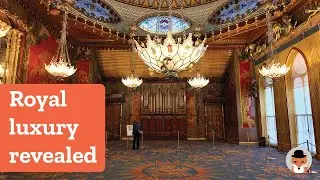
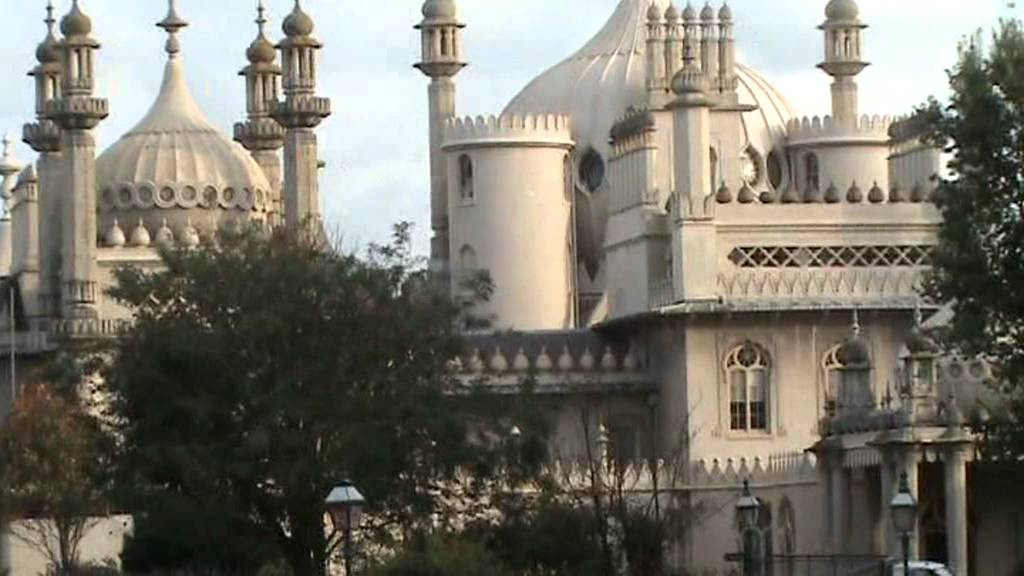
The Royal Pavilion is a former royal residence located in Brighton, England. It was built in three campaigns, beginning in 1787, as a seaside retreat for George, Prince of Wales, from 1811 Prince Regent. It is often referred to as the Brighton Pavilion. It is built in the Indo-Saracenic style prevalent in India for most of the 19th century, with the most extravagant chinoiserie interiors ever executed in the British Isles.
(The Indo-Saracenic Revival (also known as Indo-Gothic, Mughal-Gothic, Neo-Mughal, Hindoo or Hindu-Gothic) was an architectural style movement by British architects in the late 19th century in British India. It drew elements from native Indo-Islamic and Indian architecture, and combined it with the Gothic revival and Neo-Classical styles favoured in Victorian Britain. The style gained momentum in the west with the publication of the various views of India by William Hodges and the Daniell duo, (William Daniell and his uncle Thomas Daniell) from about 1795.)
In 1787 the designer of Carlton House, Henry Holland, was employed to enlarge the existing building, fitted out in Holland's French-influenced neoclassical style, with decorative paintings by Biagio Rebecca. In 1801-02 the Pavilion was enlarged with a new dining room and conservatory, to designs of Peter Frederick Robinson, in Holland's office. The Prince also purchased land surrounding the property, on which a grand riding school and stables were built in an Indian style in 1803-08.
Between 1815 and 1822 the designer John Nash redesigned and greatly extended the Pavilion, and it is the work of Nash which can be seen today. The palace looks rather striking in the middle of Brighton, having a very Indian appearance on the outside. However, the fanciful interior design, primarily by Frederick Crace and the little-known decorative painter Robert Jones, is heavily influenced by both Chinese and Indian fashion (with Mughal and Islamic architectural elements). It is a prime example of the exoticism that was an alternative to more classicising mainstream taste in the Regency style.
1845, the Government planned to sell the building and grounds. The Brighton Commissioners and the Brighton Vestry successfully petitioned the Government to sell the Pavilion to the town for £53,000 in 1850 under the Brighton Improvement (Purchase of the Royal Pavilion and Grounds) Act 1850. The town used the building as assembly rooms. The purchase of the Royal Pavilion from Queen Victoria, by Brighton, marked the beginnings of the site's tourism dominance through the Royal Pavilion's transition from a private residence to a public attraction under civic ownership. Today, the Royal Pavilion has around 400,000 people visiting it annually.
All Rights reserved to suraj varghese, sirroke/digieye.
Kakat/Dreamz blog are owned by suraj varghese.
Повторяем попытку...
Доступные форматы для скачивания:
Скачать видео
-
Информация по загрузке: