Physics+ Lagrangian, Noether and Momentum: UNIZOR.COM - Physics+ 4 All - Lagrangian
Автор: Zor Shekhtman on UNIZOR Education
Загружено: 2026-03-15
Просмотров: 10
Описание:
UNIZOR.COM - Creative Mind through Art of Mathematics
Read full text of notes for this lecture on UNIZOR.COM - Physics+ 4 All - Lagrangian - Noether Theorem and Momentum Conservation
Notes to a video lecture on UNIZOR.COM
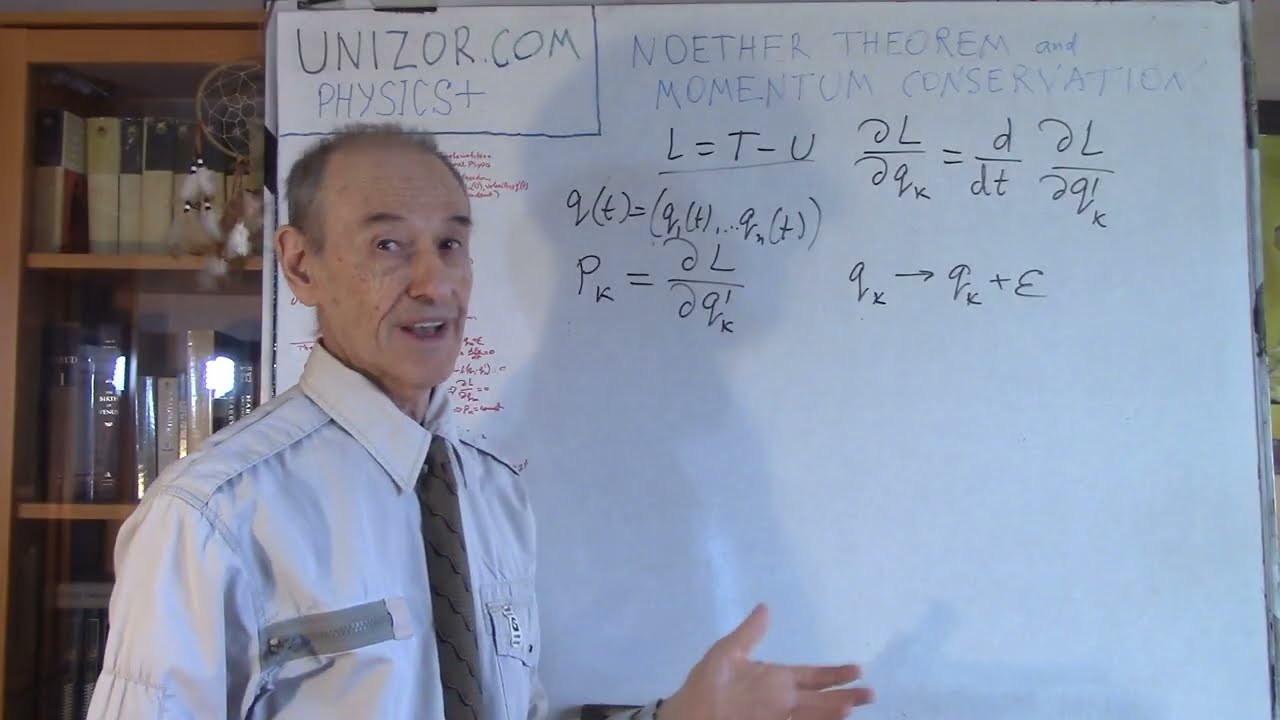
Noether's Theorem
Symmetry and Momentum Conservation
Let's introduce a concept of momentum in generalized coordinates.
We are familiar with a vector of momentum in Euclidean three-dimensional space with Cartesian coordinates (x,y,z) for a point-mass m, as a vector with three components
px(t) = m·x'(t)
py(t) = m·y'(t)
pz(t) = m·z'(t)
Another approach, that uses the kinetic energy of this object
T=½m·(x'²+y'²+z'²)
would be to define
px = ∂T/∂x'
py = ∂T/∂y'
pz = ∂T/∂z'
Both definitions are equivalent, but the latter leads us to the third definition using the Lagrangian
L=T−U
instead of just kinetic energy T, because potential energy U does not depend on velocity:
px = ∂L/∂x'
py = ∂L/∂y'
pz = ∂L/∂z'
Since the Lagrangian of a mechanical system is usable in both Cartesian and non-Cartesian (generalized) coordinates, we can define a generalized momentum
(p1,...,pn)
as a set of partial derivatives of the Lagrangian L by corresponding component of generalized velocity (∂L(...)/q1',...,∂L(...)/qn').
The time-dependent function
pk(t) = ∂L(...)/∂qk'
is called the kth component of the generalized momentum.
Consider a mechanical system with n degrees of freedom and its trajectory in generalized coordinates
q(t) = (q1(t),...,qn(t)).
Theorem
If the Lagrangian of this system
L(q1,...,qn,q1',...,qn',t)
is invariant under translation of qk by infinitesimal value ε
qk → qk + ε
then the kth coordinate of the generalized momentum
pk = ∂L/∂qk'
is conserved.
Повторяем попытку...
Доступные форматы для скачивания:
Скачать видео
-
Информация по загрузке: