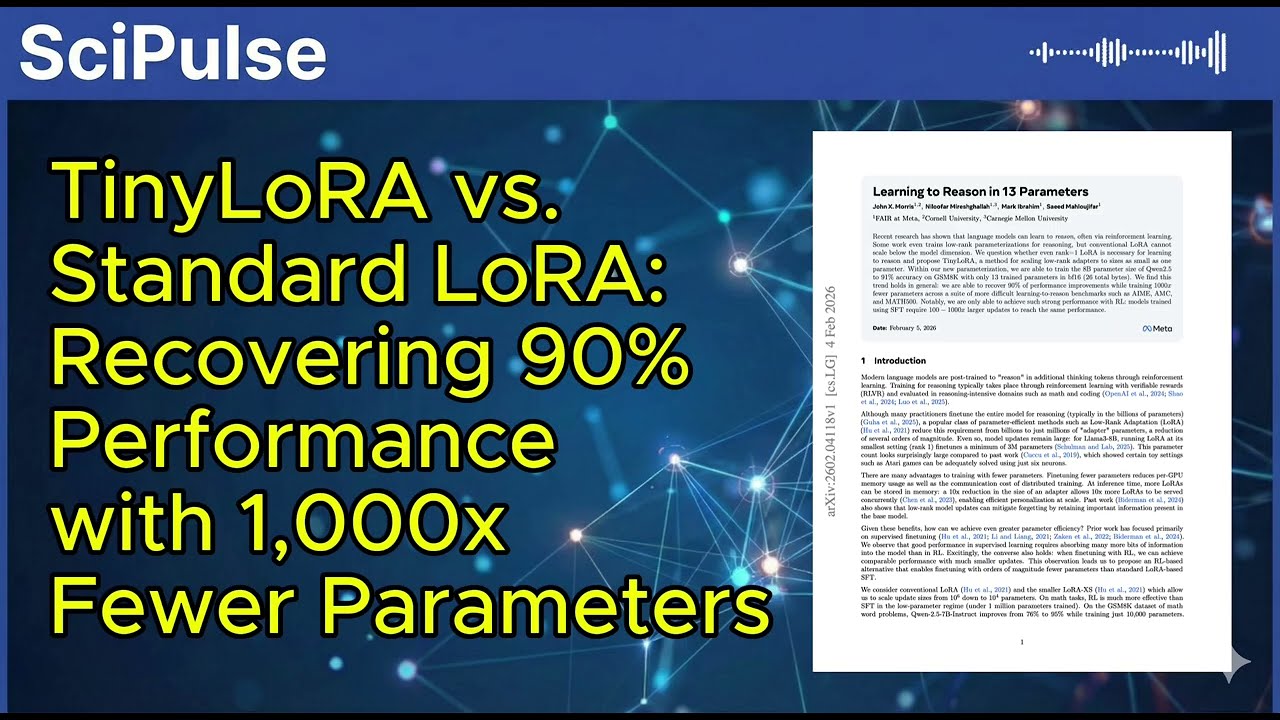
TinyLoRA vs. Standard LoRA: Recovering 90% Performance with 1,000x Fewer Parameters
Автор: SciPulse
Загружено: 2026-02-09
Просмотров: 63
Описание:
Can 13 parameters teach an 8B model to reason? Discover TinyLoRA, a revolutionary method achieving 91% on GSM8K by training just 26 bytes of data via Reinforcement Learning.
The Deep Dive In this analysis, we examine "Learning to Reason in 13 Parameters," a paper that introduces TinyLoRA. While conventional Low-Rank Adaptation (LoRA) is limited by model dimensions, TinyLoRA scales adapters down to sizes as small as a single parameter. By applying this to the Qwen2.5-8B architecture, researchers have demonstrated that the vast majority of "reasoning" performance can be recovered while training 1,000x fewer parameters than previously thought possible.
The methodology highlights a significant divergence between Supervised Fine-Tuning (SFT) and Reinforcement Learning (RL). The study finds that while SFT requires substantial parameter updates to see gains, RL thrives in this ultra-low-parameter environment. We explore the architectural implications of these findings, the compute efficiency of TinyLoRA across benchmarks like AIME and MATH500, and what this means for the future of on-device reasoning and "low-rank" model plasticity.
Academic Integrity Section Disclaimer: This episode is a summary and architectural analysis intended for educational purposes. While we strive for technical precision, viewers are encouraged to consult the original peer-reviewed paper for raw data, full methodology, and formal proofs to ensure complete academic accuracy.
Original Paper: https://arxiv.org/abs/2602.04118
#SciPulse #MachineLearning #TinyLoRA #ReasoningModels #ArtificialIntelligence #ReinforcementLearning #LLM #STEM #ResearchAnalysis #ComputeEfficiency #Qwen #GSM8K #MathematicalReasoning #AIResearch
Повторяем попытку...
Доступные форматы для скачивания:
Скачать видео
-
Информация по загрузке:










![Почему реактивный двигатель не плавится? [Veritasium]](https://imager.clipsaver.ru/F6UB0V2Fct4/max.jpg)